





Related: Better Maintenance Scheduling Leads to Better Service
5 Ways to Improve Shop Productivity
Every minute a truck is in the shop is a minute it’s not on the road making money. And while there is no way to eliminate all visits to the shop, improving shop efficiency will get trucks in and out faster.
February 24, 2015
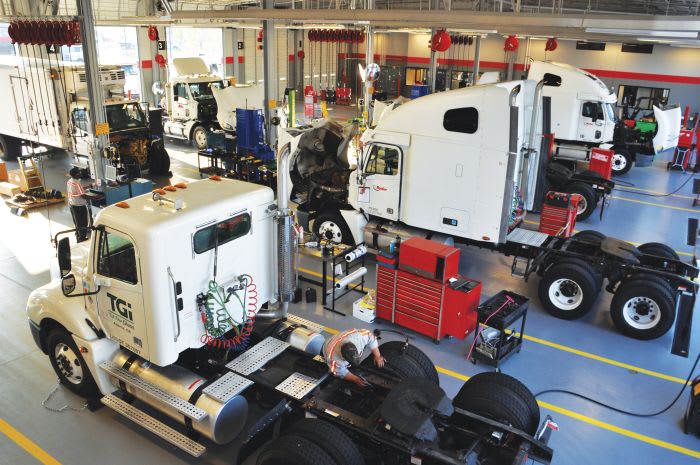
Reorganizing the shop and optimizing workflow reduces the number of steps technicians have to take when inspecting vehicles.
6 min to read
Reorganizing the shop and optimizing workflow reduces the number of steps technicians have to take when inspecting vehicles.
Having trucks in the shop is a fact of life, but most fleet managers want them out as quickly as possible. These five strategies will improve shop efficiency and allow you to service more trucks in less time.
1. Use standards
Using a universal language to describe the reason a truck is in the shop, why the technician thinks the part failed and what he did to fix it goes a long way to improving shop efficiency. All that is possible with the use of Vehicle Maintenance Reporting Standards.
“Using VMRS codes makes it easier for technicians, so instead of spending their time writing sentence after sentence, they can check off Code Keys and get to the repair more quickly,” says Jack Poster, VMRS services manager at the Technology & Maintenance Council of the American Trucking Associations.
Coupling VMRS-coded repairs with labor time guidelines allows you to better schedule work in your shops and to assess technician productivity.
“The major void in this type of information makes it difficult to plan shop throughput because you have no idea how long a job takes,” says Scott DiGiorgio, general manager of Mitchell 1. “To be able to project what jobs you have in front of you and how much time it’s going to take for each procedure, will give you the ability to keep your bays full and the work flowing throughout your shop.”
Michael Riemer, vice president products and channel marketing at Decisiv, says, “Not all fleets use VMRS and Standard Repair Times, so it’s hard for them to actually compare technician efficiency and productivity.” Tracking technician productivity helps determine additional training needs.
2. Keep techs certified and trained
When asked how certification translates into improved shop productivity, Tony Molla, vice president, communications for the National Institute for Automotive Service Excellence, quickly points out that it is certification and training.
“Certification measures knowledge, and our certifications have a five-year time limit,” he explains. “Every five years you have to essentially demonstrate that you have kept up with technology.”
According to an ASE study, productivity rates of ASE certified fleet technicians were 19% higher than non-certified technicians. In addition, certified fleet technicians had a 41% lower come back rate.
Mike McDonald, director of fleet maintenance for the Iowa-based truckload carrier Don Hummer Trucking, says his technicians get a lot of training through truck OEs and component suppliers. That training “has allowed us to diagnose trucks faster and to do in-house warranty work.”
Mel Kirk, vice president of maintenance and quality operations at Ryder System, the truck lessor and operator, says today’s trucks are so different from older trucks that it is no longer a matter of fixing the root problem.
“You now need to look upstream and downstream to see what else might have been compromised. This makes technician training more important than ever.”
Ryder is currently in the process of re-assessing its technicians to ensure they have the knowledge and expertise appropriate for their classification level.
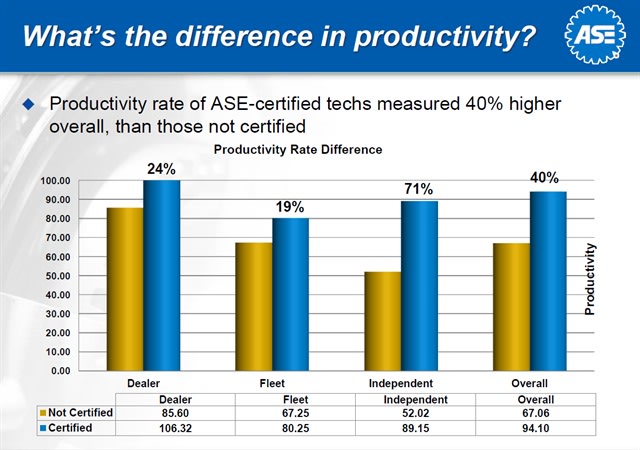
The productivity of ASE certified technicians working in fleet shops was 19% higher than their non-certified counterparts, according to a 2010 study. Productivity of ASE certified technicians across all sectors was 40% higher than that of non-certified technicians.
3. Reorganize the shop
When was the last time you looked at your shop layout and procedures? Ryder recently performed a lean analysis of its preventive maintenance bays.
“We optimized the work flow and rearranged the way work on the maintenance checklist was laid out so the technicians walk around less.” The reorganization of the work bay itself saved more than 600 footsteps, Kirk says. “We optimized the actual PM checklist workflow and saved the average technician over two miles of walking back and forth around the vehicle.”
4. Automate the process and leverage data
Once you have the PM workflow figured out, automating the inspection and check-in processes is a good next step. “This eliminates issues with paper forms being unreadable which makes it difficult to determine what’s wrong with the truck,” says Jessica Frazer, director of product management at Zonar. Zonar’s system uses RFID tags around the truck to make it easy to inspect the truck accurately.
“You can save 10 to 30 minutes for each check-in inspection and in some cases more depending on the latency associated with getting the data into the system and assigned to a technician,” Riemer says.
There is a wealth of data available from the vehicle itself, which can be accessed while the truck is still on the road via telematics. That “gives the shop manager an early warning of what is wrong with the truck before it even arrives at the shop,” Kirk says. “You have the opportunity to identify the appropriate parts needed so you are ready to begin the repair when it arrives.”
Working with its partners, PeopleNet has automated the creation of work orders. “When you automate the process, you streamline it,” says Rick Ochsendorf, executive vice president. “This allows you to schedule maintenance a lot better from a perspective of communication with dispatch.”
Don Hummer Trucking switched to a paperless work order system so once the vehicle inspection is complete, information is entered into the computer, which pre-assigns the work. The technician can even scan parts into the system by bar code. Technicians use tablet computers, “which they carry around with them to the truck and it gives them easy access to diagnostic trees and such without leaving the bay,” McDonald explains.
He says the various measures the fleet has taken have resulted in a 10-20% improvement in overall shop productivity.
It’s also important to make sure you are relying on all the available data. Steve Bryan, CEO of Vigillo, says fleets should look at their CSA data “like having 10,000 enforcement officers serving as maintenance inspector.” Combining CSA data with breakdown data allows fleets to see patterns.
“Looking at this data gives them a good idea that maintenance facility XYZ is experiencing an inordinate number of both violations and breakdowns.”
The fleet can leverage that data to conduct additional training to reduce breakdowns out of that facility. Because they are unpredictable, breakdown repairs often wreak havoc on shop productivity.
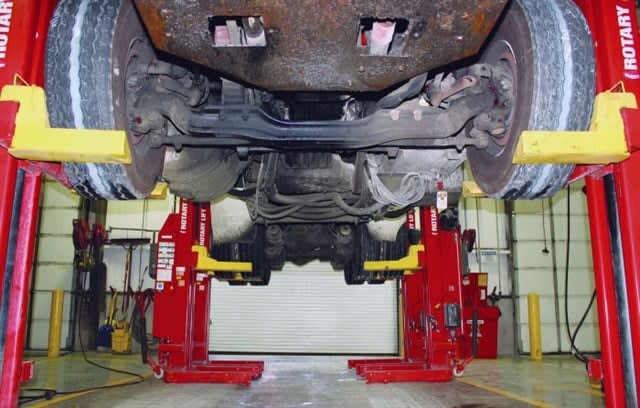
While fewer than 10% of heavy-duty shops have vehicle lifts, according to Rotary Lift, studies have shown using lifts results in an average 40% time savings during repairs.
5. Use vehicle lifts
Vehicle lifts are a staple in the automotive world, but fewer than 10% of heavy-duty service bays have lifts, according to Kirk Dawson, vice president of heavy duty for Vehicle Service Group, the parent company of Rotary Lift. This in part is due to the fact that until recently there was enough clearance under the truck for a technician to “fairly easily with a creeper be able to work,” he says. With technology changes resulting from emissions reduction efforts, however, ground clearance has been reduced, and more subsystems need to be serviced under the vehicle.
But that is not the only reason to add lifts to your service bays. “We have done time studies to determine the savings associated with using lifts and have found on average a 40% time savings,” Dawson says. He offered this extreme example from when he worked in a distributorship. The shop was averaging five and a half hours to perform DPF filter maintenance. The Standard Repair Time for that procedure was four hours. “We started using lifts and we were able to reduce the average repair time to about an hour and a half.”
Subscribe to Our Newsletter
More Aftermarket

What Three Fleets Are Doing Differently When Buying Truck Parts in 2026
With freight improving but costs still climbing, fleet maintenance executives explain how they're balancing price, quality, and supplier relationships.
Read More →
ConMet Expands Aftermarket Brake Drum Lineup With TruCast
A new heavy-duty truck brake drum option in the aftermarket gives customers more flexibility within the ConMet product family.
Read More →
Phillips Opens High-Tech Distribution Center for Faster Parts Delivery
Phillips Industries’ new Cincinnati-area distribution center is now shipping aftermarket trucking parts nationwide, aiming to speed up delivery times for customers.
Read More →
Volvo to Sponsor America’s Road Team for 2025
Volvo Trucks announced that it is extending its exclusive sponsorship of America’s Road Team for 2025.
Read More →
Webb to Start Taking Orders for UltraSet Pre-Adjusted Wheel Hubs
Webb, which recently acquired the Stemco Trifecta pre-adjusted hub program, will soon start taking orders for its replacement pre-assembled hub, the UltraSet.
Read More →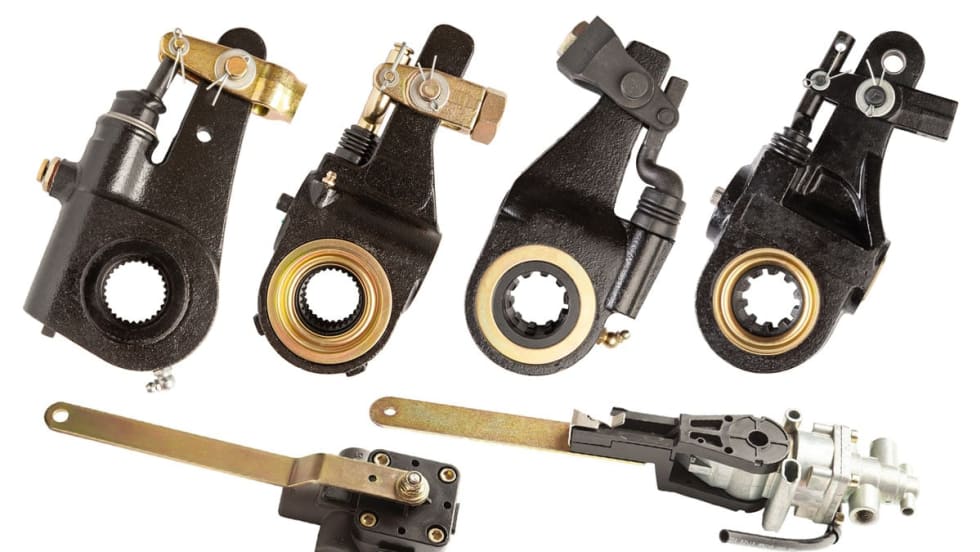
All-Makes Automatic Brake Adjusters, Ride Height Control Valves from Midland
SAF-Holland has added automatic brake adjusters and ride height control valves to its Midland All-Makes Program.
Read More →
ZF Aftermarket Expands [pro]Academy Training
ZF Aftermarket said it is expanding its ZF [pro]Academy training and will be adding 40 new modules this year.
Read More →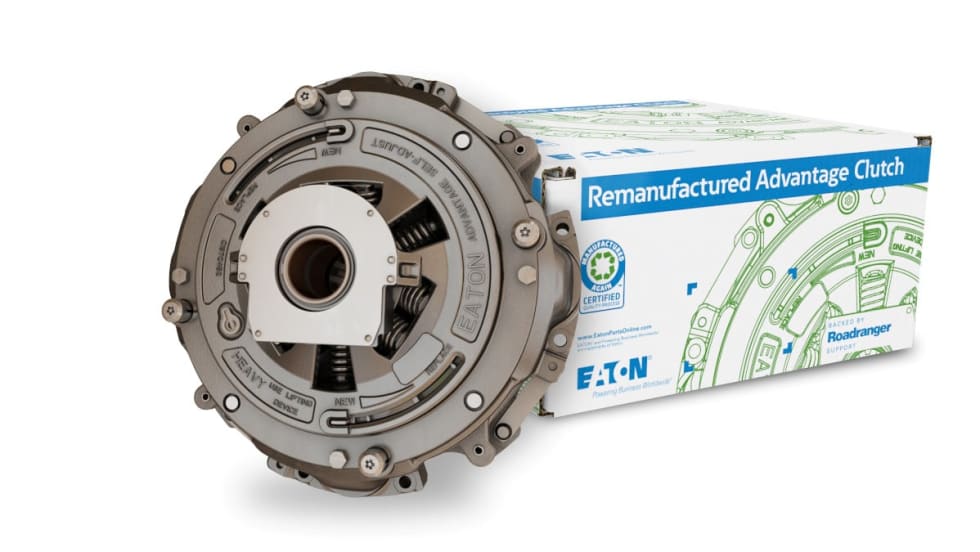
Eaton Adds Remanufactured Advantage Line of Clutches
Eaton has added its Advantage clutches to its remanufactured product line. The clutches feature a unique strap drive intermediate plate designed to allow customers to choose the latest OE specification
Read More →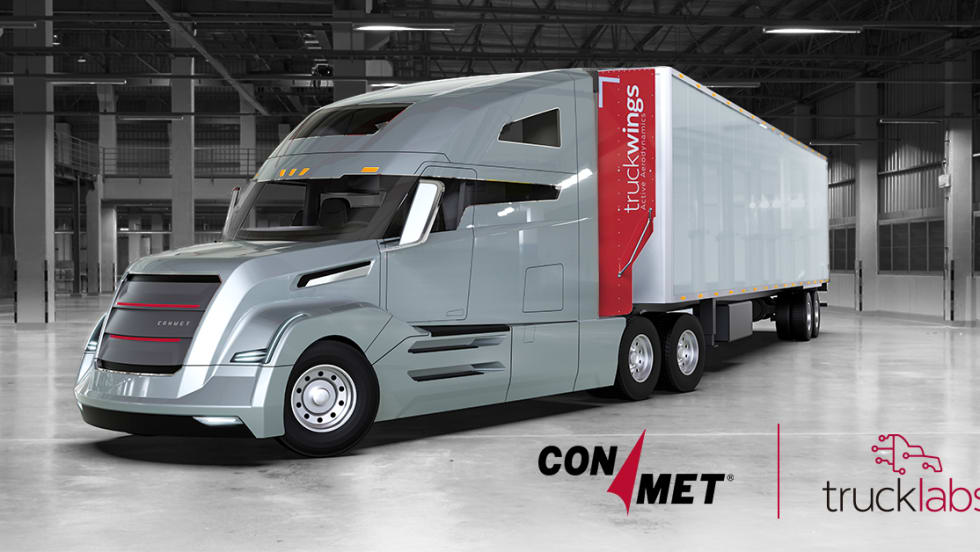
ConMet Acquires TruckLabs, the Creator of TruckWings
Commercial truck and trailer parts provider ConMet acquired TruckLabs, the company that created TruckWings, an aerodynamic device that attaches to truck cabs and deploys to close the gap between truck and trailer. TruckLabs now operates as a subsidiary of ConMet.
Read More →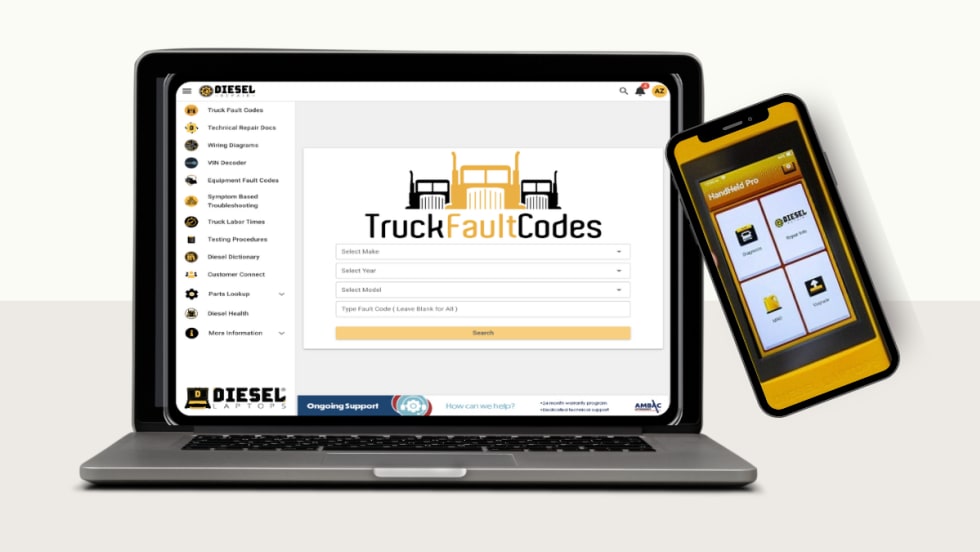
Diesel Laptops Releases Fault-Code-to-Part-Number Tool
Diesel Laptops said its Truck Fault Codes allows users to input a fault code and immediately identify and order the parts needed to complete repair work.
Read More →