




4 Ways Corporate Culture Can Help Retain Women at Your Fleet
Executives from the 2021 Top Companies for Women to Work for in Transportation share four things fleets can do to create a corporate culture that retains women drivers and leaders.

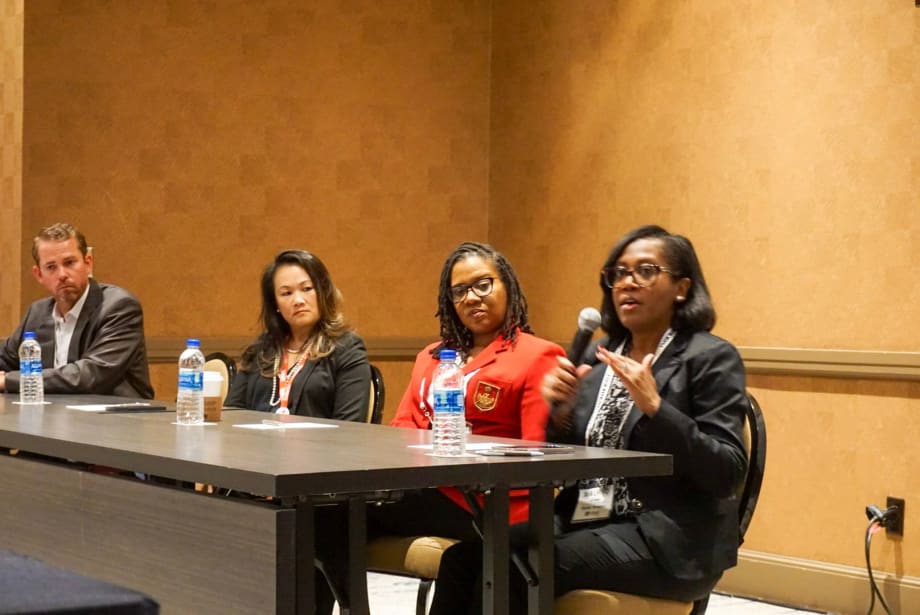
(Left to right) Ryan McDaniel of Walmart, Loan Mansy of Clean Harbors, Shanay Lewis of XPO Logistics, and Mauryo Jones of Ryder Systems discuss how to build a corporate culture that promote longevity for women in the workplace.
Photo: Vesna Brajkovic
During a panel discussion at Women In Trucking’s Accelerate Conference & Expo in Dallas, executives from four of WIT’s 2021 Top Companies for Women to Work for in Transportation shared four things fleets can do to create a corporate culture that retains women drivers and leaders.
In the panel discussion “The Corporate Culture Factor: Productivity and Longevity for Women in the Workplace,” Walmart Senior Vice President of Supply Chain Ryan McDaniel, Clean Harbors Executive Vice President of Sales and Service Loan Mansy, XPO Logistics Senior Manager of Leadership Development and Diversity Shanay Lewis, and Ryder System Group Director of Safety, Health and Security Mauryo Jones discussed emerging trends and programs that create a corporate culture attractive to women.
Here are four takeaways:
1. Look Inward and Gather Feedback
In order to attract a new or more diverse workforce, fleet executives should take an honest look into their company culture and discover what they have to offer and where they need to improve, said Ryder's Jones.
“If I was advising a company, I would say: First, take a deep look in the mirror and see where you are,” Jones said. “You attract who you are and what you are. If you truly want more women in your workforce, whether it’s female drivers, technicians, or professional women, first learn who you are [as a company] and then really put the work in [to improve].”
One way to learn what drivers, technicians and other employees think of your company is to conduct internal surveys to see what they expect, what they observe, and what areas they think need improvement as it relates to diversity.
“If you survey your workforce and put questions in there that you really want to know the answers to, they'll be honest,” explained Jones. “But you have to be in a posture of being able to really listen, being transparent, and incorporating some of the suggestions that your workforce have given.”
2. Create Avenues for Development
Leaders need to provide an avenue for all cultures and genders to develop and advance, explained XPO's Lewis. The first step in finding that avenue is to work with employees to understand their unique career plan. This allows leaders to see things from an employee’s perspective, pay attention differently, and redefine what it means to be an effective leader for each individual.
“[The career plan] doesn't have to be perfect, but we need to be working within our organizations to say, ‘This is what I want to be when I grow up at this company,’ and even after this company,” Lewis said. “So that we can sit down and determine if we're making the right decisions and develop a plan that is aligned to that.”
Her advice to potential leaders it to take advantage of opportunities and always have something to say when you’re “invited to the table.”
“If you see those things in action, I don't see any way that that doesn't attract good talent,” Lewis said.
3. Update Job Descriptions
An internal Hewlett-Packard report that’s been shared often found that women working at HP applied for a promotion only when they believed they met 100% of the qualifications listed for the job, while men applied for promotions when they thought they could meet 60% of the job requirements.
Mansy said this is one of the reasons Clean Harbors began taking a closer look at its job descriptions and started using language more purposefully. Instead of loading job descriptions with “wish list” requirements, Clean Harbors has pared it back to the key priorities to encourage more diverse applicants. The company also worked to remove gender bias in descriptive words.
4. Create Resource Groups
Creating resource groups for women in an organization can give management insights into any barriers standing in the way of women working at a company or getting promoted within one.
At Walmart, for example, employees have access to a Women’s Resource Council. Each functional division has a chapter. Members across all levels of the organizations can discuss barriers women are facing, explained Walmart's McDaniel.
Groups like this create the space to have honest, open and vulnerable conversations, which can in turn create a culture where peers, team members and leaders are confident in pushing the company towards inclusion. In order to get true feedback, “you have to create a culture of openness and vulnerability to allow that to happen,” McDainel said.
When talking about driving change in diversity and inclusion, always remember who the audience is, explained XPO’s Lewis.
“I promise you the way our CEO communicates [diversity and inclusion] is going to be very different from the way a frontline supervisor should communicate D&I,” she said. “When we talk about transparency, I find that one of the most beneficial things that we've been able to do at XPO is level the playing field, bring everyone to the table at the same time and share honestly, 'This is where we are.'”
More Fleet Management

Color Match Smarter: Tools That Restore & Perform
For fleet managers and collision repair professionals keeping heavy-duty trucks on the road, getting the color right the first time isn't just about appearance — it's about efficiency, turnaround time, and bottom-line results. Discover how today's digital color tools are transforming the repair process from guesswork to precision.
Read More →
FMCSA Pauses Biennial-Update Enforcement Amid Motus Transition
Carriers whose updates were due on or after June 1 have more time, while FMCSA works to stabilize its new registration system and warns of phishing sites impersonating its new carrier registration system, Motus.
Read More →
2026 Blueprint for Countering Smarter Supply Chain Theft
Cargo theft is no longer just the cost of doing business. It's a multi-billion-dollar criminal enterprise exploiting vulnerabilities across your fleet, drivers, and supply chain.
Read More →


How Telematics Improves Visibility, Control, and Performance in Refrigerated Fleets
Explore how telematics help refrigerated fleets improve visibility, uptime, efficiency, compliance, and cargo protection across connected cold chain operations.
Read More →
What the U.S.-Canada Trade War Means for Trucking
Escalating U.S.-Canada tariffs could disrupt cross-border freight, reduce truck volumes, raise costs, and create new uncertainty for carriers on both sides of the border.
Read More →
What Are Trucking’s Top Concerns for 2026?
The American Transportation Research Institute wants to know what's worrying trucking fleet managers, drivers, and other stakeholders in its annual Industry Issues survey.
Read More →
American Trucking Associations Looks for a New Leader
ATA President and CEO Chris Spear abruptly left his job at the association on August 21, at a pivotal time for the trucking industry.
Read More →
Public Wi-Fi Cybersecurity Risks: How Truck Drivers and Fleets Can Protect Their Data
Public Wi-Fi can expose truck drivers and fleets to credential theft, malware, and other cyber threats. Here’s how to reduce the risk on the road.
Read More →
For Nicky Cupp, Fleet Innovation Starts With Frustration
HDT Truck Fleet Innovator Nicky Cupp turns everyday pain points at Fraley & Schilling into opportunities for better technology and smarter processes.
Read More →
Adam Buttgenbach’s Approach to Electric Trucks: Start With Where They Fit
HDT Truck Fleet Innovator Adam Buttgenbach helped PepsiCo build one of North America’s largest EV fleets by focusing on where electric trucks make operational sense.
Read More →