





Related: Refinishing Wheels the Right Way
21st Century Truck Wheels
In practice, wheels function quite well with only limited attention and maintenance. But that’s no excuse not to pay attention to them at regular intervals.
December 22, 2016
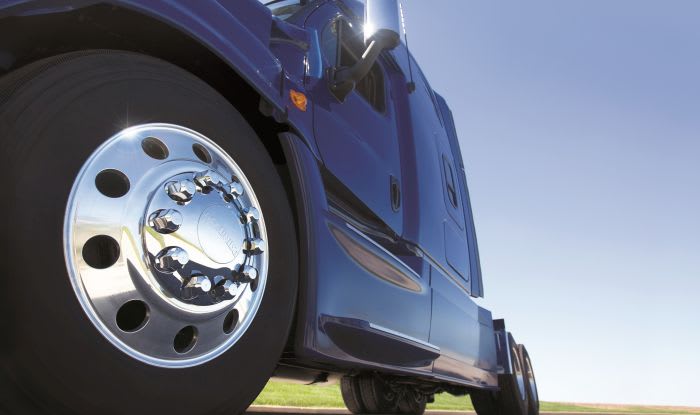
With strict emissions and fuel-economy requirements of new GHG Phase 2 regulations just around the corner, look to aluminum and lightweight steel wheels to contribute to overall equipment compliance. Photo: Accuride
5 min to read
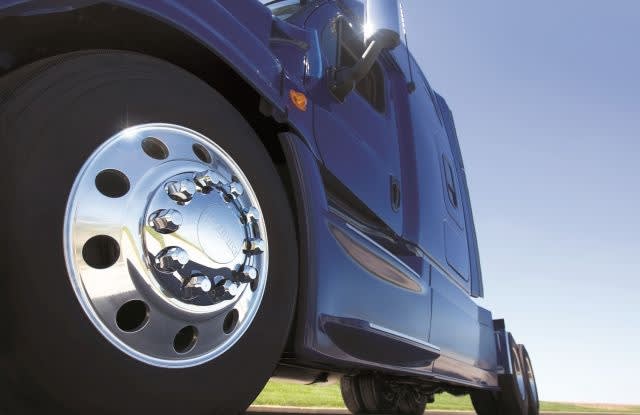
With strict emissions and fuel-economy requirements of new GHG Phase 2 regulations just around the corner, look to aluminum and lightweight steel wheels to contribute to overall equipment compliance.Photo: Accuride
The wheel is such a long-standing, fixed presence in our lives, that we rarely think about them. Until one fails, of course. In practice, wheels function quite well with only limited attention and maintenance. But that’s no excuse not to pay attention to them at regular intervals.
For many fleets, the entire thinking process behind truck wheels is to simply bolt them on and then never think about them again until the next tire change takes place, says Rafael Gonzalez, Accuride’s director of product management, wheels. ”That’s a concern for our industry, because, unfortunately, that’s a very common practice today. But the good news is that although wheels don’t require much maintenance, a little maintenance can make them last a very long time.”
Little maintenance, long lives
Fleets today have a choice between steel and aluminum wheels. Each has distinct advantages that can help fleets achieve their goals.
Steel wheels are less expensive to purchase, but require more maintenance and are generally heavier than aluminum wheels — although Craig Kessler, vice president of engineering, wheels, at Accuride, says ongoing research and development have cut the weight of both substantially.
“We’re down to 45 pounds per aluminum wheel today, and we used to be over 60 pounds,” Kessler says, with the help of new additives and changes to the base alloy. “We’ve taken out 15 pounds in unit weight for our steel wheels over a two-year period thanks to better machining methods and better manufacturing processes that give us more control over variables when forging and heat-treating the wheels.”
Merrick Murphy, president, Arconic Wheel and Transportation Products (formerly known as Alcoa), says wheel selection can lead to significant advantages for fleets of all types, with payoffs in freight efficiency, fuel economy, lower maintenance, safety and appearance all adding to the bottom line.
“Lightweight aluminum wheels produced by Arconic’s Alcoa Wheels division, like Alcoa Ultra One, can weigh as little as 40 pounds per wheel,” Murphy explains. “Lower weight wheels allow fleets to haul more with fewer loads, making them more profitable with lower operating costs and better overall fuel economy.”
Although steel wheels require more maintenance than aluminum ones, Gonzalez notes that in reality, it’s more about training your technicians to be aware of potential problems and how to deal with them when they arise.
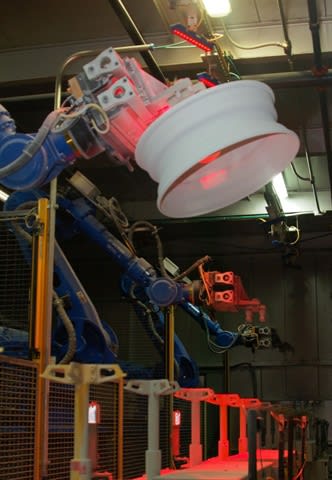
Advances in manufacturing processes enable Accuride to continue to reduce steel-wheel weight, while corrosion-fighting coating advancements keep steel wheels on the road longer, delaying initial refinishing and lowering fleets’ maintenance costs.Photo: Maxion Wheels
“Mainly, you want to keep steel wheels clean and remove any excess dirt and debris, which is harmful to any bolted joint,” he says. “Another important — and often overlooked — point is to check and retorque the lug nuts after running the truck from 5 to 100 miles after installing new wheels. It’s equally important to check the torque later on at regular intervals, as well.”
Gonzalez notes that any rust, dirt or debris on any of the wheel’s mounting surfaces will impede a flush connection and give a false reading on the torque wrench.
“But if you follow those procedures,” Kessler adds, “and get good contact between the wheel, the disc or drum and the brakes, and keep them clean going forward, steel wheels will easily last 20 years.”
Aluminum wheels lower maintenance costs simply because they are corrosion resistant and easy to keep clean, Murphy says. “Some manufacturers feature patented surface treatments to further resist corrosion and lower maintenance costs,” he notes. “The Alcoa Dura-Bright Evo Wheel, for example, can be easily cleaned with just mild soap and water and is 10 times more resistant to corrosion primarily caused by road salts and weather elements. It is also more resistant to chemicals found in the toughest truck cleaning agent, with no need to polish, paint, sandblast or retouching.”
And since it’s a surface treatment, Murphy adds, Dura-Bright penetrates the aluminum, forming a molecular bond that becomes an integral part of the wheel. “It prevents cracking, peeling and filiform corrosion often seen on coated wheels,” he says. “Which means the wheels stay looking newer, longer.”
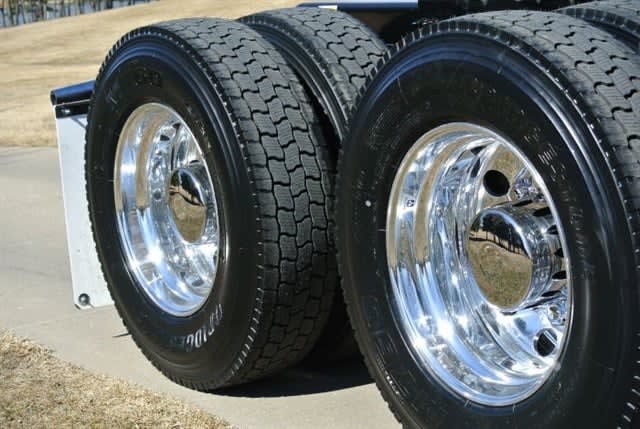
Polished aluminum wheels are a common choice for weight- and image-conscious carriers. Photo: Arconic
Time to reinvent the wheel?
Today the wheel is poised to enter the Information Age, according to Joseph Wolf, manager of Maxion’s advanced engineering and innovation team and the project leader for the company’s MaxSmart sensor wheel technology.
According to Wolf, MaxSmart is a new sensor system designed to withstand the hellish environment inside a tire/wheel cavity while collecting vital operating data and transmitting it to drivers and fleet managers.
Wolf says MaxSmart is currently capable of tracking and transmitting a number of different operational factors, including static and dynamic load on a wheel, as well as the clamp force holding the wheel to the axle.
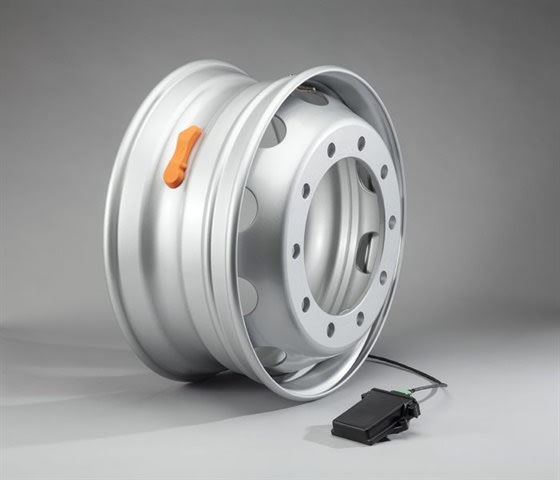
Next year, Maxion Wheels plans to launch its MaxSmart internal wheel sensors, which can wirelessly relay a host of tire and load information to both drivers and fleet managers. Photo: Maxion Wheels
“Static and dynamic load is important because it allows the driver to monitor the load in real time,” Wolf explains. “If a load shifts from side to side, or front to rear while on the highway, the driver will be alerted at once.”
Monitoring clamping force allows drivers to avert a crash in the rare instances when a wheel comes off an axle, Wolf says, adding that the system can also monitor tire cavity temperature and tire pressure. “Wheel-based sensors have been monitoring tire pressure in passenger cars for over 10 years now,” he says. “And based on feedback we got showing MaxSmart at IAA [commercial vehicle show in Germany in September], we think this is a better approach to tire monitoring in commercial vehicles going forward.”
Wolf says MaxSmart will debut next year in conjunction with a new truck launch, and is being designed to last the life of the wheel. “We’re not designing this as a stand-alone product with a little separate data screen glued to the dash. We want this to be a fully integrated system in terms of the vehicle CAN bus and how the information is relayed to the driver and to a fleet.”
Subscribe to Our Newsletter
More Equipment

How Volvo Updated Its D13 for EPA 2027 [Watch]
Volvo’s updated D13 promises lower emissions without sacrificing performance or fuel economy. Take a closer look at what changed inside the engine in this HDT Spotlight video.
Read More →
Michelin Tire Improves Efficiency and Durability for Regional Fleets
The Michelin X Multi Energy D2 is a regional haul drive tire engineered to help fleets improve fuel efficiency, durability and traction in demanding stop-and-go operations.
Read More →
ZF Expands Commercial Vehicle Push in North America
ZF is expanding its North American commercial-vehicle presence with new transmission applications, electrification, trailer technology and autonomous-driving systems.
Read More →
Tesla Wants a Self-Driving Semi. Are Cameras Enough?
Could Tesla’s camera-only autonomous driving technology work on an 80,000-pound Semi? In this commentary, HDT's Deborah Lockridge takes a look at Tesla, Cybercab, and how autonomous trucks see the road.
Read More →
Kodiak: Driverless Long-Haul Truck Launch on Track for 2026
Kodiak AI says its driverless long-haul safety case is 93% complete and it remains on track to begin commercial operations by year-end 2026.
Read More →
What DOT’s Automated Vehicle Strategy Means for Trucking
The U.S. Department of Transportation issued a new automated-vehicle strategy that outlines plans for driverless-truck regulations, cross-state freight corridors, and federal safety standards.
Read More →
East Coast Port Launches $45M Electric Truck Push
The Port Authority of New York and New Jersey announced millions in incentives for zero-emission drayage trucks, yard tractors, and new charging hubs near the port.
Read More →
PlusAI Going Public to Fund Autonomous Truck Launch
A SPAC deal could provide PlusAI with up to $300 million as it works toward a 2027 commercial launch of factory-built autonomous trucks.
Read More →
NHTSA Moves to Rewrite Truck Fuel-Economy Rules
The National Highway Traffic Safety Administration says it lacks authority to regulate medium- and heavy-duty truck engines separately from complete vehicles, but the existing standards have not yet been eliminated.
Read More →
Detroit Opens Orders for EPA 2027 Engines
Detroit isn’t starting from scratch to meet EPA 2027 diesel emissions standards. Its Gen 6 DD13 and DD15 engines keep much of today’s platform while updating the fuel and aftertreatment systems.
Read More →