





Related: Technology Is Changing How Carriers, Shippers, and Brokers Connect
New Marketplace Will Monetize Data for U.S. Logistics Players
A web-based omnichannel data marketplace for U.S. transportation and logistics firms is being rolled out via a partnership between dexFreight and Ocean Protocol of Singapore.
February 13, 2020
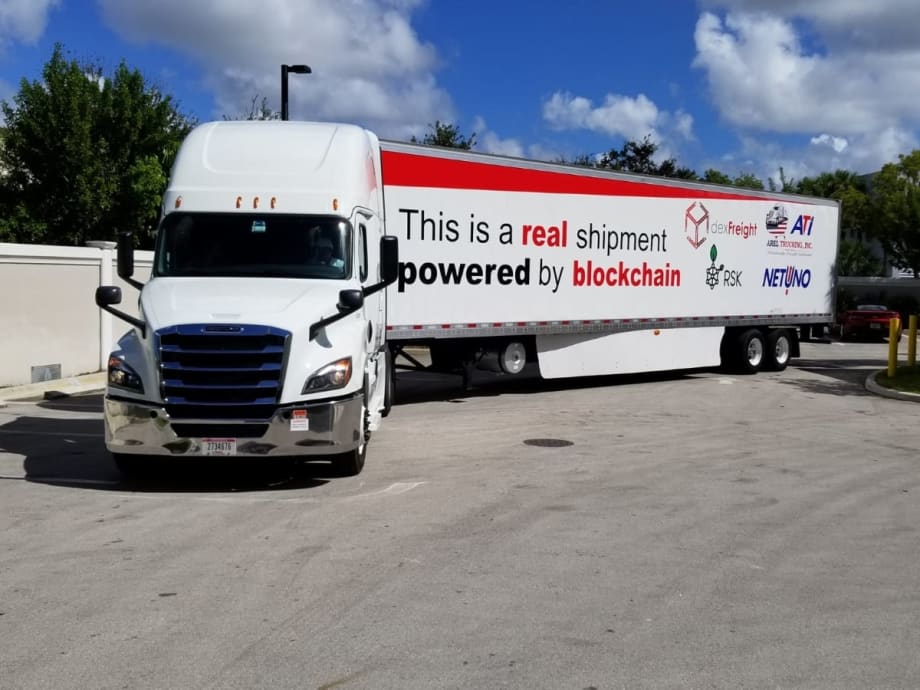
In this new marketplace, carriers, brokers, and shippers will own their data and have the option of sharing it with the community without revealing a company’s identity or strategic competitive information.
Photo: dexFreight
3 min to read
A web-based omnichannel data marketplace for transportation and logistics firms is being rolled out via a partnership between Sunrise, Florida-based dexFreight and Ocean Protocol of Singapore. While dexFreight provides a blockchain-based logistics platform, Ocean Protocol fields a decentralized data-exchange protocol to unlock data for artificial-intelligence use.
The companies said in a news release that the new omnichannel data marketplace will “enable companies to aggregate and monetize operational data.” It will open in April and will first focus on serving U.S.-based truckload transportation providers.
Ocean Protocol and dexFreight also stated that the U.S. logistics industry is comprised of 500,000 trucking companies, 16,000 brokers, and millions of shippers— with the majority of them being small- and medium-size companies.
More to the point, according to the two firms, “Currently, they [logistics players] are unable to receive any compensation as actual owners of their data while third-party software vendors are able to aggregate and sell data to competitors, marketing firms, insurance companies, government agencies and others leaving them out of this revenue from data monetization opportunity.”
Several types of logistics data will be generated in the dexFreight omnichannel marketplace, including information on the historical location of trucks, shipment attributes, prices, indices and invoices.
In the marketplace, carriers, brokers, and shippers will own their data and have the option of sharing it with the community without revealing a company’s identity or strategic competitive information.
Users contributing data will be compensated in tokens via smart contracts. They will also have access to premium marketplace features made possible by harvesting the data, such as rate predictions.
For the data marketplace, dexFreight will manage data gathering and pruning, clean and create metadata information, and identify government data and city pairs to be added. It will also coordinate the testing of the marketplace, handle user onboarding and relations, and gather ongoing feedback.
Ocean Protocol’s role in the marketplace will enable intuitive publishing and consumption of data, and the creation of royalty distribution methods, and payment and pricing functions. The company will also develop a UX for Web3 onboarding, wallets and connections with tokens, and a system for dispute resolution.
“The collaboration of dexFreight and Ocean Protocol aims to break down data silos in the logistics industry,” said Trent McConaghy, founder of Ocean Protocol. “In the near future, we will bring this template to other verticals as well, such as pharma, Ocean Protocolautomotive and the financial services industries.”
“The dexFreight omnichannel data marketplace powered by Ocean Protocol architecture and smart contracts to trace the provenance of data will present an important opportunity for the entire logistics industry to aggregate their data and be compensated accordingly,” said Rajat Rajbhandar, CIO & co-founder of dexFreight. “Through this partnership to launch the industry’s first Web3 data marketplace with a transparent compensation method, we will enable trucking companies, freight brokers and shippers to put their data to work, generating revenue.”
A fact sheet with more information and use cases has been posted by dexFreight.
More Fleet Management

How MFA Helps Protect Trucking Fleets
Multi-factor authentication adds protection when passwords are stolen. Here’s how it works and where fleets should start.
Read More →
How Better Freight Data Helps Trucking Teams Get Ahead of Disruption
Trucking and logistics teams have plenty of data. The problem is getting the right information in front of the right people soon enough to act. Better-connected data can help teams spot trouble earlier and make smarter decisions before small problems become big ones.
Read More →
Trimble: Taking Artificial Intelligence in Trucking Beyond Faster Tasks
At Insight 2026, Trimble executives argued that fleets may need to redesign workflows to get more from AI as it introduced new products and enhancements. AI’s value will depend on how fleets combine automation with their people's knowledge.
Read More →
Sponsored•September 28, 2026
Build a bulletproof fleet: Uniting ELDs and dash cams for total compliance
An ELD can prove compliance, but it cannot always prove what happened on the road. Discover how uniting accurate ELD data with AI-powered dash cam video can help your fleet strengthen compliance, defend against liability, protect drivers and reduce operational costs.
Read More →
Nominations Open for HDT Emerging Leaders
Heavy Duty Trucking is looking for accomplished trucking fleet professionals under 40 who are making an impact and helping lead the industry forward.
Read More →
Why Private Fleets Are Taking More Freight
Private fleets are putting their own trucks on demanding customers and high-cost lanes as companies seek greater control over service, costs, and capacity.
Read More →
Sponsored•September 16, 2026
Color Match Smarter: Tools That Restore & Perform
For fleet managers and collision repair professionals keeping heavy-duty trucks on the road, getting the color right the first time isn't just about appearance — it's about efficiency, turnaround time, and bottom-line results. Discover how today's digital color tools are transforming the repair process from guesswork to precision.
Read More →
FMCSA Pauses Biennial-Update Enforcement Amid Motus Transition
Carriers whose updates were due on or after June 1 have more time, while FMCSA works to stabilize its new registration system and warns of phishing sites impersonating its new carrier registration system, Motus.
Read More →
Sponsored•September 14, 2026
2026 Blueprint for Countering Smarter Supply Chain Theft
Cargo theft is no longer just the cost of doing business. It's a multi-billion-dollar criminal enterprise exploiting vulnerabilities across your fleet, drivers, and supply chain.
Read More →
What the U.S.-Canada Trade War Means for Trucking
Escalating U.S.-Canada tariffs could disrupt cross-border freight, reduce truck volumes, raise costs, and create new uncertainty for carriers on both sides of the border.
Read More →