




Tom McLeod Talks About the Technology Transforming Trucking
From artificial intelligence to autonomous trucks, McLeod Software President and CEO Tom McLeod focused on new and on-the-cusp technology in his opening remarks at the 29th annual McLeod User Conference

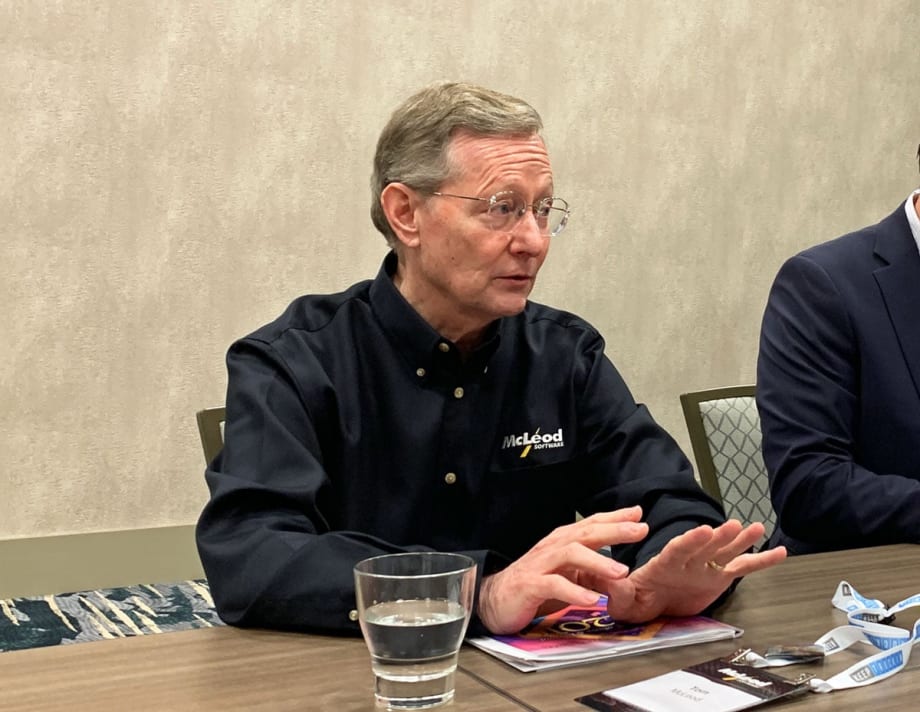
McLeod Software President and CEO Tom McLeod talks to reporters at the company's annual user conference.
Photo by Deborah Lockridge
From artificial intelligence to autonomous trucks, McLeod Software President and CEO Tom McLeod focused on new and on-the-cusp technology in his opening remarks at the 29th annual McLeod User Conference, held in Denver with nearly 1,100 attendees.
Noting that the trucking industry is not at the same unprecedented high level it saw in 2018, with fleets reporting profitability and revenue numbers all over the place, McLeod said that it’s not just the economy, which is still growing – it’s change.
“And what does change represent?” he asked the audience at the Gaylord Rockies convention center. “Opportunity!” several responded, prompting McLeod to ask if they had peeked at his notes. “Change can mean great opportunity for your business if you’re prepared,” he said. .
McLeod said technology is a primary driver of the transformation we’re seeing in the industry – not only information technology and things like artificial intelligence, machine learning, and predictive analytics, but also the technology on the truck, he noted, such as advanced safety systems and remote upgrades and diagnostics.
“The transformation is not something that’s done in a week,” McLeod said. “It’s an incremental thing. We want you to change from within, rather than having change forced on you from the outside,” and education such as that provided at the UC can help with that, he noted.
In his opening remarks as well as in a follow-up session with trucking editors, McLeod talked about “topics that are going to transform the industry over the next few years and already at work.”
Artificial Intelligence
Artificial intelligence is a broad term, McLeod noted, but he shared examples of what it can do for trucking and brokerage businesses.
In a subset of AI, machine learning, he said, the machine, or computer, “makes a recommendation based on certain data and parameters, then takes the outcome of that recommendation and adds that to the database and is able to improve on those recommendations.”
In the freight world, he cited two main areas where AI and machine learning can be applied: Pricing decisions and putting the right truck on the right load in less time.
Machine learning can help with pricing decisions not only on longer-term basis such as rate and bid requests for contract freight, but also on the individual load level in the spot freight market, McLeod said.
"When it comes to putting the right truck on the right load in less time,” he noted, “this is one area we’ve been at work."
Other areas where AI can help, he said are in hiring the right driver, calling the right customer, and getting insight into drivers who need help, who may be unhappy and thinking about leaving the company.
Machine learning can help leverage actionable insights, McLeod said, citing as an example its McLeod IQ business intelligence platform, with real-world dashboards developed by customers.
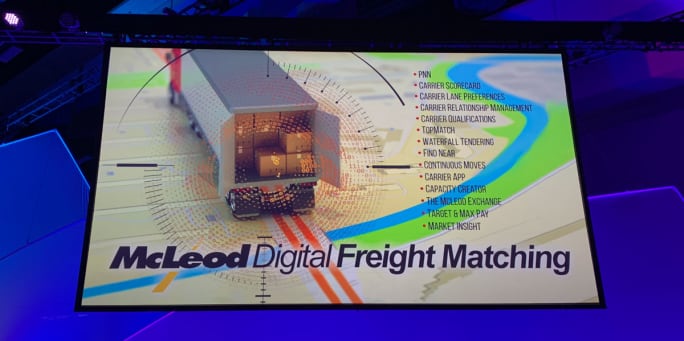
Digital freight-matching isn't just for startups looking to disrupt the industry.
Photo by Deborah Lockridge
He also cited the TopOrder module in McLeod’s Loadmaster TMS, where data is used to develop a star rating for each load. When a load comes in, users can see the rating and determine what they need to do, in terms of load planning or rate negotiations, to increase the score. “It can help you make better, more profitable decisions in real time.”
Improving the Driver Experience
Technology also can be used to improve the driver experience, McLeod said. He specifically cited two new modules McLeod is rolling out in LoadMaster: a new Driver Choice Module and Trip Management.
“Would your drivers feel more involved if they had something to say about the loads they’re being assigned?” McLeod asked.
The Driver Choice module has a profile for each driver, with their preferences in areas such as length of haul, time home, areas they don’t want to go, minimum revenue for owner-operator loads, etc. “We use that information to make recommendations for the next loads for that driver, so the driver’s getting assignments that fit,” McLeod explained.
On top of that, fleets can customize the amount of control the driver has of his or her loads. Owner-operators may be able to make their own selection from all of the recommended loads. Company drivers typically would have fewer options, but having choices, from loads already designed to fit their personal profile parameters, can go a long way in driver satisfaction.
McLeod later told reporters that one large customer using primarily owner-operators has been using Driver Choice since January and has found it to be such a competitive advantage, it didn’t want to share details about how well it has been working.
Trip Management helps drivers plan better and make better use of the time they have to drive, McLeod said. Using a driver’s hours-of-service and position information, a trip plan is created and displayed in LoadMaster. By taking into account road conditions, live and historical traffic patterns, and driver breaks, fleets can get more accurate, real-time estimated time of arrival (ETA) at customer stops and actual arrival time at locations, giving the planners and driver managers the ability to proactively deal with any potential service incidents at future stops.
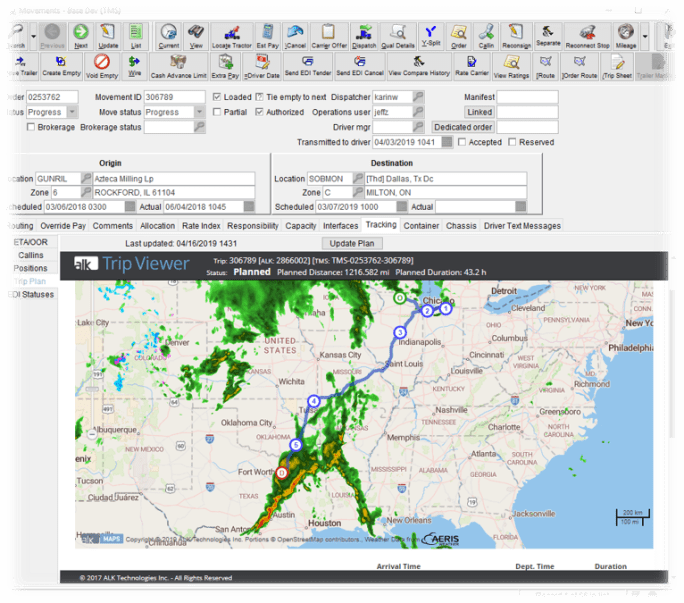
Trip Management takes into account real-time weather.
Photo courtesy McLeod Software
Jointly developed with Trimble Maps (formerly ALK), the module can be used with McLeod’s existing Driver Feasibility module, which determines whether the load can be completed based on the driver’s current position, the distances involved, the appointment windows for pick-up and delivery, and that driver’s available hours of service. The interactive nature of McLeod’s new Trip Management module gives the driver the opportunity to be part of the planning process.
Digital Freight Matching
A lot of technology investment in recent years has been poured into developing more efficient ways to match freight that needs to be moved with trucks that have space to move it, including many startups. McLeod has its own technology as part of its PowerBroker product for brokerage operations – and Tom McLeod pointed out that “many of these [new] digital freight brokers are also freight brokers,” i.e., competitors.
“There’s a lot of options on the table in terms of being able to allocate and locate freight,” he said. “I think it’s important to get involved in, because more and more freight is going through these channels.”
Digital freight-matching isn't just for startups looking to disrupt the industry.
Photo by Deborah Lockridge
However, he said, technology can’t replace relationships. “Last year when the capacity was strained, we thought the freight brokers might get squeezezd out. Exactly the opposite happened. Shippers couldn’t find trucks. They needed to get the freight moved, and they turned to freight brokers who really have great skills and build relationships with carriers, so they’re able to secure capacity even in tight markets.
"That trend of outsourcing is going to continue, and more freight is going to be available through connected networks and digital freight matching.”
McLeod’s Top Match technology allows McLeod PowerBroker users to combine several carrier search methods into one comprehensive search and find the carrier or carriers who are known based on history and preferences to be the best match for every load. TopMatch then feeds the best ranked-carriers to PowerBroker's Waterfall Tendering to help the automated freight matching process be more effective at covering the load.
In addition, on the carrier side, McLeod emphasized how the Backhaul module in LoadMaster can help make carriers “better negotiators and a better player in the world of digital freight matching.”
Preparing the Way for Autonomous Trucks
McLeod noted that all the truck OEMs, as well as startups, are working on this technology. “Please be talking to your truck suppliers about where they are in that process,” he said. “We have started conversations with truck makers and aftermarket supplies about the dispatch process, which has to be a lot more precise than just a street address for pickup and delivery, and the monitoring of that vehicle en route is critical.”
McLeod expects early fully autonomous operations to involve drivers meeting autonomous trucks at off-ramps, with the driverless portion of the trip limited to highways without a great deal of traffic and congestion. “This will increase the need for command control coming out of the system. We want you to be ready for that when it occurs.”
The company has an initiative it’s dubbed Smart Tractor As A Client, or STAAC. It is building on the notion that a smart truck is simply another computer, or client, on the integrated information and data network of the supply chain.
Some other areas of technology McLeod touched on included:
Cybersecurity: McLeod is hosting a conference on that topic at its Birmingham, Alabama, headquarters on Oct. 23
Business process automation: With its FlowLogix product, McLeod said, “We’re doing more and more to automate the repetitive tasks, save time, and get the work done on a timely basis,” he said, offering as an example an automated collections process that allows you to set up friendly notifications to go out a certain number of days before the bill is due, including a link that lets them access all the paperwork that went with that load.
Blockchain: McLeod Software is a co-founder of the Blockchain in Transportation Alliance, which he said is still “alive and well, with committees at work developing standards. “There will be real products that roll out and provide visibility and cooperation between companies in the industry and the supply chain. It’s a technology that was overhyped in the beginning, but it’s coming along just fine.”
‘Not All Technology Spending is Equal’
McLeod also shared some cautionary thoughts about the wave of private investment that has been been poured into trucking and logistics in recent years, from motor carriers to digital freight matching.
“Who knew there were so many private equity companies?” he said. “Almost any idea can get funded.” Because McLeod integrates with many different technology offerings (even with some that are owned by competitors), “many companies come to us, so we’re in a position of seeing companies with remarkable and starkly different strategies toward solving the same problem – and we’re in the position of trying to pick some winners.”
He pointed out that previous bubbles have led to busts, including the “dot-com” boom in the early 2000s and the housing bubble that led to the Great Recession when it burst. “I can’t tell you if there’s a bubble” currently in play, he said, “but if there is one, it may be this. With many of these investments, the investor borrows against a very high valuation of the company. Not in all cases, but in many cases, a tremendous amount of borrowing, and they are counting on the acquired company to be able to cover that debt payment. I’m simply saying, be careful.”
Talking to reporters later, McLeod shared his thoughts on how a privately held company such as McLeod, which doesn’t rely on private equity, may have some advantages. “We do feel like we can make decisions for the long term, by comparison to what I see some other companies do inside and outside our industry.
“To me, taking investment money is like taking a big bet. There’s a time frame; it’s almost like you’ve lit a fuse, and if you don’t get whatever critical mass is defined as [by that deadline], things blow apart.” Although that’s not as bad as it was some years ago when companies earned the derogatory nickname “vulture capitalists,” he said. “I think companies have gotten smarter about how they’ve approached investments.”
In addition, he said, “if you’re developing a product, it’s very important you have people who understand the marketplace. We’ve seen cases where there was lots [of money] poured into a product that didn’t really fit.”
More Fleet Management

Color Match Smarter: Tools That Restore & Perform
For fleet managers and collision repair professionals keeping heavy-duty trucks on the road, getting the color right the first time isn't just about appearance — it's about efficiency, turnaround time, and bottom-line results. Discover how today's digital color tools are transforming the repair process from guesswork to precision.
Read More →
FMCSA Pauses Biennial-Update Enforcement Amid Motus Transition
Carriers whose updates were due on or after June 1 have more time, while FMCSA works to stabilize its new registration system and warns of phishing sites impersonating its new carrier registration system, Motus.
Read More →
2026 Blueprint for Countering Smarter Supply Chain Theft
Cargo theft is no longer just the cost of doing business. It's a multi-billion-dollar criminal enterprise exploiting vulnerabilities across your fleet, drivers, and supply chain.
Read More →


How Telematics Improves Visibility, Control, and Performance in Refrigerated Fleets
Explore how telematics help refrigerated fleets improve visibility, uptime, efficiency, compliance, and cargo protection across connected cold chain operations.
Read More →
What the U.S.-Canada Trade War Means for Trucking
Escalating U.S.-Canada tariffs could disrupt cross-border freight, reduce truck volumes, raise costs, and create new uncertainty for carriers on both sides of the border.
Read More →
What Are Trucking’s Top Concerns for 2026?
The American Transportation Research Institute wants to know what's worrying trucking fleet managers, drivers, and other stakeholders in its annual Industry Issues survey.
Read More →
American Trucking Associations Looks for a New Leader
ATA President and CEO Chris Spear abruptly left his job at the association on August 21, at a pivotal time for the trucking industry.
Read More →
Public Wi-Fi Cybersecurity Risks: How Truck Drivers and Fleets Can Protect Their Data
Public Wi-Fi can expose truck drivers and fleets to credential theft, malware, and other cyber threats. Here’s how to reduce the risk on the road.
Read More →
For Nicky Cupp, Fleet Innovation Starts With Frustration
HDT Truck Fleet Innovator Nicky Cupp turns everyday pain points at Fraley & Schilling into opportunities for better technology and smarter processes.
Read More →
Adam Buttgenbach’s Approach to Electric Trucks: Start With Where They Fit
HDT Truck Fleet Innovator Adam Buttgenbach helped PepsiCo build one of North America’s largest EV fleets by focusing on where electric trucks make operational sense.
Read More →