




Solar Panels Feasible for Tractors, Trailers, Says NACFE
Solar power makes sense for many commercial trucks, and in many applications, an investment in the right equipment can be paid back in roughly three years, says the North American Council for Freight Efficiency in its latest Confidence Report.

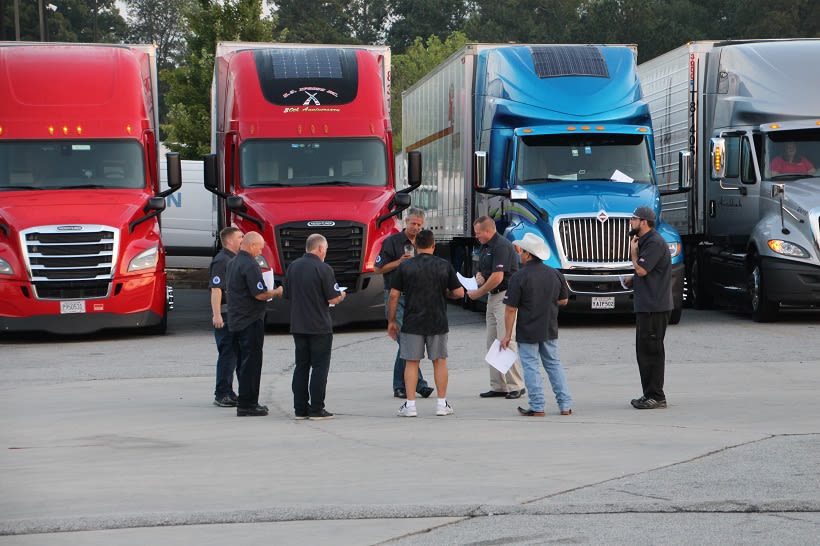
Two tractors involved in an NACFE-sponsored fuel-economy test last fall had solar panels mounted on their roof air deflectors, a common location. At least one fleet has begun putting panels on hoods.
Photo by Schaller LLC.
Solar power makes sense for many commercial trucks, and in many applications, an investment in the right equipment can be paid back in roughly three years, says the North American Council for Freight Efficiency in its latest Confidence Report, “Solar for Tractors and Trailers,” issued June 28.
Solar panels’ cost has come down and efficiency has increased, and they are especially useful for sleeper-cab tractors, said NACFE’s executive director, Mike Roeth, and two researchers, Jessie Lund, of the Rocky Mountain Institute, and Kevin Otto, a retired Cummins electronics engineer. They briefed reporters during a call-in press conference upon issuance of the report.
Solar power can run electric HVAC systems in sleepers, thus reducing engine idling during overnight breaks. But they don’t save a lot of fuel, Roeth said.
“The minimum savings we see with these panels in most applications, and in particular with tractors, is battery health,” Roeth said. “Panels can extend the life of the battery and the cost of replacement, as well as reduce service calls” on the road.
Solar power helps a truck’s alternator keeps batteries charged and ready for use to operate heating, air conditioning and “house” loads from dusk to dawn, they said. And drivers report that the panels begin generating electricity first thing in the morning.
“You do take some wear off the alternator as you’re going down the road charging,” Otto said. “A 300-watt panel during an 8- or 9-hour period is worth an extra battery (in power storage). You can figure that batteries will have a couple of hours more (operating) life… So there are fewer call-outs for batteries and you do get longer battery life.”

Solar panel-generated electricity helps a tractor’s alternator keep batteries charged so they are ready to work when the engine’s shut down. Extending battery life and reducing road calls for run-down batteries is where most solar savings come from.
Image courtesy of NACFE
A 100-watt panel ideally will produce 7 to 8 amperes, but various real-life conditions will often reduce that by 30%, he added. So that panel might make 1 amp at dawn and 5 to 6 amps at noon.
“Solar” implies sunlight, whose intensity varies due to weather conditions and geographic region, Otto said. “In the dark East, you get two-thirds of the output compared to when you’re in areas like Phoenix.”
Panels are now thin and flexible enough to mount on curved surfaces, so can be affixed to roof air deflectors and even on hoods.
There’s much more room on van and reefer trailers to place panels, and they are used primarily to charge batteries in reefer units and for lift gates and pallet jacks. Reefer unit makers offer panels that help keep batteries charged so engines can start every time they’re needed to run refrigeration equipment.
“Lift gates use a very large amount of power for a very short amount of time,” Otto said. “There are different sizes and capacities, and you need to size your batteries to the liftgate.”
The job of solar panels on trailers differs greatly according to application, Otto said. So the number and output of a panel complement needs to be carefully planned.
Cost of a 300-watt installation, including panels and control apparatus, is about $2,000, Otto said. The recent Trump-imposed tariffs on foreign metals and products might add only $40 to $50 to that, said Lund, the other researcher.
The report has four main conclusions:
Technology has progressed and fleets are adopting to do work
Fuel savings are generally quite small. Depends on where you’re operating and how intense the energy is. Calculator on line
Installation should be designed expressly for the application. They come in standard sizes, but it’s important to understand what problem it’s trying to overcome.
Manufacturers’ claims are close to the real world, but numbers from fleet users are lacking.
“We found some comments from drivers and fleet managers that told the story about solar very well,” Roeth said. “We don’t know, but we think it will help with attraction and retention of drivers” because solar addresses their needs for heating and air conditioning.
NACFE’s report includes a payback calculator for tractors and a “confidence matrix” for tractors and trailers that users can employ to gauge the financial feasibility of installations. The report is available here.
Related: Real-World Fuel-Economy Lessons From NACFE Run on Less
More Fuel Smarts

Trucking’s Diesel Squeeze Isn’t Letting Up
With diesel topping $6 a gallon nationally, ATA's Bob Costello explains why fleets should prepare for continued pressure at the pump.
Read More →
FlowBelow Redesigns Trailer AeroSlider to Cut Fuel Use
The lighter trailer aerodynamic system installs in less than 45 minutes, according to the company, with potential payback in under a year depending on fuel prices and trailer mileage.
Read More →
Why Diesel Price Relief Efforts May Fall Short
Diesel prices have eased from September’s record high, but doubts about additional Russian supply and limits on dyed-diesel tax relief mean trucking fleets still face expensive fuel. And prices could go higher.
Read More →
Why Small Fuel Savings Matter in Trucking
Can better fuel economy help pay for driver raises? In this podcast, GP Transco explains how small efficiency gains create room to reinvest in its people.
Read More →
How GP Transco Cuts Trucking Fuel Costs, a Tenth of a Gallon at a Time
What’s another tenth of a mile per gallon worth? GP Transco shares how equipment upgrades and driver coaching turn small gains into meaningful fuel savings.
Read More →
Electric Yard Tractors Move Beyond Pilots
Operating-cost savings have overtaken sustainability goals as the leading reason surveyed fleets are adopting battery-electric terminal tractors, according to new NACFE research.
Read More →
Geotab Links Fleet Card to Vehicle Data
The new card combines fuel discounts with telematics-based purchase controls. Geotab’s analysis also points to potential savings from choosing lower-priced fuel stops.
Read More →
Fleet Economics Shape Electric Truck Outlook
ACT Research expects costs, charging infrastructure, and technology improvements to drive zero-emission commercial vehicle adoption as federal regulations and incentives retreat.
Read More →
Wex Adds Cardless Fuel Payments for Over-the-Road Customers
A new fuel card feature for Wex customers offers convenience and security.
Read More →
New California Law Could Shed Light on Electric Truck Prices
Why do battery-electric Class 8 trucks remain so expensive? A California bill signed by Gov. Gavin Newsom would give fleets and state agencies more visibility into what manufacturers charge.
Read More →