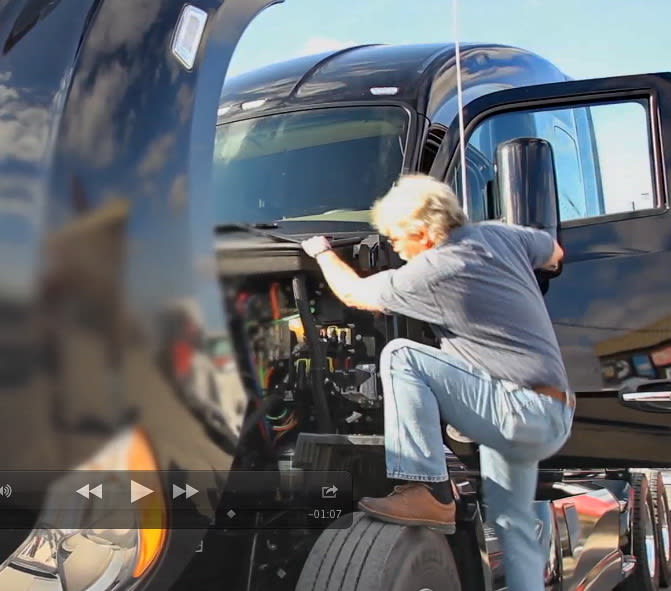
What do you think the aerodynamic penalty would be from a grab handle on the side of a truck that would help a driver climb up to a place he or she could safely clean the windshield? 0.0003%, maybe?
What do you think the aerodynamic penalty would be from a grab handle on the side of a truck that would help a driver climb up to a place he or she could safely clean the windshield? 0.0003%, maybe?
Trucks are pretty slippery these days -- in more ways than one. We often speak of slippery surfaces when extolling the virtues of modern aerodynamics. But if you have ever tried swinging a leg from the top step over to the top of the tire, dodging the mirror and shifting your weight at just the right moment, you'll grasp the other dimension of the word slippery.
Ad Loading...
The truth is, when a wet rubber boot meets a wet rubber tire, the coefficient of friction is pretty low. Certainly less than some health and safety standards would deem appropriate in any workplace that involved wet floors. How is it then, after so many years, that truckers don't have safe and convenient access to the upper reaches of the engine compartment where they must stand to effectively clean their windshields, or to change a wiper or a marker lamp?
It wasn't so bad in previous years when stepping from the top of a battery box to the tire didn't involve swinging around a huge, plastic, slippery aerodynamic mirror. Heck, the old mirror mounts made pretty good grab handles in their own way.
There's also the chassis fairing to deal with. The cab steps are integrated into the fairing, and placed -- not surprisingly -- under and slightly to the rear of the door opening, so it's a real stretch to just reach the tire. The fairing is usually wider and taller than the tire, so it's a perfect obstacle to the only landing spot under the hood, which is the tire itself.
Climbing on the wheel nuts isn't any safer. They protrude maybe two inches from the face of the wheel, and they don't make very secure footholds. Besides, there's nothing above the wheel to hold onto anymore. There once were metal rods securing the radiator to the cab. They worked, if you were tall enough to reach them, but they're gone too.
To be fair, and realistic, climbing around a big chrome air cleaner to gain a perch on the tire to clean the windshield wasn't much safer. Often, it was easier to slip behind the wheel and climb up on the frame rails. There's was more room around the wheels on some of those trucks, but wet (or oily) frame rails aren't any safer to stand on than wet tires.
Ad Loading...
None of the trucks I've driven recently -- like, in the last five years -- had any grab handles on the outside of the truck. Even the handles that once existed at the back of the cab or sleeper to help drivers climb onto the rear deck to connect the gladhands to the trailer have disappeared.
One truck I drove recently had two nice handles rigged on the inside of the rear cab fairings. The problem is you can't reach them from any natural position. You can reach across your chest with your right arm to grab the handle -- which is on the left side of your body -- or reach around back of the fairing to grab the handle with an unnatural bend of the left wrist. I'd say if a driver slipped while holding that handle with his or her left hand, he or she would have a broken wrist on top of all their other problems.
So how about it, OEMs; how about a few solid handholds to help drivers scale the sides of their trucks to clean their windows? I don't know if the coefficient of drag on such a handle is actually 0.0003%, but it couldn't be much more. Whatever it is, it's not enough to prevent you from devising some safer way than leaping onto a tire to climb high enough to perform a necessary safety function.
Just try walking around a diesel island when the ground is wet. It's slippery enough on flat ground with all that spilled fuel around. That stuff travels on your shoes up to the frame rails and the tires and the wheel nuts. I'm surprised more drivers haven't tumbled off their trucks. Or maybe we just don't hear about them.
Whether 'tis safer to twist a knob or press a button than to swipe right then swipe down to scan the menu for your favorite playlist...? That's a question for the age.
The government doesn't seem to mind asking trucking to invest a trillion dollars toward a greener future. But they won't let us pull turnpike doubles making 30% less CO2. Which is insanity, says HDT's Jim Park in his On the Road blog.
How does your recruiting and retention messaging compare with the reality at your company? Would your drivers agree with your own assessment? Jim Park explores those questions in his On the Road blog.
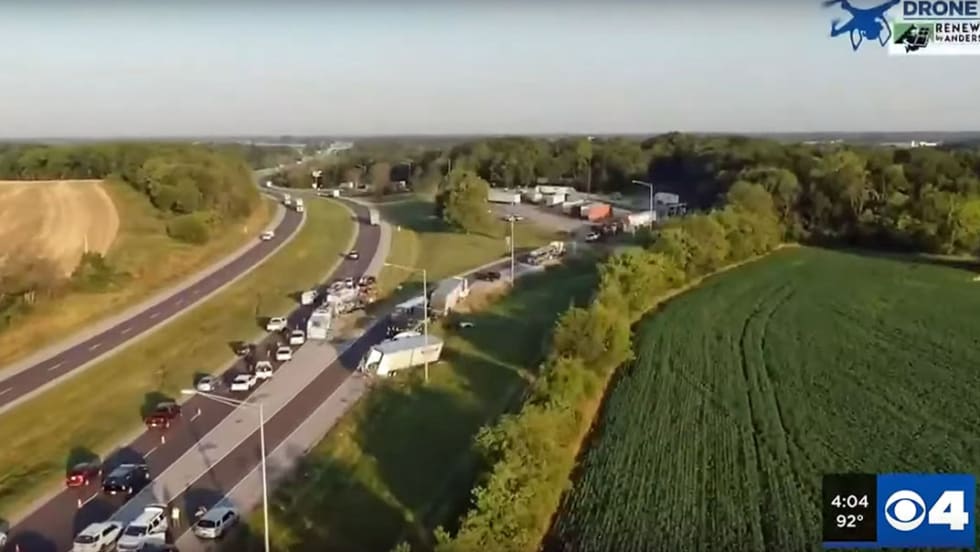
The causes of the Highland Park rest area crash go far beyond the parking shortage and the need for flexibility in hours of service — but those issues must be addressed, too, says Jim Park in his On the Road blog.
While the push for zero-emissions trucks rings clear for regulators, advocates and even a small crowd of suppliers, ZEVs seem to have run out of steam down on Main Street, says HDT Equipment Editor Jim Park in his latest On the Road blog.
The EPA’s Final Rule on NOx reduction will be incredibly difficult if not nearly impossible for trucking to comply with. Rather than endure another round of equipment failures, downtime and loss of customer faith, industry needs to rally ‘round the OEMs and seek a solution to this wrong-headed rule.
Is there a connection between downsped drivetrains and increased brake wear? There shouldn’t be. Downsped fleets seeing increased brake wear are probably not letting the technology do its job, explains HDT Equipment Editor Jim Park.
Published out-of-service rates don’t mean much until you dig into the why. With brake problems consistently placing in two of the top five spots, maybe we’re missing something in brake maintenance, writes HDT Equipment Editor Jim Park.
We’re in electric-truck heydays now. But like another famous heyday, the 1849 California Gold Rush, there will be a lot fewer winners than losers, says Jim Park in his On the Road blog.
Where do drivers learn mountain-driving techniques? It's sure not from the typical state CDL manual. Jim Park shares what he learned following a deadly 2019 Colorado crash.