




Inside the Small Fleet
Small fleets make up the vast majority of trucking companies. Comdata shares some research into their challenges and habits.
August 8, 2017

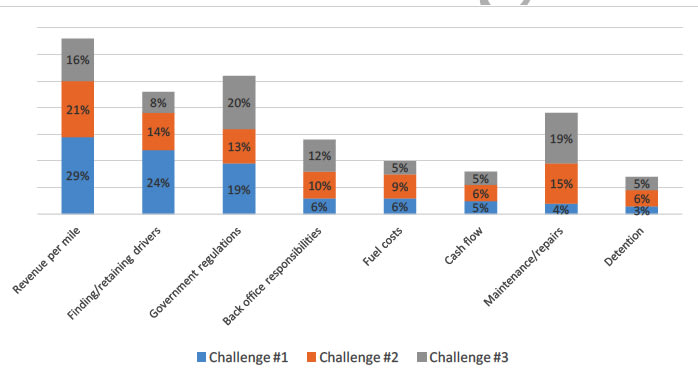
Small fleets cite their top three challenges. Graph courtesy Comdata
4 min to read
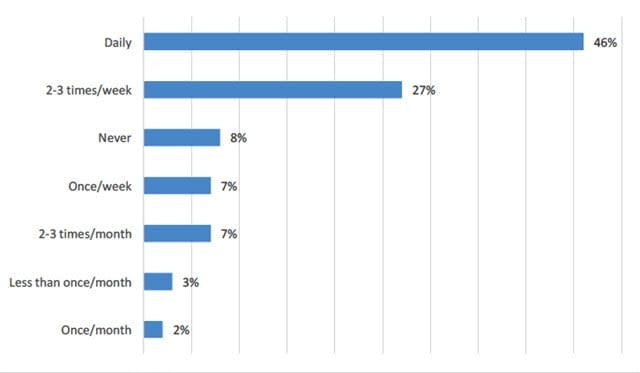
How often small fleets search for loads.Graph courtesy Comdata
According to the U.S. Department of Transportation, there are more than half a million for-hire carriers on file with the Federal Motor Carrier Safety Administration – and 97% operate fewer than 20 trucks.
Comdata recently shared with us some research it’s done on small fleets of 100 trucks and fewer. Out of its respondents, the biggest group was the 2-10 truck segment at 53%.
Keeping those trucks loaded is a top priority for small fleets, with 46% of respondents searching for loads daily, and an additional 27% looking for loads two to three times per week. As nearly half of fleets are searching for loads daily, this implies that they either lack regular customers, or at the very least need to find backhauls, Comdata notes. One fleet owner from New York told Comdata that 90% of her fleet’s loads come from direct customers, but she still looks for loads on load boards daily, whether for LTLs or backhaul.
Of its respondents, 46% of fleets with 2-10 trucks look for loads daily, and 61% of fleets with 11-20 trucks look for loads daily.
Fleets rely most heavily on load boards, with over 76% of respondents using load boards and 68% using brokers. Many described load boards as a last resort; they will first use personal contacts, such as calls and emails directly from brokers they’ve worked with in the past, and then use load boards for brokerages (such as Coyote or Landstar), and then use a load board such as Truckstop.com or DAT, Comdata explains. Respondents repeatedly cited their comfort with working with trusted repeat customers, and were willing to take a slightly lower rate from them because they were guaranteed payment.
Despite all the hype about “Uber for Trucking” load-matching apps, only 2% reported using Uship or similar websites. There have been a number of new entrants into this space since the research was conducted last year.
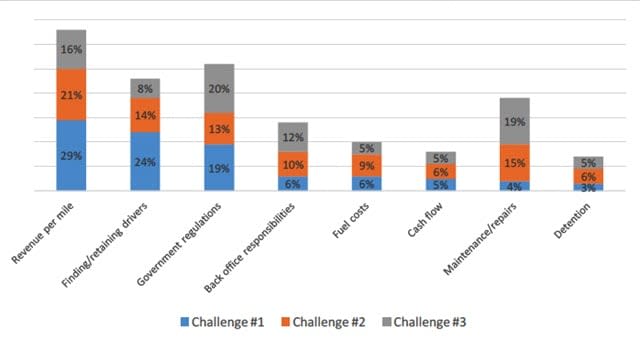
Small fleets cite their top three challenges. Graph courtesy Comdata
One of the biggest challenges beyond keeping the trucks loaded is making enough money on those loads. When asked about their three biggest challenges, 29% of the Comdata respondents reported their biggest challenge as revenue per mile. They discussed the low rates being offered by shippers and brokers, and the fact that it is difficult to cover expenses. The current rates have led to both a general feeling of animosity toward brokers, who carriers hold responsible for the low rates, Comdata says, and a feeling that it is impossible to grow one’s fleet given the current rate climate.
A big challenge that many respondents share with larger fleets is finding and retaining drivers, with 24% of respondents reported that to be their biggest challenge. A fleet financial manager from Missouri with 30 trucks stated that she had four or five open trucks that she needed drivers for at the time of her interview.
Government regulations was another big challenge, with respondents cited their frustrations the ELD mandate, hours of service, and other safety and compliance challenges. It was repeatedly stated that it is difficult for small fleets to keep up with ever-changing regulations. Again, this is a challenge shared with larger fleets, as regulations – the ELD mandate, HOS, and the cumulative effect of regulations – were the three highest industry issues on the ATRI’s list of critical issues within the trucking industry in 2016.
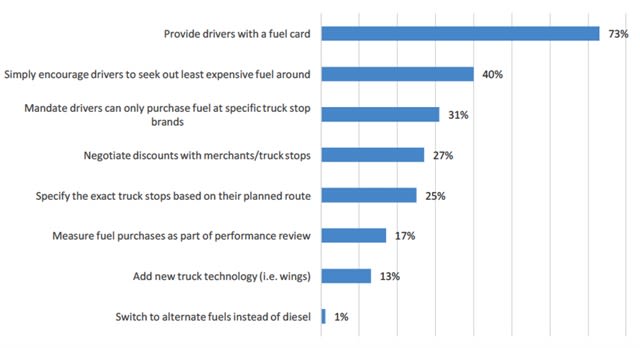
Small-fleet strategies for saving on fuel spend. Graph courtesy Comdata
When asked how they minimize what they spend on fuel, 73% of respondents provide their drivers with a fleet card which they use to purchase fuel. 40% of respondents encourage their drivers to seek out the least expensive fuel around. 31% of respondents mandate where their drivers can make fuel purchases, citing specific truck stop brands.
The majority (79%) receive discounts through their fleet/fuel card. 27% negotiate discounts directly with merchants and truck stop brands. 25% participate in group discount/rebate programs through aggregators such as Truckers B2B. 21% report receiving no discounts at all.
When asked whether they use specific pieces of technology for work and/or personal purposes, 78% of respondents said use a smartphone for both personal and work purposes, and an additional 16% use smartphones for either personal or work purposes. In addition, 55% of respondents use a laptop for personal and work purposes and 21% use a laptop for either personal or work purposes.
Some respondents spoke of their frustration with using an app versus the website for popular trucking sites. One fleet owner from Florida with three trucks cited the difficulty with using the app version of a popular load board, as it does not self-refresh and is less convenient. This respondent prefers to use a laptop and work via the website; Comadata says this illustrates that while these small fleet owners and managers have smartphones and are tech-savvy, they still prefer to use their computers for certain functions.
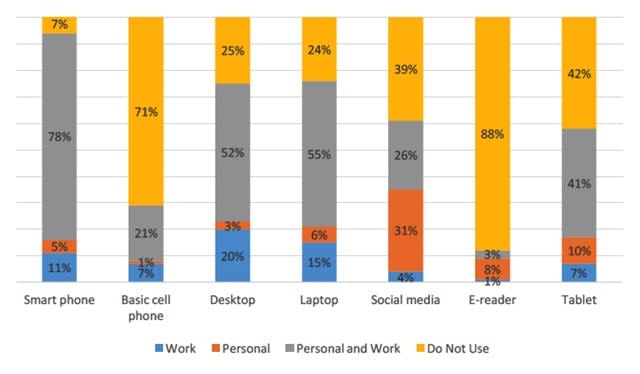
How small fleets use smartphones, computers and tablets. Graph courtesy Comdata
After conducting this research, Comdata expanded its options for smaller fleets.
Subscribe to Our Newsletter
More Fleet Management

Sponsored•September 16, 2026
Color Match Smarter: Tools That Restore & Perform
For fleet managers and collision repair professionals keeping heavy-duty trucks on the road, getting the color right the first time isn't just about appearance — it's about efficiency, turnaround time, and bottom-line results. Discover how today's digital color tools are transforming the repair process from guesswork to precision.
Read More →
FMCSA Pauses Biennial-Update Enforcement Amid Motus Transition
Carriers whose updates were due on or after June 1 have more time, while FMCSA works to stabilize its new registration system and warns of phishing sites impersonating its new carrier registration system, Motus.
Read More →
Sponsored•September 14, 2026
2026 Blueprint for Countering Smarter Supply Chain Theft
Cargo theft is no longer just the cost of doing business. It's a multi-billion-dollar criminal enterprise exploiting vulnerabilities across your fleet, drivers, and supply chain.
Read More →


Sponsored•September 1, 2026
How Telematics Improves Visibility, Control, and Performance in Refrigerated Fleets
Explore how telematics help refrigerated fleets improve visibility, uptime, efficiency, compliance, and cargo protection across connected cold chain operations.
Read More →
What the U.S.-Canada Trade War Means for Trucking
Escalating U.S.-Canada tariffs could disrupt cross-border freight, reduce truck volumes, raise costs, and create new uncertainty for carriers on both sides of the border.
Read More →
What Are Trucking’s Top Concerns for 2026?
The American Transportation Research Institute wants to know what's worrying trucking fleet managers, drivers, and other stakeholders in its annual Industry Issues survey.
Read More →
American Trucking Associations Looks for a New Leader
ATA President and CEO Chris Spear abruptly left his job at the association on August 21, at a pivotal time for the trucking industry.
Read More →
Public Wi-Fi Cybersecurity Risks: How Truck Drivers and Fleets Can Protect Their Data
Public Wi-Fi can expose truck drivers and fleets to credential theft, malware, and other cyber threats. Here’s how to reduce the risk on the road.
Read More →
For Nicky Cupp, Fleet Innovation Starts With Frustration
HDT Truck Fleet Innovator Nicky Cupp turns everyday pain points at Fraley & Schilling into opportunities for better technology and smarter processes.
Read More →
Adam Buttgenbach’s Approach to Electric Trucks: Start With Where They Fit
HDT Truck Fleet Innovator Adam Buttgenbach helped PepsiCo build one of North America’s largest EV fleets by focusing on where electric trucks make operational sense.
Read More →