




Q&A: Al Cohn on Fuel-Efficient Tires, Footprints and Inflation
We sat down with tire-industry expert Al Cohn to gain some insight into fuel-efficient tires. We asked about inflation pressure and how it relates to tire wear and fuel efficiency, and about the wisdom of paying more for a tire that doesn't last as long.

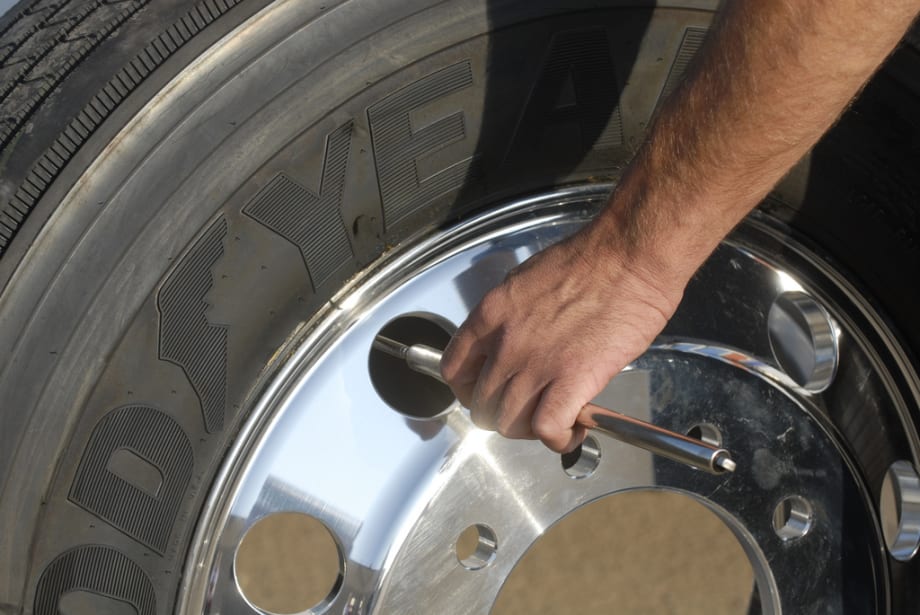
Buying fuel-efficient tires? Better make sure they're at the optimum inflation. (File photo: Goodyear)
Buying fuel-efficient tires? Better make sure they're at the optimum inflation.(File photo: Goodyear)
Al Cohn, director of new market development and engineering support for Pressure Systems International, is well-known in truck tire circles. After nearly 30 years with Goodyear and nearly another decade with PSI, he has probably forgotten more than many people know about truck tires.
We sat down with Al recently to gain some insight into a topic that's front and center with many fleets today: fuel-efficient tires. We asked about inflation pressure and how it relates to tire wear and fuel efficiency, and about the wisdom of paying more for a tire that doesn't last as long.
Q: We know that inflation pressure has a direct impact on rolling resistance and ultimately on fuel efficiency. Can you explain what happens to an underinflated tire and how that related to fuel economy?
Cohn: When a tire is underinflated, the width of the tire stays practically the same, but the length of the footprint changes dramatically. As a result, the footprint becomes a lot longer, you get more flexing in the sidewall, and when you get more rubber on the road that equates to higher rolling resistance -- which is bad for fuel.
That longer footprint could equate to about 18% more rubber actually in contact with the road. For line-haul type operations the magic number is kind of like 5, that's the ratio for the amount of rubber, or rolling resistance, to fuel economy. So 18% more rubber meeting the road equates to about 3% worse for fuel economy if you were 30% under-inflated.
If you look at the numbers from all the companies, various tire surveys, and all the work we've done over the years, we have found that 10% under inflation is pretty common. If you’re 10% underinflated, it will cost you somewhere between 1% and 1.5% in fuel consumption.
Q: Worst case scenario: The fleet is really sloppy in its maintenance and tire pressures are all over the place. How much money is that fleet wasting in not looking after its tires?
Cohn: If you assume that all the tires are under-inflated by say 30%, that would equate to about 3% in fuel economy. And 3% for a fleet is a huge number. I always like to use the example, you’ve got 100 trucks and they go 100,000 miles per year. If you start doing the math on that, you need 16,667 gallons of fuel at 6 mpg, and at 2% worse, that means you get 5.88 mpg, and you figure out the fuel and another several hundred gallons per year, per truck. At $4 per gallon times 100, you’ve got big numbers all of a sudden.
Q: Getting back to the tire footprint for a moment, if you’re putting 18% more rubber on the road it’s also going to be chewing the tire up faster too, no?
Cohn: Absolutely, you’re going to generate a lot of uneven wear. And that’s what is going to cause the early tire removals.
Q: One question that comes up a lot when I’m talking to people about inflation pressure; they’ll refer to the load and inflation charts and say for a typical tandem weight 4,250 pounds per tire, the minimum pressure would be something in the 75-80 psi range, depending on the tire. Fleets typically run their drive and trailer tires at around 100 psi. What I’m told is margin of error keeps the tire from becoming under-inflated. What’s the penalty for going the other way, say to 125 psi. What happens to the tire then?
Cohn: Actually the fuel economy is better at the higher pressure, but you now have an issue with traction. You have a smaller footprint, which is good for rolling resistance but bad for traction. It’s like when you go to the beach and you’re in a sand dune buggy and they lower the pressure in the tires because the lower the pressure, the more traction. So one of the biggest concerns with over-inflating, number one is the drivers hate it because you’re bouncing all over the highway and it’s bad for the ride. And secondly, you have a drop in the traction. So in an emergency maneuver when you really have to stop, it’s going to take you another 50 feet to stop. Now it's a safety problem.
Q: So overinflating, like underinflating, also changes the footprint of the tire?
Cohn: When you over-inflate, the footprint gets a little smaller, but the biggest impact though, especially on trailers, is the loaded vs. unloaded conditions. Because you’re spec'ing the pressure based on the loaded worst case scenario, that’s why they choose 90 or 100 psi. In reality, 50% of the time in many cases, they’re empty. So when you’re empty, I mean it’s great for rolling resistance and fuel economy, but the tire is going to develop all kinds of issues, uneven wear, because you’re bouncing up and down the highway.
So the ultimate solution is central tire inflation system like the military uses, but that’ll never happen in trucking.
But that’s really the big thing, the footprint. If you look at the footprint of a dual tire when loaded to 4,250 pounds compared to the footprint when the trailer is empty and the tire is supporting maybe 1,600 pounds -- the shoulder isn’t even touching the ground. What happens is the shoulder, since it’s not touching the ground, it generates all this cupping and shoulder wear and all this other stuff.
Q: Where does the magic number of 100 psi inflation pressure come from when the load and inflation tables tell us drive and trailer tires need only about 75 or 80 psi?
Cohn: The reason they choose that higher, typically 100, magic number is mostly because you want to have one number that's easy for the mechanics and easy for the drivers to remember. Plus, when it comes to trailers, you may only see them once a year for an annual PM. So that’s why 100 psi comes into play. If you lose a couple pounds per month just through osmosis, you’re back at that 75 number soon enough.
More Fuel Smarts

How Volvo Updated Its D13 for EPA 2027 [Watch]
Volvo’s updated D13 promises lower emissions without sacrificing performance or fuel economy. Take a closer look at what changed inside the engine in this HDT Spotlight video.
Read More →
Diesel Price Spike Shortens Payback for Natural Gas Trucks, Report Says
Energy Vision estimates fleets could recover the higher purchase price of an RNG-fueled Class 8 tractor in 1.3 to 2.8 years under current fuel-price scenarios.
Read More →
Calstart Becomes Catalyst Mobility, Reflecting Broader Focus
Calstart is now Catalyst Mobility, reflecting the nonprofit’s growing national role in clean transportation, including zero-emission trucks, infrastructure and incentive programs.
Read More →

Record Diesel Prices Squeeze Trucking Fleets
Average U.S. diesel prices have climbed to nearly $6 a gallon, surpassing the 2022 record as tight refinery capacity and Middle East disruptions keep fuel costs elevated.
Read More →
How Fuel Delivery Shapes Engine Performance
Fuel delivery depends on more than what happens at the injector. For fleet, maintenance and technical professionals, looking at the full path from pump to injector can provide useful context for understanding engine performance.
Read More →
East Coast Port Launches $45M Electric Truck Push
The Port Authority of New York and New Jersey announced millions in incentives for zero-emission drayage trucks, yard tractors, and new charging hubs near the port.
Read More →
California Bill Could Shed Light on Electric Truck Prices
Why do battery-electric Class 8 trucks remain so expensive? A California bill headed to Gov. Gavin Newsom would give fleets and state agencies more visibility into what manufacturers charge.
Read More →
Detroit Opens Orders for EPA 2027 Engines
Detroit isn’t starting from scratch to meet EPA 2027 diesel emissions standards. Its Gen 6 DD13 and DD15 engines keep much of today’s platform while updating the fuel and aftertreatment systems.
Read More →
Zero-Emission Truck Corridor Planned for West Coast
California, Oregon, Washington, British Columbia and Baja California are coordinating plans for truck charging and hydrogen fueling from Canada to Mexico.
Read More →
A Closer Look at Kenworth’s Electric T880E Vocational Truck [Video]
Learn more about Kenworth's T880E battery-electric vocational truck at the Paccar Technical Center, including its range, applications, upfitting considerations, and PTO options, in this HDT Spotlight video.
Read More →