If you look at balancing from a life-cycle point of view, the value of extending tread life speaks for itself. There’s also casing integrity to consider, retreadability, and to a growing degree, and disposal costs. Yet reliable estimates suggest only about 20% of heavy-duty truck tires are ever balanced.
In the absence of any hard statistics, reliable estimates suggest only about 20% of heavy-duty truck tires are ever balanced.
That math suggests steer tires are the most likely candidates for balancing, and the reasons are fairly intuitive. Steer tires seem to exhibit balance-related irregular wear more rapidly than drive or trailer tires, and if there’s a balance issue drivers will notice the vibration and complain about it.
Ad Loading...
On top of that, distributors of premium-brand tires will tell you that modern manufacturing processes are so exacting that their tires do not need to be balanced. While that’s probably true, it’s only part of the story. You’re not balancing the tire alone.
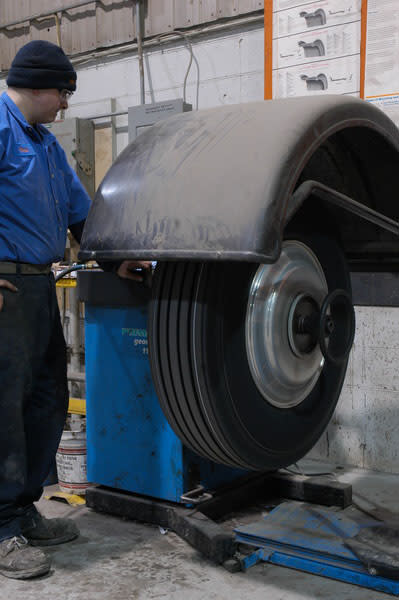
The aim is to balance the entire rotating mass that’s mounted onto the axle spindle, including the hub, brake drum, the wheel and, of course, the tire. When new, the tire may not need balancing, but as rubber wears off the tire, it seldom comes off evenly, especially if irregular wear – however caused – is present.
Continuous lifetime balancing keeps the entire wheel-end assembly in balance as long as some balancing medium is present.
The problem with tire weights, according to Mike Beckett of MD Alignment in Des Moines, Iowa, is that balancing a wheel when new often doesn’t account for irregularities in the hub and brake drum, and it certainly doesn’t adjust for tire wear.
“Correct balance derived using wheel weights gets you a single-point-in time balance,” Beckett says. “If some other problem produces uneven wear, the balance of the tire will change, but the weights won’t.”
Ad Loading...
According to Robert Coolidge, president of Centramatic, wheels using fixed weights need to be balanced repeatedly over the life of the tire.
“Balancing isn’t something a fleet will do every time a tire is changed or a flat is repaired,” he says.
“I’ve heard that it’s recommended that tires be rebalanced every 20,000 miles, but that’s just not practical. I know some fleets that do it at 50,000, but they are the exception.”
If a wheel assembly were rebalanced regularly, it would probably wear better – barring other wear-inducing problems, such as poor alignment. The better brands of internal, or in the case of Centramatic, external, balancing compounds can maintain proper balance over the life of the tire, because the medium is free to move about the tire and react to high and low areas of imbalance.
If you look at balancing from a life-cycle point of view, the value of extending tread life speaks for itself. There’s also casing integrity to consider, retreadability, and to a growing degree, and disposal costs. Yes, there’s an upfront cost to balancing, but it’s more than offset in the long run – if you take the right approach from the start.
Learn how to diagnose complex electrical and drivability issues with confidence using the Autel MS909CV, a digital storage oscilloscope, and real-world engine data in this hands-on virtual introduction to advanced commercial vehicle diagnostics.
In today’s cost-conscious market, fleets are finding new ways to get more value from every truck on the road. See how smarter maintenance strategies can boost uptime, control costs and drive stronger long-term returns.
America’s Service Line adopted Link’s SmartValve and ROI Cabmate systems to address whole-body vibration, repetitive strain, and driver turnover. The trucking fleet is already seeing measurable results.
Fleetio’s analysis of 1.2 million commercial vehicles finds older assets driving outsized service spend, while most fleets remain cautious on AI adoption.
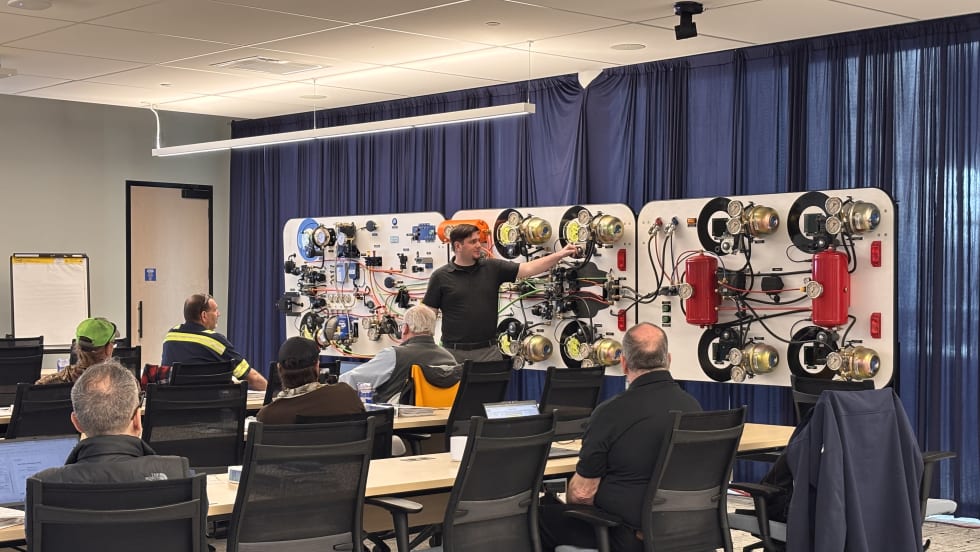
Bendix Commercial Vehicle Systems will roll out its 2026 technical training calendar with expanded access to its Advanced Technology Training program, alongside its long-running Air Brake Training course.
After reports of corrosion and thermal events on trucks already repaired under a prior campaign, DTNA is recalling nearly 27,000 Western Star 47X and 49X models to address a battery junction stud defect.
This white paper examines how advanced commercial vehicle diagnostics can significantly reduce fleet downtime as heavy duty vehicles become more complex. It shows how Autel’s CV diagnostic tools enable in-house troubleshooting, preventive maintenance, and faster repairs, helping fleets cut emissions-related downtime, reduce dealer dependence, and improve overall vehicle uptime and operating costs.
Brakes are the final frontier for telematics on Class 8 trucks. But Hendrickson is close to a breakthrough that could change the game in getting real-time brake system information back to fleets.