Negligence and apathy consign more tires to early graves than road hazards ever will. Here are the Top 5 reasons you might be straining your tire budget to the breaking point, and how you can stem the financial hemorrhage.
How many tires in your scrap pile arrived there before their time?
5 min to read
How many tires in your scrap pile arrived there before their time?
Negligence and apathy consign more tires to early graves than road hazards ever will.
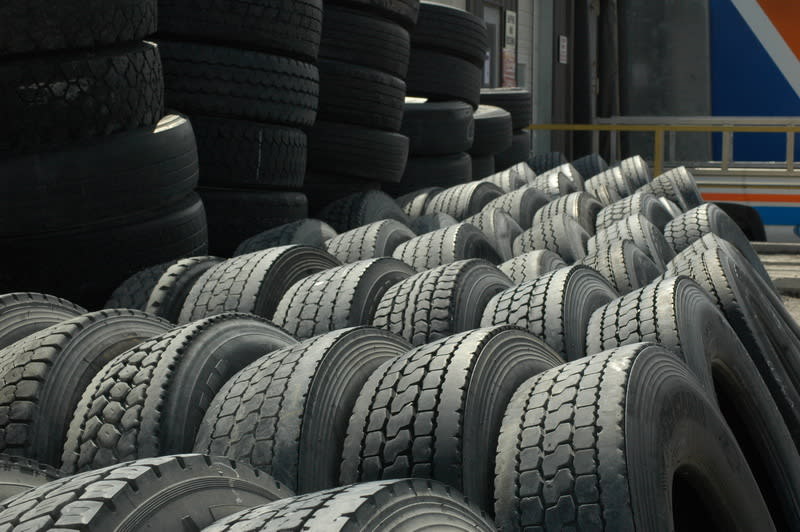
An inspection of almost any tire scrap pile will show most of the tires in the pile with a good portion of useable tread still on them died because of neglect. Irregular wear, mechanical problems, even mis-matched dual tires or inflation pressures across two tires in a dual assembly have tell-tale signs, and too often those sign are ignored until it's too late to salvage the tire.
Ad Loading...
Here are the top five reasons you might be straining your tire budget to the breaking point, and how you can stem the financial hemorrhage.
1. Under-Inflation
"You don't go from properly inflated to a blowout instantaneously unless you hit something on the highway," says Curtis Decker, manager of product development at Continental Tire. "We estimate that about 80% of the roadside tire failures are a direct result of creeping air loss."
In other words, 80% of blowouts could be prevented if tires were kept properly inflated.
The chief cause of under-inflated tires is lack of basic maintenance. Tire pressures need to be checked at a minimum on a weekly basis. While acknowledging that's almost impossible in fleets that have trailers hidden in drop-yards all around the country, some inexpensive technology can alert drivers to under-inflated tires before driving away with one -- and with telematics, alert fleet managers. Or better still, automatic inflation systems can re-inflate low tires before they leave the drop yard.
A recent DOT roadside tire survey found some significant tire pressures problems that fleets could remedy fairly easily and inexpensively.
Ad Loading...
56% of tires are 5 psi off target pressure
22% of dual sets are mismatched by 5 psi or more
22% of vehicles have one tire under-inflated by 20 psi or more
41% of fleets surveyed report inflation problems when picking up spotted trailers
Don't lull yourself into thinking your fleet doesn't have those problems too.
2. Out of Sight, Out of Mind
Following on the previous item, fleets that don't see their trailers regularly have more tire problems that fleets that can perform regular preventive maintenance and tire pressure checks. Herman Miller, president of HJM Fleet Management based in Green Bay, Wis., says trailers are the classic example.
"A lot of the big companies have problems seeing their trailers to get an annual inspection done on them; monthly or weekly maintenance is almost out of the question," he says. "They can’t do the job of tire maintenance they’d like to because they don’t see their equipment often enough."
Among the possible solutions are outsourcing equipment maintenance to a local service provider, providing on-board or remote tire pressure monitoring or automatic inflation systems. Any of those are a better prospect than beseeching your driver to check tire pressure before pulling seldom-used trailers out onto the highway.
Ad Loading...
3. Mechanical Problems
Mis-matched dual tires kill two tires for the price of one.
Here, we'll include problems lying somewhere other than with the tire itself, even though the tire will bear the brunt of the damage. Any condition that prevents the tire from running straight and true, and making constant and consistent contact with the pavement, will cause accelerated wear. It will often occur in patterns on the tire that can aid in diagnosing the problem.
Misalignment is responsible for a high percentage of premature wear, but it can come in many forms: drive axles out of alignment or bad steering geometry for example. Take feather wear across a rib steer tire tread. Feathering is when the ribs wear from high to low across each rib. If the feathering pattern is identical across both steer tires, suspect drive axle or chassis misalignment. If the feathering patterns are in opposite directions, suspect a toe-in or toe-out condition.
Loose wheel bearings, bent axles, or axles that flex excessively can cause rapid wear of the inner shoulder of the inner tire on a dual wheel. Worn shock absorbers will allow a tire to bounce more than it should, affecting the contact patch of the tire. Since that type of defect is random in nature, watch for irregular patterns of localized cupping or a scalloped appearance.
TMC's RP 219B, Radial Tire Wear Conditions and Causes: A Guide to Pattern Analysis, is an excellent resource in diagnosing tire wear problems. It's available through the Technology and Maintenance Council of the ATA.
4. Induced Flaws and Failures
Tires are often damaged through neglect or inattention. Running mismatched tires in a dual assembly is an easy way to kill two tires for the price of one. The larger diameter tire will bear more than its share of the load, which will ultimately damage the sidewall. Because of the differential in diameter and revolutions per mile between the two mismatched tires, the tread on the smaller tire will scrub off very quickly.
Ad Loading...
"While that may not sound like much, a diameter mismatch of just 5/16 inch, means the larger tire will drag the smaller one a distance of about 13 feet for every mile, or 246 miles for every 100,000 miles," says Guy Walenga, director of engineering for commercial products and technologies at Bridgestone Bandag Tire Solutions.
Many fleets don't bother at all with tire and wheel balancing. If they do, they'll probably do only the steer tires -- and mostly to avert driver complaints about vibration. Many argue that given the quality and consistency in tire manufacturing today, balancing is hardly necessary, but that doesn't take into account the rest of the hardware spinning around on the axle spindle.
Peggy Fisher, a highly regarded tire expert and president of TireStamp, says a properly balanced tire will wear more evenly over its life, so there are advantages to taking the extra step, if only because it's cheap insurance.
"Unless you have a flat spot from a skid, or something mechanical goes bad that causes the tire to run irregularly, in most cases, if it's left to its own devices, and if it was mounted correctly and balanced, it should run okay," she notes. "But if a fleet is really interested in getting every last 32nd of an inch out of a tire, they'll balance."
5. Improper Tire Selection
"One of the easiest ways to 'kill a tire' is by running it in the wrong application. Running truck tires not suited for a specific application is a sure way to reduce the tire's effectiveness," says Michelin's product marketing manager, Don Baldwin.
Ad Loading...
If a truck runs approximately half of its operation time in an off-road environment, but the tires are strictly on-highway tires, that presents a potential tire-killing situation. Taking advantage of an application-specific tire will greatly help with the tire's -- and ultimately the vehicle's -- performance and productivity.
Learn how to diagnose complex electrical and drivability issues with confidence using the Autel MS909CV, a digital storage oscilloscope, and real-world engine data in this hands-on virtual introduction to advanced commercial vehicle diagnostics.
In today’s cost-conscious market, fleets are finding new ways to get more value from every truck on the road. See how smarter maintenance strategies can boost uptime, control costs and drive stronger long-term returns.
America’s Service Line adopted Link’s SmartValve and ROI Cabmate systems to address whole-body vibration, repetitive strain, and driver turnover. The trucking fleet is already seeing measurable results.
Fleetio’s analysis of 1.2 million commercial vehicles finds older assets driving outsized service spend, while most fleets remain cautious on AI adoption.
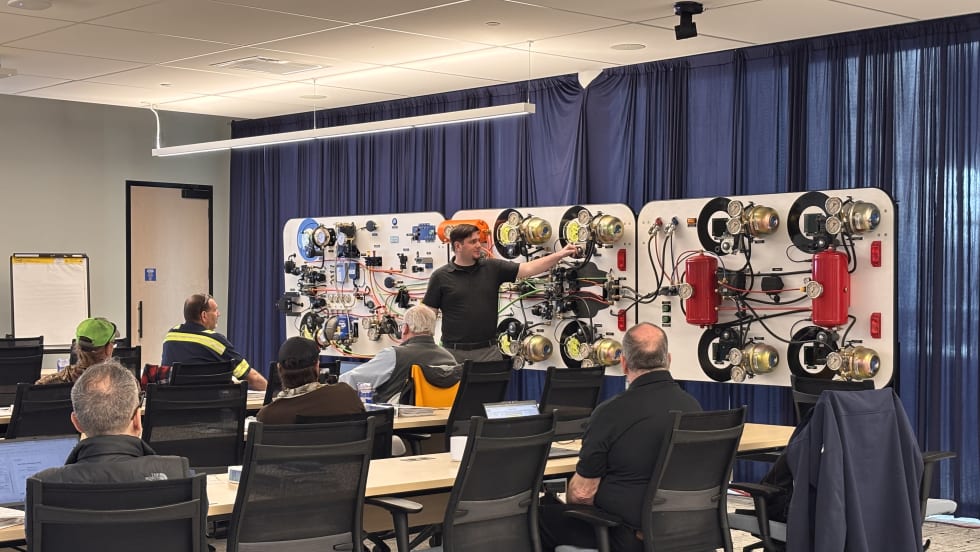
Bendix Commercial Vehicle Systems will roll out its 2026 technical training calendar with expanded access to its Advanced Technology Training program, alongside its long-running Air Brake Training course.
After reports of corrosion and thermal events on trucks already repaired under a prior campaign, DTNA is recalling nearly 27,000 Western Star 47X and 49X models to address a battery junction stud defect.
This white paper examines how advanced commercial vehicle diagnostics can significantly reduce fleet downtime as heavy duty vehicles become more complex. It shows how Autel’s CV diagnostic tools enable in-house troubleshooting, preventive maintenance, and faster repairs, helping fleets cut emissions-related downtime, reduce dealer dependence, and improve overall vehicle uptime and operating costs.
Brakes are the final frontier for telematics on Class 8 trucks. But Hendrickson is close to a breakthrough that could change the game in getting real-time brake system information back to fleets.