





Compared to, say, slopping out a hog barn, checking tire pressure is a hoot. No wonder drivers take so readily to the task.
Ask a few drivers why they are loath to contribute to the tire maintenance effort and you're likely to get answers such as, "I'm a driver, not a mechanic," and "They don't pay me to do it, so I'm not doing it."
Some might be inclined to grab a pressure gauge occasionally if they have a bit of time on their hands, or if a tire looks low. But for the most part, hoping or expecting drivers to regularly check tire pressures is like looking under your pillow for a quarter each time you lose a tooth.
You could provide incentives to encourage drivers to check their tires, but few will take you up on the offer.
"Those that do probably won't do it even though they'll tell you they did," says Darry Stuart, president of DWS Fleet Management Services. He says there's just no value or advantage in trying to encourage or coerce drivers into playing a more active role in tire maintenance.
"Do pressure checks at PM time and track the tire's pressure history," he advises. "You can do yard checks, but you don't have to check every tire. Treat it like an audit and get a sample of the fleet's tire pressures and you'll know how well your tire maintenance program is working. If need be, step up the intervals. If you don't have to, don't."
Stuart says fleets absolutely should be doing pressure surveys to identify problems. Trying to get drivers to keep tires properly inflated isn't worth the effort or potentially the cost, he says. "You're going to check those tires again during the survey, so you're duplicating the effort."
That's not to say you should discourage drivers from checking tire pressure. Just make sure they are working for you, not against you.
Our way or the highway
During the annual meeting of the ATA's Technology & Maintenance Council earlier this year, Peggy Fisher, president of Tire Stamp Inc. and a recognized expert in commercial truck tires, shared a story that shocked and amused attendees.
"There's some guy on the trucking radio channels who fancies himself as tire guru. He has been heard saying drivers should inflate their tires to 140 psi to improve their fuel mileage," she said. "If you have drivers on fuel incentive programs, you might want to check your tire pressures.
Driver training obviously plays a role here. James Husted, director of maintenance with Garner Transportation Group of Findlay, Ohio, goes over company policies with every new hire. He speaks at most driver meetings about some maintenance-related driver responsibility.
"We'd obviously like to see them take some responsibility for the equipment, but nothing we have tried has had a lasting impact," he says. The best you can do is inform them of company policies regarding equipment condition and hope they take it to heart. It's also useful to tell them what tire pressures should be and what type of make-up oil we use, for example. We'd like them to stick as close to our maintenance routine as possible."
Penske Leasing stencils recommended tire pressures right on the vehicle to advise anyone who might take a pressure gauge to the truck what the cold pressure should be.
Other fleets use "reverse incentive" programs to keep drivers honest.
"Punitive measures are intended to ensure drivers do not operate any vehicle in a way that would damage the tires," says Doug Jones, customer engineering support manager, Mi-chelin Americas Truck Tires. "In these fleets, when a tire does come out of service, a determination is made as to whether the driver was at fault for the tire's removal. If the driver is at fault, action can be taken, including charging the prorated value of the tire to an owner-operator."
Technology to the rescue
Husted says he's tried everything from encouragement to coercion, with little success. Ditto for incentives. At the end of the day, he says technology is the best solution.
"We've schooled our drivers and trained our drivers, but there are still issues with getting drivers to do tire pressure checks on a daily basis."
Tire inflation systems and tire pressure monitoring systems are near-guaranteed to keep tires properly inflated, or at least keep you in the loop regarding tire condition. Most systems now include a telematics component that sends alerts to fleet HQ. They can then advise the driver on next steps.
"I don't want to leave that decision up to the driver," says Carl Tapp, a maintenance consultant and recently retired vice president of maintenance at P.A.M. Transport of Tontitown, Ark. "He has nothing [invested] in the tire, but he knows that stopping will cost him time and money, and maybe a missed appointment. I need to know that I have a tire issue so I can advise the driver how to proceed."
While those solutions may come closer to perfection than throwing a bone to a driver so he'll check pressure more frequently, Stuart says perfection usually isn't worth the effort.
"If you can manage to keep tire pressures within 10 psi of your target pressure, you're doing good, and that's good enough in this game," he says. "Truck maintenance isn't about perfection anyway. It's like a game of horseshoes. You win by being close enough."
Clearing up pressure problems
Have you ever wondered what proper inflation is? How about what exactly is under-inflated?
You need to know two numbers related to commercial truck tires: the tire load limits at various inflation pressures and the maximum tire inflation pressure.
The latter is easy; it can be found stamped onto the sidewall and can vary from tire to tire. The rim also will have a maximum (not to exceed) inflation rating.
The load rating for a given pressure is another matter.
Each tire manufacturer publishes Load & Inflation tables for its product line, illustrating the maximum load you can put on a tire at a given pressure. You'll find most single tires in a dual setup can be run at between 75 and 80 psi under a fully loaded tandem axle (34,000 pounds).
For example, Bridgestone's tables indicate a 275/80R/22.5 tire in dual configuration can handle 4,540 pounds at 80 psi. With eight tires on the tandem group, you'd have maximum axle-group load of 36,320 pounds. At that rating, you'd have a few psi grace before a tire was in an overloaded/ under-inflated situation (in tires, the two terms are synonymous).
Michelin's tables indicate the minimum pressure for such a tire loaded to 4,300 pounds would be 75 psi (8x4,300 = 34,400 pounds).
On a steer axle in single configuration, each tire would need to support about 6,000 pounds-assuming a maximum axle loading of 12,000 pounds. To get that minimum inflation pressure, Goodyear's tables recommend 105 psi for a tire load of 6,225 pounds. Bridgestone, on the other hand, calls for 110 psi for a maximum tire load of 6,175 pounds.
In each case, the maximum legal load on the axle can be safely borne by the tire with a little wiggle room.
So why do we run dual tires at 100 psi or so when we can get away with 75 or 80 psi?
"Margin for error," saysTire Stamp's Peggy Fisher. "Ask yourself, how good is your tire maintenance? Can I afford to lose a few psi without risking a tire failure? How many pressures do you want me to remember? For those reasons and others it's simply safer and more convenient to run a higher pressure than what is absolutely required by the heaviest load you're likely to put on the axle and tire."
So more is better?
Only to a point, Fisher says.
"The tire's upper limit is its maximum pressure rating. Tires heat up in service, and pressure increases inside the tire. At 100 psi cold, you've got some room. If you're over-pressured to start, you could exceed the maximum inflation limit as the pressure rises with temperature."
Over-pressured tires are subject to specific wear patterns, such as shoulder scrubbing and wear on the tread center.
"We hear of some operators over-inflating their tires in pursuit of better fuel economy," Fisher notes. "I suppose there could be something to that, but the improvement would be too small to notice compared to the risk to your tires."
Fisher says although fleets running 100 or so psi in a dual tire are safely above the tires' minimum inflation pressure requirements as per the inflation tables, under-inflated really doesn't begin to affect tire condition until it drops below the load and inflation table recommendations for a given load.
However, she notes, "Erring on the side of caution and margin is standard industry practice. If my desired tire pressure was 100 psi, I'd be concerned if the tire was found below 90 psi."
From the August 2012 issue of HDT
Diligent Drivers Can Help Improve Tire Maintenance
Compared to, say, slopping out a hog barn, checking tire pressure is a hoot. No wonder drivers take so readily to the task
More Maintenance
Advanced Commercial Vehicle Diagnostic Strategies
Learn how to diagnose complex electrical and drivability issues with confidence using the Autel MS909CV, a digital storage oscilloscope, and real-world engine data in this hands-on virtual introduction to advanced commercial vehicle diagnostics.
Read More →
Smarter Maintenance Strategies to Keep Trucks Rolling
In today’s cost-conscious market, fleets are finding new ways to get more value from every truck on the road. See how smarter maintenance strategies can boost uptime, control costs and drive stronger long-term returns.
Read More →
How One Company is Using Smart Suspension Technology to Reduce Driver Injuries and Improve Retention
America’s Service Line adopted Link’s SmartValve and ROI Cabmate systems to address whole-body vibration, repetitive strain, and driver turnover. The trucking fleet is already seeing measurable results.
Read More →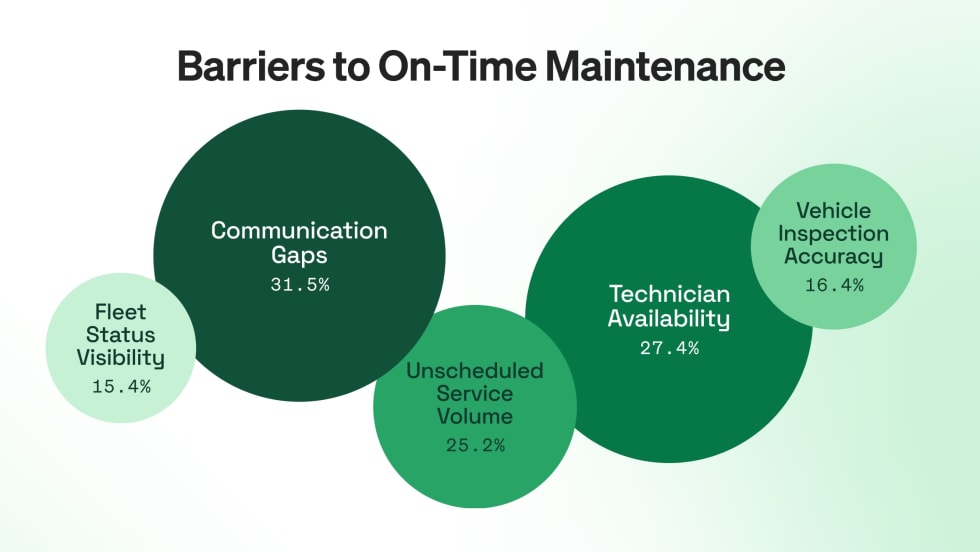
Fleetio Benchmark Report: Aging Vehicles, Rising Costs Strain Fleet Maintenance
Fleetio’s analysis of 1.2 million commercial vehicles finds older assets driving outsized service spend, while most fleets remain cautious on AI adoption.
Read More →
The Future of Class 8 Brake Telematics
Brakes are tough when it comes to telematics. But Hendrickson believes it is close to having a game-changing solution for fleets.
Read More →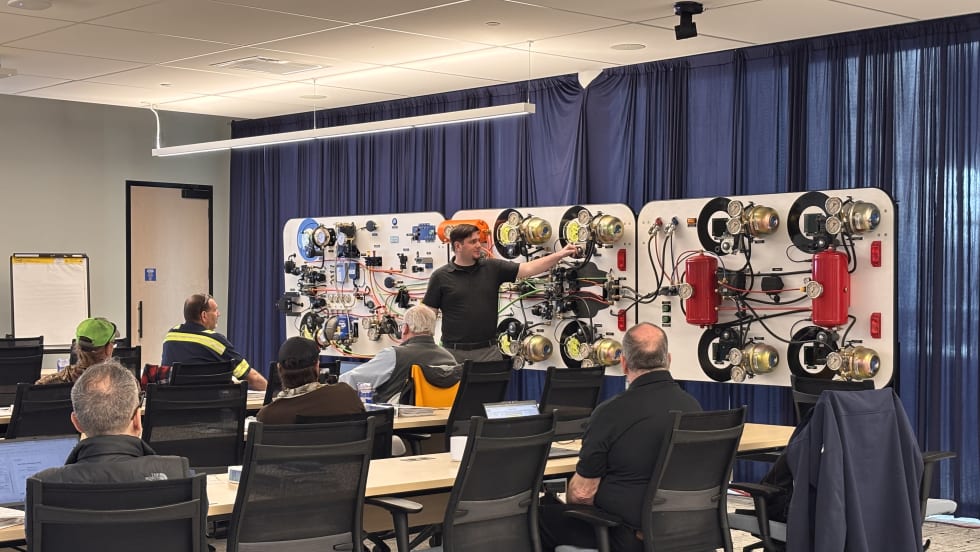
Bendix Expands 2026 Brake School Schedule with More Advanced Tech Training
Bendix Commercial Vehicle Systems will roll out its 2026 technical training calendar with expanded access to its Advanced Technology Training program, alongside its long-running Air Brake Training course.
Read More →
Western Star Expands Recall After Previous Battery Fix Fails to Prevent Fire Risk
After reports of corrosion and thermal events on trucks already repaired under a prior campaign, DTNA is recalling nearly 27,000 Western Star 47X and 49X models to address a battery junction stud defect.
Read More →
Reducing Fleet Downtime with Advanced Diagnostics
This white paper examines how advanced commercial vehicle diagnostics can significantly reduce fleet downtime as heavy duty vehicles become more complex. It shows how Autel’s CV diagnostic tools enable in-house troubleshooting, preventive maintenance, and faster repairs, helping fleets cut emissions-related downtime, reduce dealer dependence, and improve overall vehicle uptime and operating costs.
Read More →
Stop Watching Footage, Start Driving Results
6 intelligent dashcam tactics to improve safety and boost ROI
Read More →
Why Are Brake Telematics So Tough for Class 8 Trucks?
Brakes are the final frontier for telematics on Class 8 trucks. But Hendrickson is close to a breakthrough that could change the game in getting real-time brake system information back to fleets.
Read More →