




The 7 Steps to Selling Your Trucking Business
Nobody's going to buy your business if: a) it's unhealthy or b) they can just take it
Nobody's going to buy your business if: a) it's unhealthy or b) they can just take it.
John Holland works with the Plutus Consulting Group, where he specializes in helping business operators prepare their enterprises for sale and their proprietors for comfortable retirements and/or prosperous succession.
According to a study done by New York University that looked at more than 500 different businesses in 20 different countries, regardless of whether you want to sell your business or move it successfully from one generation to the next, the enterprise must pass through what Holland - and Plutus - term the Seven Stages of Selling your Business.
"Selling, retiring, having a real holiday, if you want to build your business to a level where you've got choices about how you want to spend your life, you need to go through the seven stages," he said.
In step one, Holland says, you're full of energy and engaged in making money on a day-to-day basis. "You're not actually thinking about how to grow the business; you're working 24 hours a day, you're really in the cornflakes and you're fully engaged."
Many owner-operators, he says, remain in stage one so no matter how much money they earn, they will probably never be wooed by corporate suitors and neither will they be able to watch the company move into the next generation's hands. In stage one, very often the company book keeper is a spouse and far too much business is conducted on an informal basis.
To move out of stage one, Holland advises doing some organizing, planning and defining. "This should be easy especially for an owner-operator who has plenty of time behind the wheel to think about these things," Holland says.
"Procrastination is not a business strategy. And neither is hope. Hope is not a business strategy," he says.
The "vast majority" of small businesses are stuck in stage two, he says.
You will become mired down in this stage unless you determine exactly what it is that makes your business different from the competition and exploit that difference as much as you can.
"There is not a successful company out there that was not led by an expert. The owner must develop a real passion for the service and become an expert."
At this stage, Holland says, "the business starts to separate from the owner but its success is still very dependent on the founder's drive.
"Now there are quality controls being implemented by the owner," Holland says. "You have to know the costs of your trucks and how much revenue you expect to get from them over the course of a year and how much you're budgeting for profit."
Quality controls must apply to internal accounting procedures, budgeting and personal accountability.
If you've graduated to step three, your business is growing and you are its best sales person.
It's also at the most precarious stage. "I had a client who had $10 million in sales, he was 55, had a nice profitable business but he would never be able to retire early, even though he was doing well. He was stuck because he gave his people no opportunity to flourish or grow in their jobs. You have to start letting go.
"At this point you're having fun and making money and inviting new people into the sandbox but if you're not very careful, you can get sand in your eye and ruin everything," Holland says.
You should be working on the business more than in it.
"You know those people who hang around the water cooler and moan about how much better it was in the early years? When you're in stage four, you're going to have to have a talk with those people. Either they buy in or they're out.
"I call those people muddy fish because they don't want to help clear the water; they like it murky. I promise you the day the boss does something about them is the day morale will start to increase."
According to the Seven Stages, the company's orientation by now must be towards continuous improvement, and that means having performance monitoring and management systems place.
In stage five you're looking like a franchise. "Because the business is sustainable, it could outlive the owner," Holland says. In stage five, "you're starting to make the house shine," and a team other than the owner is handling the day-to-day running of the business." By this time, the people who work for you expect and get regular performance appraisals as well as non-monetary incentives and recognition.
You have a succession plan in place, and the company is actually replicable, like a franchise.
You might still be managing the business but if you wanted to step away, you are completely comfortable with your management team. While each individual member of that team is talented and valuable, the business will thrive even if they're all replaced.
The business has a strong balance sheet and operates in the black. Only now can the owner see the real possibility of an exit ramp. Suitors have probably already come calling.
By this time, everything is optimized. You've now got a brilliant management team ready to do an IPO or a management buyout. If a venture capitalist came into the company, they'll see all the right people in the right places. You run your trucks and your offices compliantly and follow regulations rigorously. Financial performance is consistently strong; products and/or services are known and respected. A legacy is born.
And if you decide to retire now or move along, you just call in your bankers and look for a buyer.
This article originally appeared in Today's Trucking and is used with permission.
More Fleet Management

How Telematics Improves Visibility, Control, and Performance in Refrigerated Fleets
Explore how telematics help refrigerated fleets improve visibility, uptime, efficiency, compliance, and cargo protection across connected cold chain operations.
Read More →
What the U.S.-Canada Trade War Means for Trucking
Escalating U.S.-Canada tariffs could disrupt cross-border freight, reduce truck volumes, raise costs, and create new uncertainty for carriers on both sides of the border.
Read More →
What Are Trucking’s Top Concerns for 2026?
The American Transportation Research Institute wants to know what's worrying trucking fleet managers, drivers, and other stakeholders in its annual Industry Issues survey.
Read More →

American Trucking Associations Looks for a New Leader
ATA President and CEO Chris Spear abruptly left his job at the association on August 21, at a pivotal time for the trucking industry.
Read More →
Public Wi-Fi Cybersecurity Risks: How Truck Drivers and Fleets Can Protect Their Data
Public Wi-Fi can expose truck drivers and fleets to credential theft, malware, and other cyber threats. Here’s how to reduce the risk on the road.
Read More →
For Nicky Cupp, Fleet Innovation Starts With Frustration
HDT Truck Fleet Innovator Nicky Cupp turns everyday pain points at Fraley & Schilling into opportunities for better technology and smarter processes.
Read More →
Adam Buttgenbach’s Approach to Electric Trucks: Start With Where They Fit
HDT Truck Fleet Innovator Adam Buttgenbach helped PepsiCo build one of North America’s largest EV fleets by focusing on where electric trucks make operational sense.
Read More →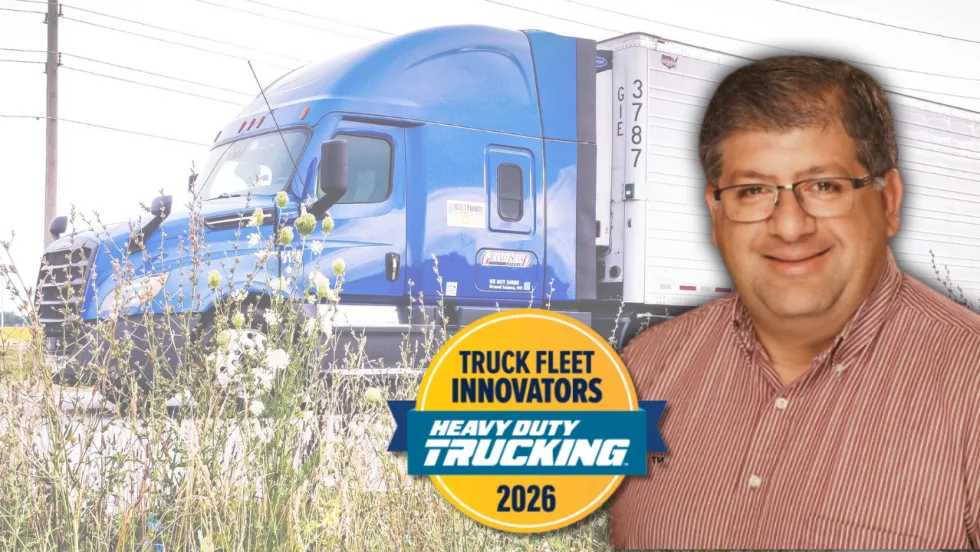
Deen Albert: Let Automation Do the Math, People Make the Decisions
HDT Truck Fleet Innovator Deen Albert makes sure people are still at the heart of operations at Grand Island Express, even while adopting artificial intelligence tools. AI-assisted dispatch helped boost revenue 25% with the same number of trucks.
Read More →
Trimble’s New AI Agent Takes Aim at Fleet Back-Office Busywork
Arc Agent works across Trimble TMS products to automate repetitive tasks such as freight orders, maintenance, invoices, fuel costs and more.
Read More →
How HDT’s 2026 Truck Fleet Innovators Are Rethinking Fleet Operations
Meet five trucking leaders who are challenging assumptions, solving operational problems, and putting innovative ideas to work.
Read More →