Spot Truckload Freight Rates Soar Along With Load-to-Truck Ratios
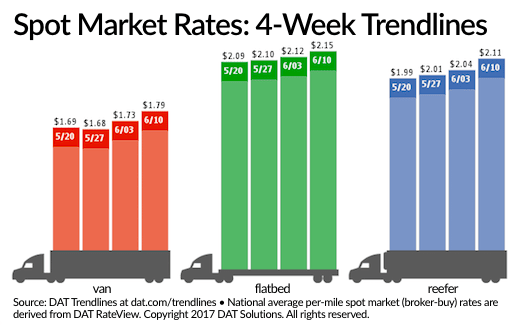
Average spot truckload freight rates jumped sharply for the second straight week in all three major equipment types while load-to-truck ratios also headed much higher for the week ending June 10, according to new figures from DAT Solutions and based on its network of load boards.
Evan Lockridge・Former Business Contributing Editor
June 14, 2017
Graphic: DAT
2 min to read
Graphic: DAT
Average spot truckload freight rates jumped sharply for the second straight week in all three major equipment types while load-to-truck ratios also headed much higher for the week ending June 10, according to new figures from DAT Solutions and based on its network of load boards.
Ad Loading...
The number of available loads was up 30% compared to the previous week, which was shortened by the Memorial Day holiday and included the annual Roadcheck truck inspection blitz. A 20% increase is more in line with expectations.
Ad Loading...
According to DAT, brokers and shippers paid a premium for capacity in most major markets and lanes. Load-to-truck ratios reflected the increased freight activity:
Van ratio: 5.7 loads per truck, up 12% from previous week
Reefer ratio: 10.1 loads per truck, up 33%
Flatbed ratio: 49.2 loads per truck, up 27%
Nationally, the number of posted van loads increased 12% while truck posts were 8% higher. The national average van rate gained 6 cents to $1.79 per mile. Outbound rates were up in almost every major van freight market:
Los Angeles: $2.28 per mile, up 10 cents
Chicago: $2.06 per mile, up 6 cents
Dallas: $1.76 per mile, up 3 cents
Charlotte: $2.16 per mile, up 11 cents
Philadelphia: $1.73 per mile, up 5 cents
Of the top 100 van lanes, only 26 had lower rates.
Ad Loading...
Reefer load posts increased 30% while truck posts fell 2%, which helped move the national average rate 7 cents higher to $2.11 per mile. California shipments are expected to stay strong at least through the Fourth of July, and a few lanes crossed the $3 mark:
Fresno-Denver surged 61 cents to $3.14 per mile
Los Angeles-Portland, Oregon, was up 45 cents to $3.33 per mile
Sacramento-Portland added 50 cents to $3.21 per mile
Sacramento-Salt Lake City rose 27 cents to an average of $3.00 mile
Florida outbound rates tumbled, including Lakeland-Charlotte, which plunged 84 cents to an average of $1.82 per mile.
In the flatbed sector, the load-to-truck ratio skyrocketed as load posts increased 38% while truck posts increased 9%.
The national average rate increased 3 cents last week to $2.15 per mile, the highest weekly average rate in nearly two years. Flatbed demand can be volatile and shifts on a lane-by-lane basis, according to DAT.
Ad Loading...
Key outbound flatbed rate movers last week include:
Las Vegas, $2.82 per mile, up 36 cents
Cleveland, $2.31 mile, up 11 cents
Harrisburg, Pennsylvania, $3.41 per mile, up 2 cents
Rates are derived from DAT RateView, which provides real-time reports on prevailing spot market and contract rates, as well as historical rate and capacity trends. All reported rates include fuel surcharges.
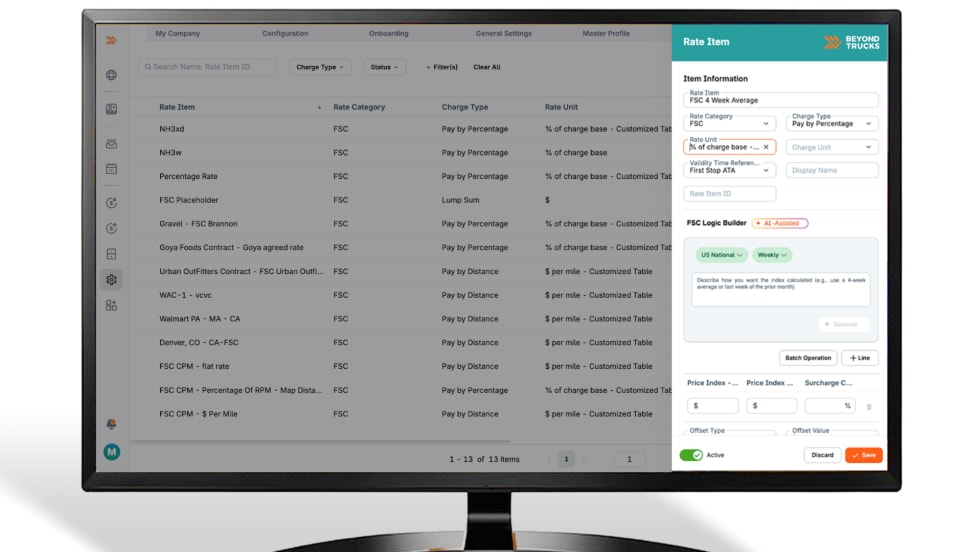
BeyondTrucks says its new RateAgents can turn plain-language rate logic into working code, starting with fuel surcharges — a critical but notoriously complex piece of carrier revenue.
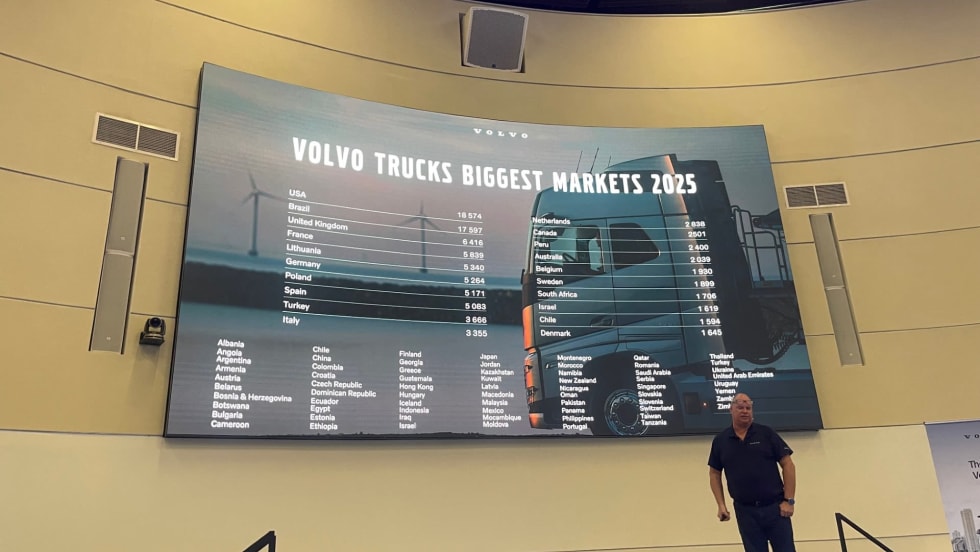
Soft freight conditions persist, but aging fleets, strong order intake, and new-product momentum signal a more optimistic second half of 2026, Volvo Trucks North America says.
Cargo theft is evolving from regional smash-and-grab operations to sophisticated fraud schemes. Strategic theft now accounts for roughly a third of cargo crime, with incidents rising sharply in recent years. Here’s how the schemes work — and what fleets can do to protect themselves.
Heavy Duty Trucking's Top 20 Products awards recognize the best new products and technologies. Check out the award presentations at the 2026 Technology & Maintenance Council annual meeting.
The Detroit® Gen 6 engine platform proves that real progress doesn’t require a complete redesign. Built on 20 years of trusted technology, these engines are designed for efficiency, stronger performance, and greater reliability than before. And they do it all while complying with 2027 EPA standards on every mile.
The 2026 ACT Expo is focusing heavily on what organizer Erik Neandross calls trucking's digital frontier. This interview excerpt dives into artificial intelligence, zero-emission vehicles, and tips to make sense of it all.
There's an amazing amount of new technology for trucking out there. For fleets, the challenge is figuring out what’s real, what’s hype, and what’s worth investing in.
Artificial intelligence, the software-defined vehicle, telematics, autonomous trucks, electric trucks and alternative fuels, and more in this HDT Talks Trucking interview
ACT Research data shows volumes hitting a four-year high and supply-demand balance strengthening, but higher oil prices are undercutting tariff relief and tempering optimism.
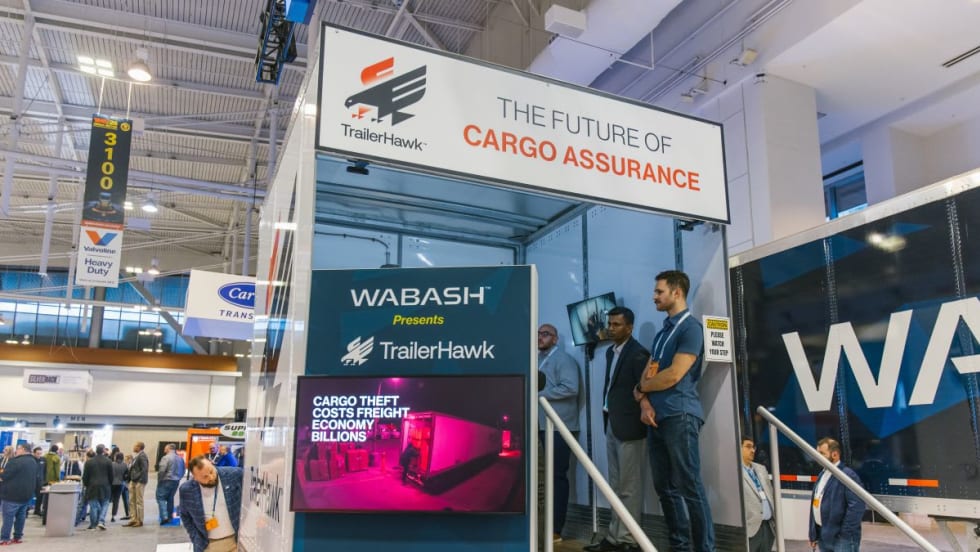
The patent-pending cargo solution integrates a digitally connected cargo door and an intelligent locking system with the TrailerHawk.AI technology platform.