




Self-Driving Robots: Delivery Fleet of the Future?
Starship Technologies, a new company launched by former Skype co-founders, will introduce fleets of delivery robots, which will have zero cost, zero waiting time and zero carbon dioxide emissions.
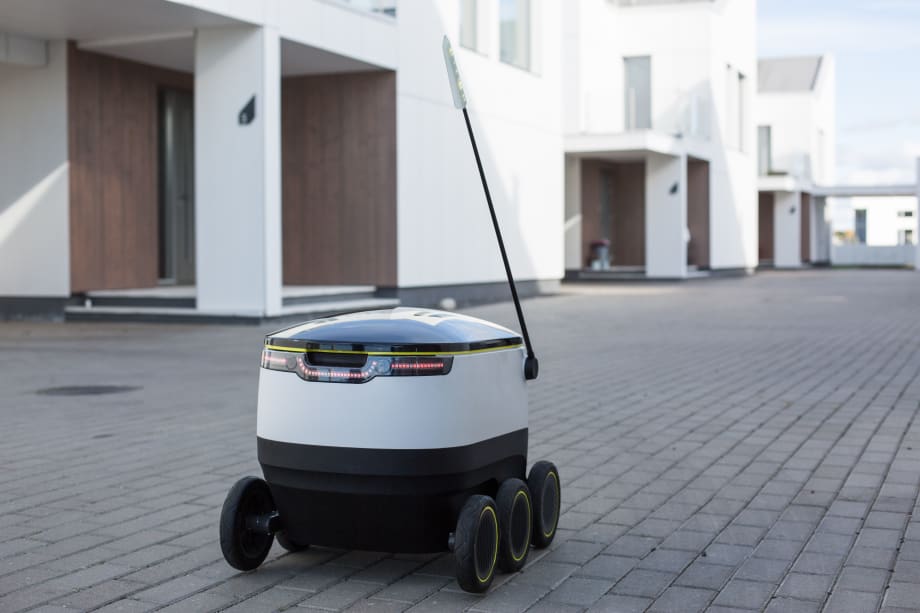
One of Starship Technologies' delivery robots. Photo via Starship Technologies.

One of Starship Technologies' delivery robots. Photo via Starship Technologies.
Launched by former Skype co-founders, Starship Technologies will introduce fleets of small delivery robots.
These robot fleets will open up new opportunities for businesses such as parcel delivery firms or grocery stores, according to the company.
“Our vision revolves around three zeroes — zero cost, zero waiting time and zero environmental impact,” said Ahti Heinla, a Skype co-founder and CEO at Starship Technologies. “We want to do to local deliveries what Skype did to telecommunications.”
Capable of carrying the equivalent of two grocery bags, the robots can complete local deliveries within five to 30 minutes from a local hub or retail outlet — for 10-15 times less than the cost of current last-mile delivery alternatives, according to the company.
Customers can choose from a selection of short, precise delivery slots — meaning goods arrive at a time that suits them. During delivery, shoppers can track the robot’s location in real time through a mobile app. And on arrival only, the app holder is able to unlock the cargo.
Integrated navigation and obstacle avoidance software enables the robots to drive autonomously, but they are also overseen by human operators who can step in to ensure safety at all times, says the company.
For businesses, Starship’s technology eliminates the largest inefficiency in the delivery chain: the last mile. Instead of door-to-door delivery, retailers can ship the goods in bulk to a local hub. Then the robot fleet completes the delivery to the shopper’s door for a fraction of the cost, according to the company.
“With ecommerce continuing to grow, consumers expect to have more convenient options for delivery — but at a cost that suits them,” said Heinla. “The last few miles often amount to the majority of the total delivery cost. Our robots are purposely designed using the technologies made affordable by mobile phones and tablets — it’s fit for purpose and allows for the cost savings to be passed on to the customer.”
The robots are intended to slip seamlessly and safely into the environment. “They travel at the slow speed of four miles per hour — a brisk walking pace,” said Heinla. “They don’t fly — these are not drones. They travel on pavements/sidewalks, blending safely in with pedestrian traffic.”
Starship Technologies is currently testing and demonstrating prototypes and plans to launch the first pilot services with its service partners in the U.S., U.K. and other countries in 2016, says the company.
More Fleet Management

Geotab Links Fleet Card to Vehicle Data
The new card combines fuel discounts with telematics-based purchase controls. Geotab’s analysis also points to potential savings from choosing lower-priced fuel stops.
Read More →
How MFA Helps Protect Trucking Fleets
Multi-factor authentication adds protection when passwords are stolen. Here’s how it works and where fleets should start.
Read More →
How Better Freight Data Helps Trucking Teams Get Ahead of Disruption
Trucking and logistics teams have plenty of data. The problem is getting the right information in front of the right people soon enough to act. Better-connected data can help teams spot trouble earlier and make smarter decisions before small problems become big ones.
Read More →

Trimble: Taking Artificial Intelligence in Trucking Beyond Faster Tasks
At Insight 2026, Trimble executives argued that fleets may need to redesign workflows to get more from AI as it introduced new products and enhancements. AI’s value will depend on how fleets combine automation with their people's knowledge.
Read More →
Build a bulletproof fleet: Uniting ELDs and dash cams for total compliance
An ELD can prove compliance, but it cannot always prove what happened on the road. Discover how uniting accurate ELD data with AI-powered dash cam video can help your fleet strengthen compliance, defend against liability, protect drivers and reduce operational costs.
Read More →
Nominations Open for HDT Emerging Leaders
Heavy Duty Trucking is looking for accomplished trucking fleet professionals under 40 who are making an impact and helping lead the industry forward.
Read More →
Why Private Fleets Are Taking More Freight
Private fleets are putting their own trucks on demanding customers and high-cost lanes as companies seek greater control over service, costs, and capacity.
Read More →
Color Match Smarter: Tools That Restore & Perform
For fleet managers and collision repair professionals keeping heavy-duty trucks on the road, getting the color right the first time isn't just about appearance — it's about efficiency, turnaround time, and bottom-line results. Discover how today's digital color tools are transforming the repair process from guesswork to precision.
Read More →
FMCSA Pauses Biennial-Update Enforcement Amid Motus Transition
Carriers whose updates were due on or after June 1 have more time, while FMCSA works to stabilize its new registration system and warns of phishing sites impersonating its new carrier registration system, Motus.
Read More →
2026 Blueprint for Countering Smarter Supply Chain Theft
Cargo theft is no longer just the cost of doing business. It's a multi-billion-dollar criminal enterprise exploiting vulnerabilities across your fleet, drivers, and supply chain.
Read More →