




NYC Adding Truck Side Guards to Protect Pedestrians, Cyclists
New York City will begin adding side guards to 240 of its medium-duty trucks that will prevent a pedestrian or cyclist from being caught under a vehicle during a collision, Mayor Bill de Blasio has announced.
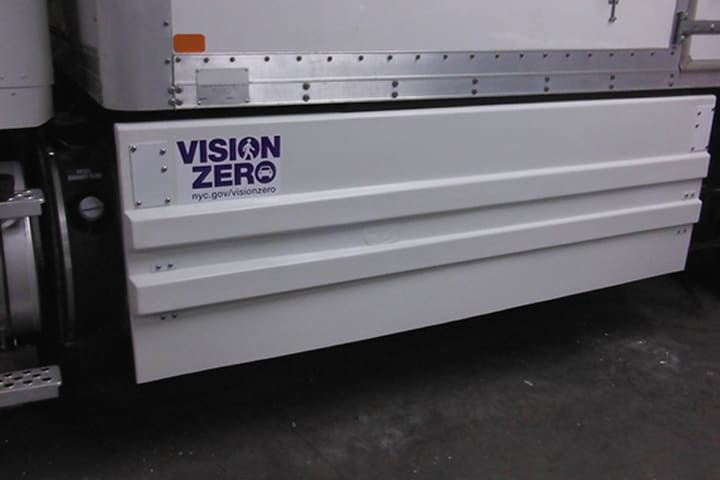
Photo of truck side guards courtesy of New York City.
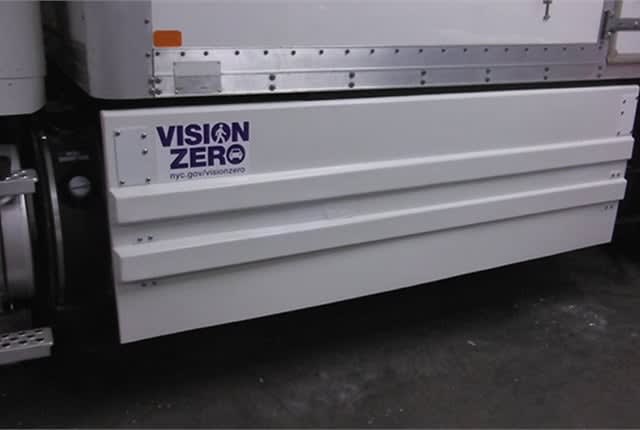
Photo of truck side guards courtesy of New York City.
New York City will begin adding side guards to 240 of its medium-duty trucks that will prevent a pedestrian or cyclist from being caught under a vehicle during a collision, Mayor Bill de Blasio has announced.
The initiative, which is part of the city's Vision Zero program, will initially bring side guards to 18 trucks; the city will retrofit the remaining 222 by the end of the year. The city operates a fleet of more than 27,000 vehicles.
"When we change the way we do business like this, it changes our streets for the better," said Stacey Cumberbatch, commissioner of the Department of Citywide Administrative Services. "DCAS is working in partnership with City agencies to improve safety for the public and our drivers including installing these life-saving side guards."
The city moved forward with the installation of the side guards after cyclist Hoyt Jacobs — a 36-year-old poet and Queens College adjunct professor — was struck and killed in Long Island City by a sanitation truck Jan. 17, said Council Member Ydanis Rodriguez.
"Last month, in response to the first cyclist death of 2015, I called upon our Mayor to install side guards on the City truck fleet in order to end these preventable accidents," Rodriguez said.
The guards cost about $3,000 each to purchase and install.
"Side guards have a proven record of preventing fatalities and injuries on the road and are a worthy investment of tax-payer dollars," said Council Member Julissa Ferreras, who chairs the finance committee.
The department began studying whether to install the guards in May, when it began a partnership with the Volpe Center at the U.S. Department of Transportation. The research included a review of international standards for side-guard use and exemptions, according to a city release. Volpe Center officials reviewed each city department's specific equipment, and issued a final report identifying 4,734 trucks eligible for the side guards. Trucks with a gross vehicle weight under 10,000 pounds were exempted.
As part of Vision Zero, DCAS has been tracking and analyzing collisions involving city vehicles. The city has expanded its defensive driving training and has installed telematics systems on city vehicles to better monitor driving behavior.
More Safety & Compliance
PrePass, Kodiak Connect Driverless Trucks to Roadside Enforcement
The system will allow enforcement agencies to verify Enhanced Inspection information and decide whether Kodiak’s autonomous trucks can bypass roadside screening sites.
Read More →
From One Generation to the Next: How Mentorship Builds Safer Truck Drivers
After three decades in trucking, Harold Perry shares what he's learned about driver safety, mentorship, and helping the next generation build confidence behind the wheel.
Read More →
FMCSA Pauses Biennial-Update Enforcement Amid Motus Transition
Carriers whose updates were due on or after June 1 have more time, while FMCSA works to stabilize its new registration system and warns of phishing sites impersonating its new carrier registration system, Motus.
Read More →
ZF Expands Commercial Vehicle Push in North America
ZF is expanding its North American commercial-vehicle presence with new transmission applications, electrification, trailer technology and autonomous-driving systems.
Read More →
Truck Drivers Need More Than Another Alert
Fleets have more visibility into truck health, safety events, and driver activity than ever. The next challenge is turning all that information into useful guidance for the person who has to decide what to do next.
Read More →
Tesla Wants a Self-Driving Semi. Are Cameras Enough?
Could Tesla’s camera-only autonomous driving technology work on an 80,000-pound Semi? In this commentary, HDT's Deborah Lockridge takes a look at Tesla, Cybercab, and how autonomous trucks see the road.
Read More →
What DOT’s Automated Vehicle Strategy Means for Trucking
The U.S. Department of Transportation issued a new automated-vehicle strategy that outlines plans for driverless-truck regulations, cross-state freight corridors, and federal safety standards.
Read More →
NYC Expands Speed, Pedestrian Safety Tech Across Fleet
New York City is expanding intelligent speed assistance and pedestrian-alert systems across its municipal fleet, moving the technologies from pilot programs into vehicle procurement and retrofit requirements.
Read More →
FMCSA Removes 110 Truck Driver Training Schools from Certified ELDT List
Federal regulators also are targeting more than 160 additional training providers and launching a nationwide audit of third-party CDL skills testers as part of a broader crackdown on trucking fraud.
Read More →
Beyond DOT Compliance: What Makes a Trucking Fleet Truly Safe?
A trucking fleet can follow every rule and still make unsafe decisions. The real test comes when safety conflicts with freight, productivity, or cost.
Read More →