




ATA Applauds Tennessee Predatory Towing Law
The American Trucking Associations is voicing support for a new law that will address abuses made famous by a Memphis towing company that became national news.

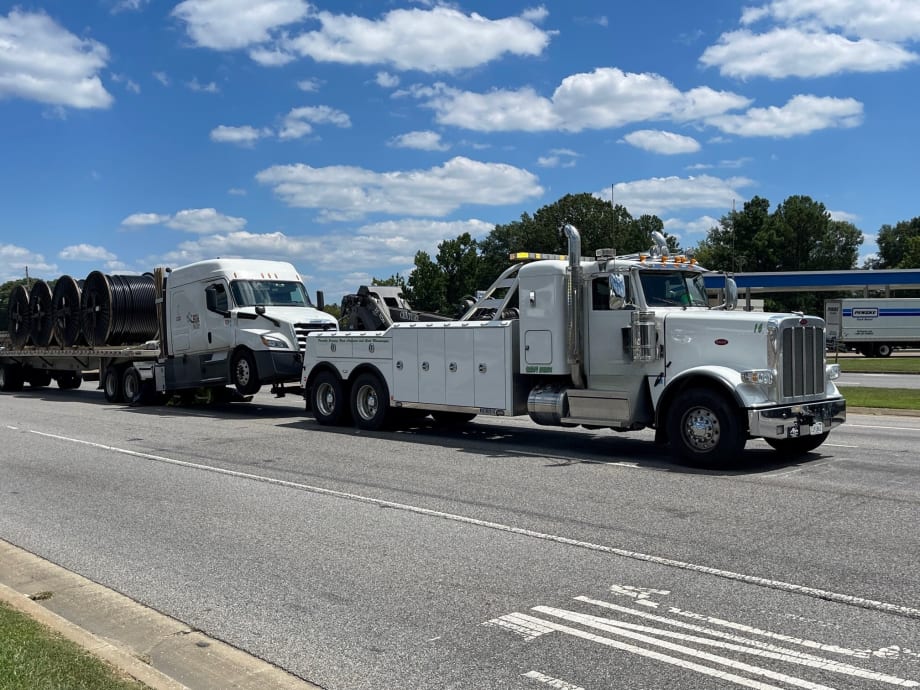
Tennessee has passed a new law aimed at curbing predatory towing after a Memphis company's practices trained a national spotlight on the problem.
Photo: Jack Roberts
The American Trucking Associations commended Tennessee on enacting comprehensive reforms to crack down on predatory towing companies that target heavy-duty trucks.
The bill, SB1692/HB1731, was signed into law by Governor Bill Lee after passing the Tennessee Senate unanimously and the House overwhelmingly without a single dissenting vote.
An Illegal Towing Hotspot
Predatory towing entails any incident in which a towing operator severely overcharges; illegally seizes assets; damages assets by use of improper equipment; or illegitimately withholds release of a truck, trailer and/or cargo.
Memphis has been a hotspot for illegal towing for several years.
Last fall, one trucker was prevented from paying a $275 booting fee, and her company was forced to pay thousands of dollars for the return of the vehicle.
In a separate incident, a trucker was booted and blocked in while he was in the process of paying for parking. He waited in his truck for over 33 hours to prevent it from being towed.
Tennessee’s new law, which was drafted by Senate Majority Leader Jack Johnson (R-Franklin) and Representative Jake McCalmon (R-Franklin) with recommendations from the Tennessee Trucking Association, will protect truckers by prohibiting unlicensed individuals from booting vehicles anywhere in Tennessee.
The law limits booting to commercial lots only. In order to boot a vehicle in a commercial parking lot, a licensed parking attendant must be present, easily identifiable as an employee of the commercial lot and available to remove the boot within 45 minutes from point of contact.
The law caps the fee to remove a boot at $75. Notice provisions will ensure drivers are aware that parking in a lot without pay could result in the vehicle being booted or towed.
An End to Asset Hostage-Taking Practices
Most noteworthy for the trucking and transportation industry, this legislation will make it illegal to boot or use a device to immobilize any truck and trailer in Tennessee that is clearly identified as a commercial vehicle with a USDOT number or with a commercial license plate issued for all classes of trucks and trailers described and registered pursuant to T.C.A. 55-4-113(a)(2) and T.C.A. 55-4-113(a)(5).
The legislation also ensures that vehicle owners are properly notified if their vehicle is towed, sold or demolished by a towing company and directs the Department of Revenue to create a motor vehicle portal.
The portal may be accessible by law enforcement, towing companies, vehicle owners and lien holders. The portal, to be active by July 2025, will be used for all public notifications of the sale of unclaimed vehicles.
“Predatory towing companies that hold equipment and cargo hostage with inflated, excessive and fraudulent invoices tarnish the reputation of the entire towing sector, said American Trucking Associations President and CEO Chris Spear. “They have taken advantage of the trucking industry for far too long, and we refuse to continue making these ransom payments any longer. ATA’s federation of state associations is prepared to fight back against unscrupulous companies that target our industry by injecting more accountability and fairness in state and local laws pertaining to towing.”
“Several high-profile predatory towing incidents in Tennessee have exposed how this egregious practice not only disrupts our state’s supply chain, but also costs truck owners thousands of dollars for each unwanted tow,” added said Tennessee Trucking Association President & CEO Donna England. “We grateful to Majority Leader Johnson, Representative McCalmon and Tennessee legislators for listening to our concerns about this unfair tactic, and we thank Governor Lee for swiftly signing this bill into law. We look forward to our continued partnership with our state’s leaders on commonsense reforms that promote justice, fairness and safety. Trucking is the lynchpin of our economy, and we should be prioritizing policies that are welcoming to truckers who deliver the goods we count on every day.”
An Essential Partnership Damaged
There is an essential partnership between trucking companies and towing companies, ATA noted. Truckers depend on towers when there is a mechanical breakdown.
Unfortunately, when a truck is towed without the owner’s consent, rogue towing companies can exploit the situation. Truck drivers and trucking companies have little choice other than to pay the exorbitant bill since the truck is their livelihood and deliveries may be time sensitive. Legislation to reign in predatory towing creates guardrails that levels the playing field to ensure that both parties are treated fairly.
According to a recent study by the American Transportation Research Institute, the most common types of predatory towing are excessive rates, experienced by 82.7% of motor carriers, and unwarranted extra service charges, experienced by 81.8% of carriers.
A majority of carriers encountered additional issues such as truck release or access delays, cargo release delays, truck seizure without cause and tows misreported as consensual.
The trucking industry plays a significant role in the Tennessee economy and is a key provider of middle-class jobs, employing nearly 250,000 Tennesseans across the state. More than 90% of Tennessee communities rely exclusively on trucks to receive their goods.
More Fleet Management

How MFA Helps Protect Trucking Fleets
Multi-factor authentication adds protection when passwords are stolen. Here’s how it works and where fleets should start.
Read More →
How Better Freight Data Helps Trucking Teams Get Ahead of Disruption
Trucking and logistics teams have plenty of data. The problem is getting the right information in front of the right people soon enough to act. Better-connected data can help teams spot trouble earlier and make smarter decisions before small problems become big ones.
Read More →
Trimble: Taking Artificial Intelligence in Trucking Beyond Faster Tasks
At Insight 2026, Trimble executives argued that fleets may need to redesign workflows to get more from AI as it introduced new products and enhancements. AI’s value will depend on how fleets combine automation with their people's knowledge.
Read More →

Nominations Open for HDT Emerging Leaders
Heavy Duty Trucking is looking for accomplished trucking fleet professionals under 40 who are making an impact and helping lead the industry forward.
Read More →
Why Private Fleets Are Taking More Freight
Private fleets are putting their own trucks on demanding customers and high-cost lanes as companies seek greater control over service, costs, and capacity.
Read More →
Color Match Smarter: Tools That Restore & Perform
For fleet managers and collision repair professionals keeping heavy-duty trucks on the road, getting the color right the first time isn't just about appearance — it's about efficiency, turnaround time, and bottom-line results. Discover how today's digital color tools are transforming the repair process from guesswork to precision.
Read More →
FMCSA Pauses Biennial-Update Enforcement Amid Motus Transition
Carriers whose updates were due on or after June 1 have more time, while FMCSA works to stabilize its new registration system and warns of phishing sites impersonating its new carrier registration system, Motus.
Read More →
2026 Blueprint for Countering Smarter Supply Chain Theft
Cargo theft is no longer just the cost of doing business. It's a multi-billion-dollar criminal enterprise exploiting vulnerabilities across your fleet, drivers, and supply chain.
Read More →
What the U.S.-Canada Trade War Means for Trucking
Escalating U.S.-Canada tariffs could disrupt cross-border freight, reduce truck volumes, raise costs, and create new uncertainty for carriers on both sides of the border.
Read More →
What Are Trucking’s Top Concerns for 2026?
The American Transportation Research Institute wants to know what's worrying trucking fleet managers, drivers, and other stakeholders in its annual Industry Issues survey.
Read More →