




Waabi's New Autonomous Texas Truck Terminal
A new facility near Dallas will serve as Waabi’s Texas home base as well as a working autonomous truck terminal.

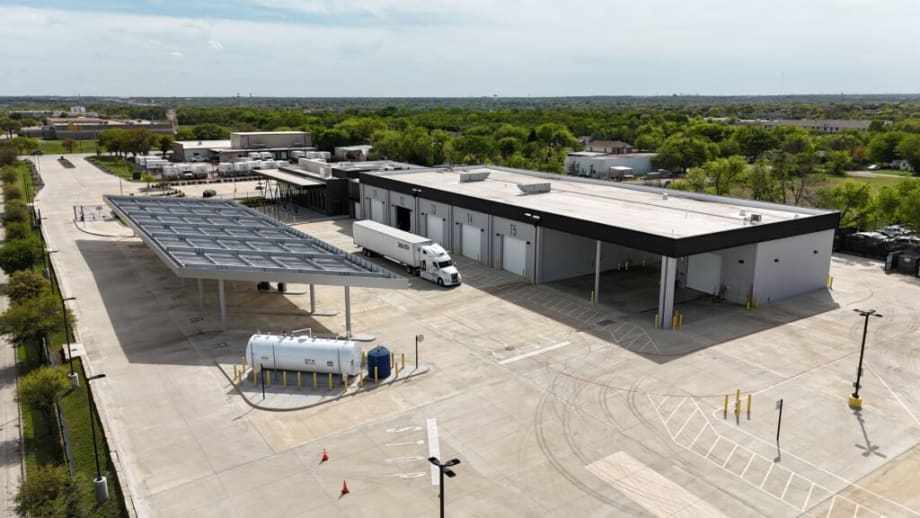
A new autonomous truck terminal in Lancaster, Texas will allow Waabi to establish, practice, and refine the required infrastructure, operating processes, and customer services needed for commercial driverless operations.
Photo: Waabi
Autonomous truck developer Waabi has signed a multi-year lease on a new flagship autonomous trucking terminal, the company announced. The new facility is located in the Dallas suburb of Lancaster, Texas. It will serve as the center for the company’s Texas operations.
Waabi said the new facility is purpose-built for autonomous trucking. It will support the company’s current development operations and continued commercial growth in the southern United States.
Waabi established its initial commercial presence in Texas last year, hauling autonomous loads between Dallas and Houston through a partnership with Uber Freight. The Lancaster terminal will allow the company to establish, practice, and refine the required infrastructure, operating processes, and customer services needed for commercial driverless operations. It will also enable greater commercial and development activity with a growing set of commercial partners, the company said.
An Autonomous Trucking Hot Spot
Waabi said the eight-plus acre terminal was built intentionally for autonomous trucking. The facility includes several acres for trailer parking, a 24,000 square-foot office and maintenance shop, high-speed data offload, a fueling station, truck weighing scales, and a dedicated pre-trip and post-trip inspection area.
These commercial-ready capabilities will enable Waabi to rapidly house, maintain, prepare, inspect, and deploy autonomous trucks over the next several years, the company said.
“Texas is a critical location for us as it is the home to our first commercial operations and several important shipping corridors,” said Raquel Urtasun, founder and CEO of Waabi. “By establishing our presence here, we are committed to creating more opportunities for autonomous trucking in the region,” “We see this facility as a key player in not only Waabi’s future, but the future of autonomous trucking, as we use it to scale our operations to continue pushing the boundaries of this industry.”
“The Texas Trucking Association couldn’t be more excited to witness Waabi’s growth right here in Texas,” added John Esparza, president and CEO of The Texas Trucking Association (TXTA). “With the addition of this new AV terminal, we will continue to show ourselves as a state committed to innovation in autonomous trucking and safety. This new investment is a testament not only to the opportunities here, but a commitment to the highest safety standards.”
As a result of this new facility, Waabi said it expects to expand its team in the Dallas region in the coming years to support operations for current and future trucking routes, as well as research and development efforts.
To learn more about career opportunities in Lancaster, Texas and beyond, visit Waabi’s career page.
More Equipment

How Volvo Updated Its D13 for EPA 2027 [Watch]
Volvo’s updated D13 promises lower emissions without sacrificing performance or fuel economy. Take a closer look at what changed inside the engine in this HDT Spotlight video.
Read More →
Michelin Tire Improves Efficiency and Durability for Regional Fleets
The Michelin X Multi Energy D2 is a regional haul drive tire engineered to help fleets improve fuel efficiency, durability and traction in demanding stop-and-go operations.
Read More →
ZF Expands Commercial Vehicle Push in North America
ZF is expanding its North American commercial-vehicle presence with new transmission applications, electrification, trailer technology and autonomous-driving systems.
Read More →
Tesla Wants a Self-Driving Semi. Are Cameras Enough?
Could Tesla’s camera-only autonomous driving technology work on an 80,000-pound Semi? In this commentary, HDT's Deborah Lockridge takes a look at Tesla, Cybercab, and how autonomous trucks see the road.
Read More →
Kodiak: Driverless Long-Haul Truck Launch on Track for 2026
Kodiak AI says its driverless long-haul safety case is 93% complete and it remains on track to begin commercial operations by year-end 2026.
Read More →
What DOT’s Automated Vehicle Strategy Means for Trucking
The U.S. Department of Transportation issued a new automated-vehicle strategy that outlines plans for driverless-truck regulations, cross-state freight corridors, and federal safety standards.
Read More →
East Coast Port Launches $45M Electric Truck Push
The Port Authority of New York and New Jersey announced millions in incentives for zero-emission drayage trucks, yard tractors, and new charging hubs near the port.
Read More →
PlusAI Going Public to Fund Autonomous Truck Launch
A SPAC deal could provide PlusAI with up to $300 million as it works toward a 2027 commercial launch of factory-built autonomous trucks.
Read More →
NHTSA Moves to Rewrite Truck Fuel-Economy Rules
The National Highway Traffic Safety Administration says it lacks authority to regulate medium- and heavy-duty truck engines separately from complete vehicles, but the existing standards have not yet been eliminated.
Read More →
Detroit Opens Orders for EPA 2027 Engines
Detroit isn’t starting from scratch to meet EPA 2027 diesel emissions standards. Its Gen 6 DD13 and DD15 engines keep much of today’s platform while updating the fuel and aftertreatment systems.
Read More →