





More About CFI: CFI's Laredo Shop Wages Culture War for Safety
CFI Endures More Than 70 Years, Even Through Ownership Changes
Contract Freighters, from single owner-operator to North American truckload giant.
December 31, 2022
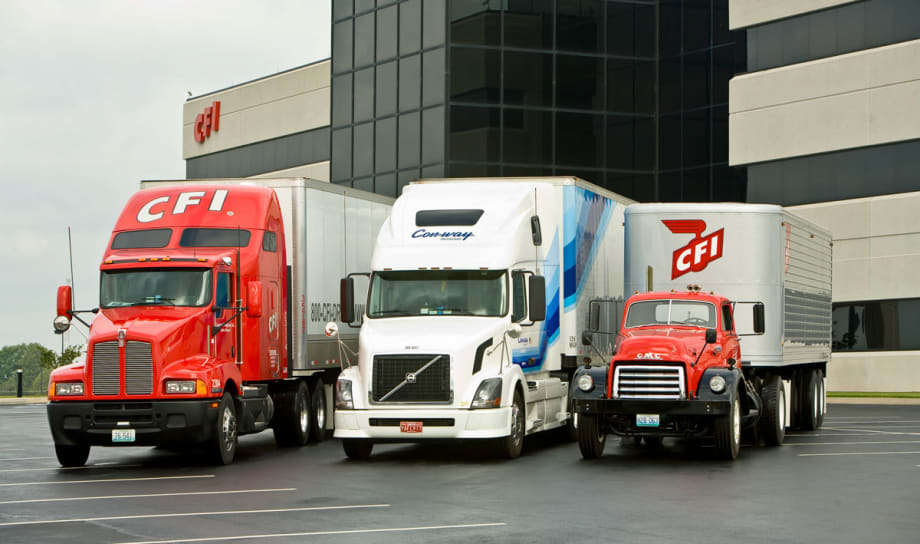
Three trucks staged for CFI's acquisition by Con-way, including an early truck, the original Kenworth T600, and a new truck.
Photo: CFI
4 min to read

In 1951, Ursul Lewellen started out as an owner-operator in Joplin, Missouri, with a truck and two trailers.
Photo: CFI
In conjunction with Heavy Duty Trucking's 100th anniversary, we are highlighting motor carriers that have also stood the test of time.
In 1951, Ursul Lewellen started out as an owner-operator in Joplin, Missouri, with a truck and two trailers. What became Contract Freighters Inc. grew as an owner-operator fleet. Today, despite several ownership changes, the truckload carrier endures.
By 1985 CFI had a fleet of 940 owner-operator rigs and bought its first company truck, one of the first Kenworth aerodynamic T600s, nicknamed the “anteater” for its then-radical pointed nose.
The same year, CFI began providing service to Canada and Mexico. Two years later CFI opened its first international office, in Monterrey, Nuevo Leon, Mexico. In 1988 it opened its first Canadian office, located in Toronto, Ontario.
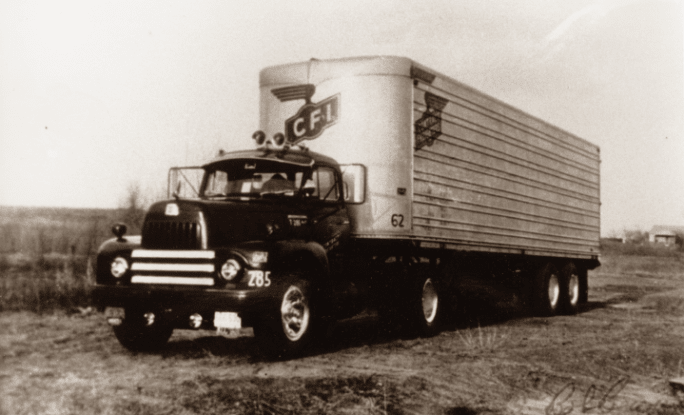
An early Contract Freighters rig.
Photo: CFI
CFI pioneered cross-border shipping with Mexico pre-NAFTA and continues this business today. In 1990, the company was the first motor carrier to receive the President’s “E” Award for its role in increasing U.S. exports. By the late 1990s, CFI Logistica was incorporated and operating in Mexico. Throughout the first decade of the 2000s it expanded its operations south of the border, establishing a headquarters in Guadalajara and opening terminals in Monterey, San Luis Potosi, Mexico City and Queretaro.
CFI's Red Racer
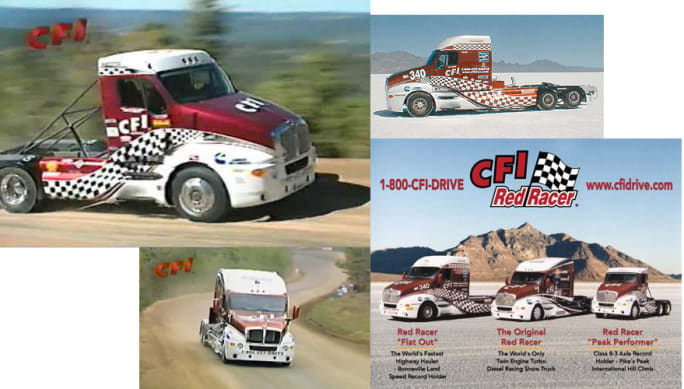
In the 1990s and into the 2000s, CFI garnered publicity with special racing trucks.
Photo: CFI
n the 1990s and into the early 2000s, CFI chief Glenn Brown promoted the company by teaming up with Kenworth for racing events in the Kenworth/CFI Red Racer, including the Pikes Peak International Hillclimb, nicknamed "Race to the Clouds." In 1999, a Kenworth T2000 driven by Contract Freighters President Glenn Brown averaged 162.579 mph over two runs to set a new world land speed record for a heavy-duty truck during the 1999 World Finals at Utah's Bonneville Salt Flats.
Into the 21st Century
By the year 2000, CFI had surpassed 2,000 trucks.
CFI was an early adopter of technology; in 1998 it offered online proof of delivery, allowing customers to retrieve, view, and print bills of lading and delivery receipts. In the late 1990s it equipped all its trucks with the HighwayMaster mobile communications and information system. This system provides both voice and data communications, along with global positioning satellite data.
In 2000, it launched a website aimed at drivers, allowing them to apply for employment, review company statistics, meet the drivers of the month and get information on pay and benefit packages. And it began offering drivers free Internet access through PNV at its terminals.

CFI's "war room" in Joplin, Missouri.
Photo: CFI
In 2003 CFI equipped its fleet of 2,400 trucks with Aether MobileMax, a fleet tracking and messaging solution. ADV Monitor would provide real-time information on vehicle and driver performance, state-line crossings and vehicle fault codes; a Proximity Alert feature to automatically notify them of critical arrival and departure information. Aether MobileMax used a multi-mode system that automatically switched between land-based and satellite communications without driver or dispatcher intervention to ensure complete coverage and more cost-efficient communications.
In 2005, Con-way announced it would begin compensating drivers based on Rand McNally Practical Route Miles rather than the industry-standard Short Route Miles.
CFI Perseveres Through Multiple Acquisitions
In 2007, CFI was purchased by Con-way and a year later became Con-way Truckload, a business unit of more than 2,800 tractors, 8,000 trailers and 3,500 employees.
In 2015, XPO bought Con-way. It looked into selling off the truckload operation, which didn’t fit well into its global logistics business, but decided after looking at several offers that it would keep it.s
In 2016, Transforce International acquired CFI and its subsidiaries, bringing back the CFI name, and launched CFI Logistics.
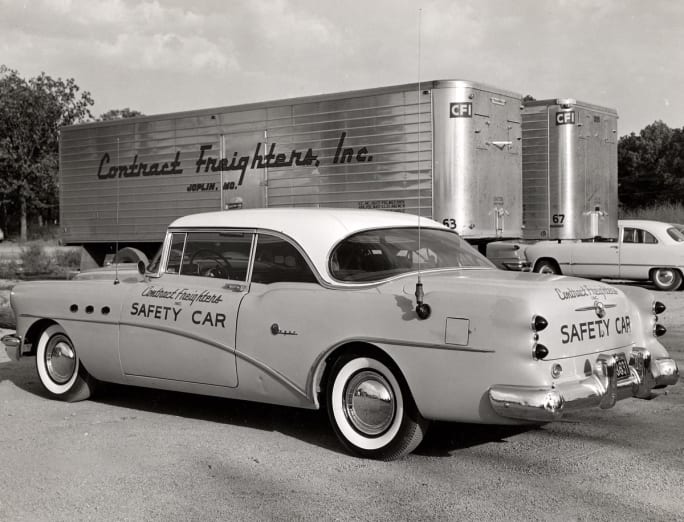
Before on-board communications systems and cell phones, a CFI fleet safety car spot-checked a professional driver’s safety performance on the road.
Photo: CFI
Through both the Con-way and XPO acquisition, the Joplin-based operations maintained their own IT, communication, HR departments, etc.
In 2021, CFI added temperature-controlled freight to its offerings with the acquisitions of MCT and D&D Sexton.
In 2022, TFI sold CFI to Heartland Express. The truckload carrier bought Contract Freighters non-dedicated U.S. dry van and temperature-controlled truckload business and CFI Logistica operations in Mexico from TFI International (but not the CFI Dedicated or CFI Logistics U.S. brokerage operations.) CFI continues to operate under its existing brand, management, and terminal locations, remaining headquartered in Joplin, Missouri.
Subscribe to Our Newsletter
More Fleet Management

Sponsored•September 1, 2026
How Telematics Improves Visibility, Control, and Performance in Refrigerated Fleets
Explore how telematics help refrigerated fleets improve visibility, uptime, efficiency, compliance, and cargo protection across connected cold chain operations.
Read More →
What the U.S.-Canada Trade War Means for Trucking
Escalating U.S.-Canada tariffs could disrupt cross-border freight, reduce truck volumes, raise costs, and create new uncertainty for carriers on both sides of the border.
Read More →
What Are Trucking’s Top Concerns for 2026?
The American Transportation Research Institute wants to know what's worrying trucking fleet managers, drivers, and other stakeholders in its annual Industry Issues survey.
Read More →

American Trucking Associations Looks for a New Leader
ATA President and CEO Chris Spear abruptly left his job at the association on August 21, at a pivotal time for the trucking industry.
Read More →
Public Wi-Fi Cybersecurity Risks: How Truck Drivers and Fleets Can Protect Their Data
Public Wi-Fi can expose truck drivers and fleets to credential theft, malware, and other cyber threats. Here’s how to reduce the risk on the road.
Read More →
For Nicky Cupp, Fleet Innovation Starts With Frustration
HDT Truck Fleet Innovator Nicky Cupp turns everyday pain points at Fraley & Schilling into opportunities for better technology and smarter processes.
Read More →
Adam Buttgenbach’s Approach to Electric Trucks: Start With Where They Fit
HDT Truck Fleet Innovator Adam Buttgenbach helped PepsiCo build one of North America’s largest EV fleets by focusing on where electric trucks make operational sense.
Read More →
Deen Albert: Let Automation Do the Math, People Make the Decisions
HDT Truck Fleet Innovator Deen Albert makes sure people are still at the heart of operations at Grand Island Express, even while adopting artificial intelligence tools. AI-assisted dispatch helped boost revenue 25% with the same number of trucks.
Read More →
Trimble’s New AI Agent Takes Aim at Fleet Back-Office Busywork
Arc Agent works across Trimble TMS products to automate repetitive tasks such as freight orders, maintenance, invoices, fuel costs and more.
Read More →
How HDT’s 2026 Truck Fleet Innovators Are Rethinking Fleet Operations
Meet five trucking leaders who are challenging assumptions, solving operational problems, and putting innovative ideas to work.
Read More →