




NACFE Run on Less Results Shed Light on Truck Electrification
The North American Council on Freight Efficiency’s Run on Less Electric event shows that 5.2 million trucks could be electrified today.

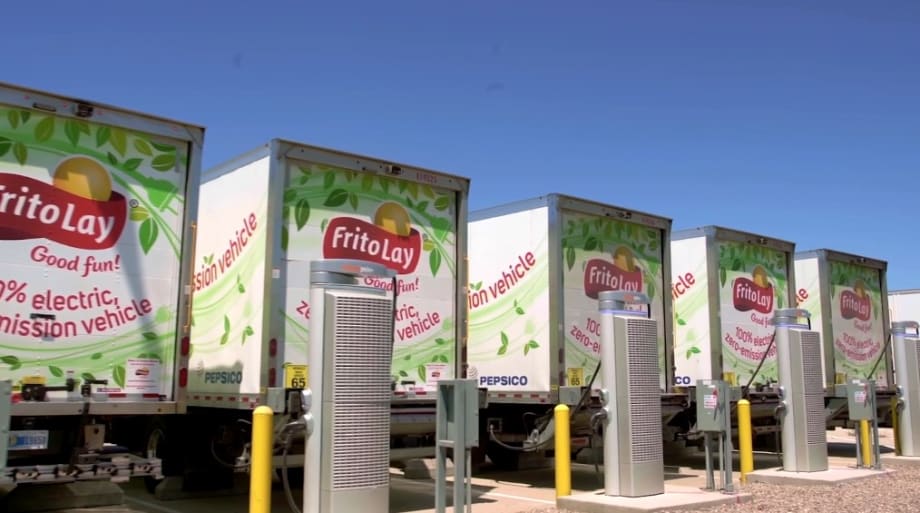
NACFE’s Run-on-Less-Electric demonstration has shown that millions of trucks could be practically electrified today, saving more than 100 million tons of CO2.
Photo: NACFE
The North American Council on Freight Efficiency continues to strip away some of the mysteries surrounding truck electrification. The recently completed Run on Less – Electric (RoL-E) real-world technology demonstration verified some of what some believed to be true about electric trucks, and even provided a few surprises in terms of segment readiness.
The big take-away was that nearly 5.2 million trucks powered by internal combustion engines operating in North America today could be electrified tomorrow. Between the package-delivery fleets, box trucks, short-haul tractor service and shunt trucks, the range and duty cycles would work with today’s technology.
From Sept. 2 through Sept. 19, the RoL-E demonstration project tracked 13 Class 3 through Class 8 electric trucks operating in various duty cycles. Metrics from each truck and service location were collected and posted daily on RunOnLess.com.
Data collected included the battery state-of-charge over the course of each day, charging data, and the levels of regenerative braking (energy recovery). Details on weather, miles travelled, and deliveries completed was also collected.
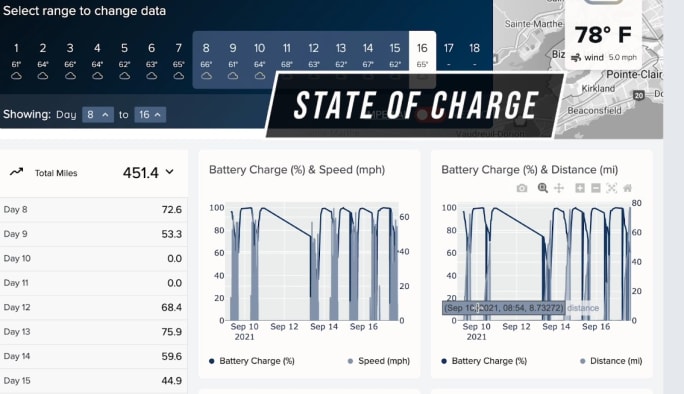
Data downloaded from the trucks during Run on Less-Electric are displayed on the website under the company profile section.
Source: NACFE
What emerged is a more accurate picture of electric trucks in the field than the industry had before. While NACFE and its partner, RMI, continue sifting through the terabytes of data collected, perhaps the greatest take-away that has emerged is that full-scale electrification of certain industry segments totally feasible today.
“It’s clear from the data collected during the Run that it is time for fleets to go electric in certain market segments, including the van/step van, medium-duty box truck, terminal tractor and short heavy-tractor regional delivery segments,” said Mike Roeth, NACFE’s executive director.
Roeth said there are about 5.2 million active trucks in North America represented by the four segments included in Run on Less. If all those trucks were electrified, NACFE says it would keep about 100 million tons of CO2 from being released into the atmosphere.
“That's about 25 coal fired power plants that could be eliminated if all of those trucks went battery electric,” Roeth said. “And we believe all the trucks in this population are electrifiable today.”
By NACFE’s calculations, powering those 5.2 million readily electrifiable trucks would consume about 168 gigawatt-hours of electricity, or about 5% of today’s electricity production in the U.S. and Canada.
Preliminary Findings
The 13 trucks participating in Run-on Less-Electric were closely monitored with data collected at all stages from charging to driving and everything in between. Some of the monitored metrics include battery state-of-charge at various points during the shift compared against vehicle weight, speed and distance traveled and the opportunities for top-off charging through regenerative braking that occurred along the routes. They were looking at the time spent driving versus idling or waiting to unload as well as the weather conditions in which the truck was operating.
All that data is displayed the website under the Participant Metrics tab in the Fleet Profile section.
“We spent quite a bit of time thinking about what kind of metrics we want to show and [we felt] it was important to make it intuitive and easy to understand while still providing enough data for someone to really understand what's happening,” said NACFE’s Engineering Director Yunsu Park in an accompanying video. “Fleets or anyone else can go in and see the kind of duty cycles and conditions they're operating in and get a good feel for what these trucks are capable of today.”
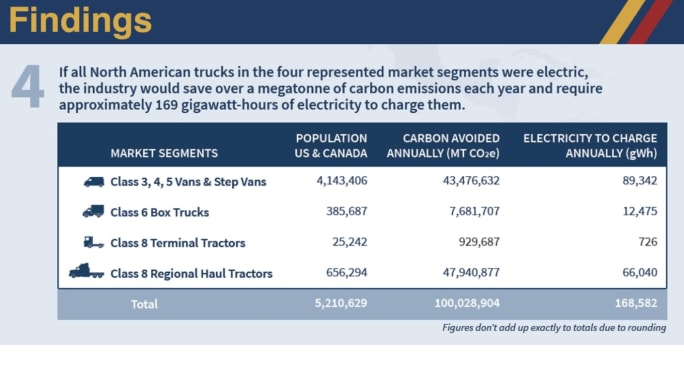
Estimates on the CO2 savings are based on traditional fossil fuel consumed by trucks in applications that could be easily replaced today.
Source: NACFE
While no revelations have surfaced yet in the analysis, it is clear that fleets are over-estimating their battery needs or under-utilizing the equipment. Trucks were seldom returning to base at below 50 or 60% state-of-charge. Some fleets indicated they were being a bit cautious because range anxiety is a big think with drivers, Roeth noted in his remarks.
“One of the fleets told us they were keep the electric trucks closer to base and letting the conventional trucks handle the longer runs,” Roeth said. “They indicated they would be looking at the batteries on those trucks; the thinking being, ‘if we don’t need all of the battery pack, why buy it?’”
Downsizing the batteries could present some difficulties if the fleet wanted to send the truck on a lounger route and possibly at resale time, but this thinking underscores the need to carefully evaluate the application and the routes for the trucks.
As for applications, Michael Berube, deputy assistant secretary for Sustainable Transportation at the U.S. Department of Energy, who spoke during the program result presentation, pointed out that 50% of all freight in U.S. moves 100 miles or less from origin to destination, and 75% of all freight moves 250 miles or less.
“As the battery technology gets better over the next five years, you're going to start growing the number of vehicles that can do this,” he said.
And looking a little further out to a corridor distribution model, he said trucks moving within 200 miles could recharge at a depot before returning to base.
“I think in the next three or four years, we can get to that level of demonstration,” he said.
One of the surprises that emerged was beverage delivery trucks. Roeth said he was a bit skeptical at first because they’re heavy, but in the RoL-E demonstration, they saw the trucks spent most of the time stopped making deliveries rather than covering miles.
“They weren’t doing the miles we expected with all the stopping, loading and unloading at grocery stores and so forth,” he said.
TCO Still a Work in Progress
While a close examination of the cost of the trucks and charging equipment was not big part of this exercise, it did come up for discussion.
Rob Reich, executive vice president and chief administrative officer at Schneider, who will be putting about 50 trucks into drayage service next year at ports in Southern California, said among the first steps fleets need to take in bringing electric trucks to market is engaging their customers.
“I think the first step is simply taking a look at your current network characteristics and identifying where you have these lengths of hauls or operating characteristics that the vehicles can support,” he said. “I think the other half of the equation is working with your customers. We know that the shipper community and all of our customers are equally interested in sustainability and the future of battery electric vehicles. I think talking with them about these opportunities,
Reich said Run-on-Less has shown that electric trucks can operate in a real-world environment. The next phase will be to further understanding the full total cost of ownership because it requires fleets to manage things they historically haven’t had to manage.
“I think the key next step for us, as you think about how to grow this even faster, is to get good and understand better at managing the total cost of ownership,” said Reich.
This Run-on-Less event might prove pivotal in the near future of electric trucks. As Roeth noted, the trucks available now from the manufacturers, chargers that can do the work are available too, and with incentives and other factors, the total cost of ownership is almost there.
“It might make sense for fleets to go fast, or in particular areas, maybe be a little slower, but [we showed] these fleets are electrified today with the products that are that are available today,” he said.
More Fuel Smarts
Trucking’s Diesel Squeeze Isn’t Letting Up
With diesel topping $6 a gallon nationally, ATA's Bob Costello explains why fleets should prepare for continued pressure at the pump.
Read More →
FlowBelow Redesigns Trailer AeroSlider to Cut Fuel Use
The lighter trailer aerodynamic system installs in less than 45 minutes, according to the company, with potential payback in under a year depending on fuel prices and trailer mileage.
Read More →
Why Diesel Price Relief Efforts May Fall Short
Diesel prices have eased from September’s record high, but doubts about additional Russian supply and limits on dyed-diesel tax relief mean trucking fleets still face expensive fuel. And prices could go higher.
Read More →
Why Small Fuel Savings Matter in Trucking
Can better fuel economy help pay for driver raises? In this podcast, GP Transco explains how small efficiency gains create room to reinvest in its people.
Read More →
How GP Transco Cuts Trucking Fuel Costs, a Tenth of a Gallon at a Time
What’s another tenth of a mile per gallon worth? GP Transco shares how equipment upgrades and driver coaching turn small gains into meaningful fuel savings.
Read More →
Electric Yard Tractors Move Beyond Pilots
Operating-cost savings have overtaken sustainability goals as the leading reason surveyed fleets are adopting battery-electric terminal tractors, according to new NACFE research.
Read More →
Geotab Links Fleet Card to Vehicle Data
The new card combines fuel discounts with telematics-based purchase controls. Geotab’s analysis also points to potential savings from choosing lower-priced fuel stops.
Read More →
Fleet Economics Shape Electric Truck Outlook
ACT Research expects costs, charging infrastructure, and technology improvements to drive zero-emission commercial vehicle adoption as federal regulations and incentives retreat.
Read More →
Wex Adds Cardless Fuel Payments for Over-the-Road Customers
A new fuel card feature for Wex customers offers convenience and security.
Read More →
New California Law Could Shed Light on Electric Truck Prices
Why do battery-electric Class 8 trucks remain so expensive? A California bill signed by Gov. Gavin Newsom would give fleets and state agencies more visibility into what manufacturers charge.
Read More →