




Daimler Trucks Focuses on Zero-Emissions Future
Daimler Trucks is rapidly ramping down its internal-combustion-engine development as it puts more research and development investments into its dual-focus zero-emissions strategy of both battery-electric and fuel-cell-electric commercial vehicles.


Daimler Trucks believes hydrogen-fuel-cell trucks are necessary for the future of long-haul zero-emissions freight transport.
Daimler Trucks Strategy Day presentation screenshot
Daimler Trucks is rapidly ramping down its internal-combustion-engine development as it puts more research and development investments into its dual-focus zero-emissions strategy of both battery-electric and fuel-cell-electric commercial vehicles.
In a virtual business strategy presentation on May 20, company officials outlines a two-pronged strategy for moving forward as Daimler Trucks prepares to be spun off as a separate, publicly traded company from Mercedes-Benz. While one is resetting its profitability around the world, the other is leading the way in zero emissions. (See Daimler Truck Outlines Strategy as Stand-Alone Company.)
“As my American friends like to say, we are going ‘all in’ on zero emissions,” said Martin Daum, chief of Daimler Trucks, who for many years led Daimler Trucks North America.
“It is our responsibility to lower our carbon footprint,” he said. “We owe that to society and to the planet. And we will deliver on that promise in a way that is profitable and delivers value to our shareholders.”
Daimler’s Dual-Track Zero-Emissions Strategy
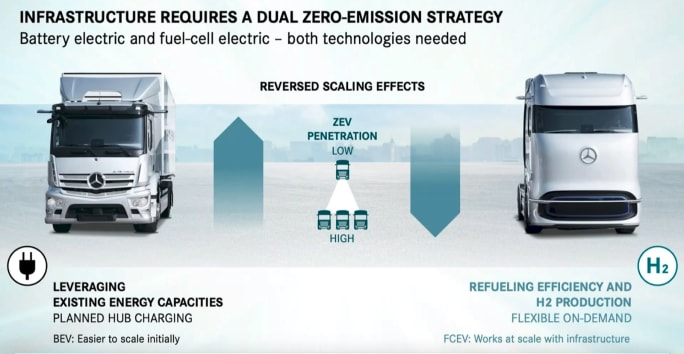
The company has made a key decision in its push for zero emissions, Daum explained – a dual-track strategy with both battery-electric and fuel-cell electric trucks.
“The customer needs both. The industry needs both. The world needs both. And we are going to develop and deliver both.”
The company is already selling electric trucks and buses today, he said, with more than a million miles on vehicle in customer hands, providing information that will allow Daimler to improve them further.
The big advantage of fuel-cell trucks for long-haul operations is that they have a higher energy density.
Currently, he explained, battery-electric trucks are relatively easy to deploy in small quantities, and the charging infrastructure can be built relatively quickly, at least compared to hydrogen. If you have 1,000 trucks, battery-electric charging is easy, he said. If you have 10,000 trucks, it’s expensive. “If you have 100,000, it’s really expensive, and we have 4 million in Europe alone.”
In contrast, he said, fuel-cell trucks benefit from scale when it comes to the fueling infrastructure. It doesn’t really start getting economically viable until you have 100,000 trucks. “4 million is a piece of cake. So we start with electric, and then fuel cell.”
Daimler Trucks Strategy Day presentation screenshot
“We also need hydrogen trucks,” he said. “The electric grid can only support the charging of electric trucks up to a point. Transportation will need a second energy source, and this is where hydrogen comes in.”
Andreas Gorbach, head of truck technology, explained that to increase range, battery-electric trucks need more and more batteries, but fuel-cell trucks can see increased range by simply increasing the size of the tank. At some point, from a cost-benefit perspective, “these lines must cross,” he said.
“It is impressive how battery-electric has developed in the past year, in ways we didn’t anticipate, and it will continue to. Yet there are limitations, including the elements that are available on this planet.”
The challenge for hydrogen-electric trucks, even more so than for battery-electric, is the fueling infrastructure.
“There are massive investments needed by the energy companies,” Daum said. “But once they are done, they will scale easily, supporting hundreds of thousands of trucks and ultimately millions.”
And in fact, one company, Shell, has stepped up to the plate to partner with Daimler Trucks to develop a freight lane in Europe where hydrogen-fueling infrastructure will be available. Shell intends to initially rollout a hydrogen-refuelling network joining three green hydrogen production hubs at the Port of Rotterdam, in the Netherlands as well as Cologne and Hamburg in Germany. In 2024, Shell plans to launch heavy-duty refuelling stations between the three locations and Daimler Truck aims to hand over the first heavy-duty hydrogen trucks to customers in 2025. The plan aims to continuously expand the hydrogen-powered freight corridor, which will cover 1,200 kilometres by 2025, in order to deliver 150 hydrogen refuelling stations and around 5,000 Mercedes-Benz heavy-duty fuel cell trucks by 2030.
Daum said competitors who are focusing only on battery-electric and remain skeptical of hydrogen fuel cells are short-sighted.
“We believe in the hydrogen economy, and we know hydrogen trucks work,” Daum said. The company is confident, he said, that it will be able to achieve a rapid reduction in costs that can make a hydrogen-fuel-cell truck cheaper than a battery-powered truck, thanks to its new cellcentric partnership with Volvo, which lessens development costs by adding scale.
Next-Generation Battery-Electric Truck
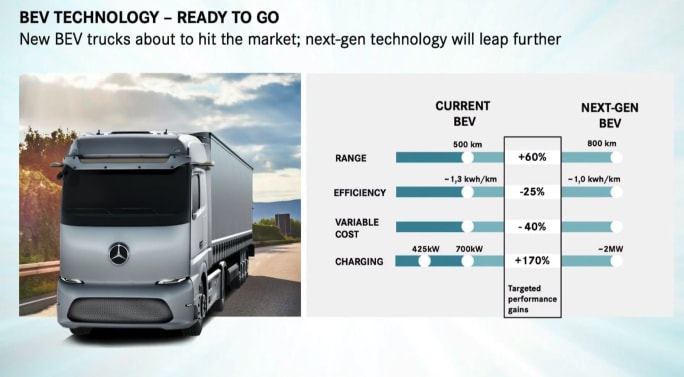
Daimler Trucks will put its battery-electric Mercedes eActros into production later this year and the Freightliner eCascadia in 2022. But it’s fast-tracking next-generation BEV technology.
Daimler has “ambitious plans for the ultimate next-generation battery-electric truck,” Daum said.
Daimler Trucks Strategy Day presentation screenshot
Daimler announced an expanded battery partnership with lithium-ion battery manufacturer and developer Contemporary Amperex Technology Co. Limited. The two are already jointly exploring the possibility to localize production in Europe and in North America, which would result in lower costs due to less shipping costs. CATL will supply batteries for Mercedes-Benz eActros LongHaul truck starting 2024, and the partners intend to jointly design and develop even more advanced next-generation battery cells and packs for truck-specific applications.
Daimler engineers are working on a state-of-the-art battery system, and a “strong TCO proposition” that will focus on total system integration and optimization.
That includes not only the vehicle itself, but also charging – both the physical charging infrastructure and the charge-management software. It plans to play a key role in the deployment of electric charging.
“Just offering a truck in the future will not be sufficient,” said Gorbach. “That is why we are partnering for the infrastructure as well.”
That was recently seen in North America, where the new “Electric Island” charging station was opened near Daimler Trucks North America headquarters in Portland, Oregon, in a joint project with Portland General Electric.
In North America, the focus is currently on battery-electric. Daimler Trucks North America is already delivering electric Thomas Built buses to school districts across the country, and there are 40 developmental units of the Freightliner eCascadia and eM2 in customer hands, noted John O’Leary, president and CEO. Both trucks are slated to start series production in late 2022. In addition, the battery-electric walk-in van chassis from Freightliner Custom Chassis, “the right vehicle to capitalize on the surge in e-commerce spending and the resulting surge in last-mile delivery,” will begin deliveries late this year.
In response to a question from HDT about fuel-cell-electric trucks in North America, O’Leary responded that historically, we have often seen technology migrate from Europe and ultimately make its way to the U.S., citing as examples automated transmissions and advanced safety systems.
“So that doesn’t mean [fuel-cell truck technology] won’t be active in the U.S. at some point in future. If it does become a thing in the U.S., we will have a product ready to go. We will be on both paths, just like our European colleagues. If customers want hydrogen fuel cell trucks in the future, they will have it.”
Speed to Deployment
Gorbach said in addition to the dual-technology development strategy, there are two other ways Daimler is working to make this transition.
One is the “fast-rampdown of the current ICE powertrain,” he said, noting that Daimler already has made an agreement with Cummins to handle its medium-duty engines as it completely exits that business. And the company is actively seeking partners to share the development costs for internal-combustion engines to meet upcoming European emissions regulations.
“This is a joint challenge of the industry, and we have to solve it together, and we will solve it together.”
The other is about speedy penetration into the product portfolio and the rapid evolution of the technology itself.
“If we want to comply with the Paris agreement and our own emission goals, 20 years is set” as a deadline, Gorbach said – but “we are convinced this will happen fast, in 10 to 15 years.”
It’s hard to predict adoption more specifically, he said, since trucking is made of up many different use cases, the legislative/regulatory landscape varies, and the infrastructure is in its infancy and developing at different speeds around the globe.
“What is the catalyst that makes the reaction go faster?” he asked. “The answer is total cost of ownership. TCO is the catalyst. In that very moment where the customer starts benefitting more from a zero-emissions truck than the diesel truck, there is no longer any reason to buy a diesel truck.”
Despite the uncertainty, he projects that tipping point to come around 2025 for battery-electric and 2027 for fuel-cell electric.
More Fuel Smarts

How Volvo Updated Its D13 for EPA 2027 [Watch]
Volvo’s updated D13 promises lower emissions without sacrificing performance or fuel economy. Take a closer look at what changed inside the engine in this HDT Spotlight video.
Read More →
Diesel Price Spike Shortens Payback for Natural Gas Trucks, Report Says
Energy Vision estimates fleets could recover the higher purchase price of an RNG-fueled Class 8 tractor in 1.3 to 2.8 years under current fuel-price scenarios.
Read More →
Calstart Becomes Catalyst Mobility, Reflecting Broader Focus
Calstart is now Catalyst Mobility, reflecting the nonprofit’s growing national role in clean transportation, including zero-emission trucks, infrastructure and incentive programs.
Read More →

Record Diesel Prices Squeeze Trucking Fleets
Average U.S. diesel prices have climbed to nearly $6 a gallon, surpassing the 2022 record as tight refinery capacity and Middle East disruptions keep fuel costs elevated.
Read More →
How Fuel Delivery Shapes Engine Performance
Fuel delivery depends on more than what happens at the injector. For fleet, maintenance and technical professionals, looking at the full path from pump to injector can provide useful context for understanding engine performance.
Read More →
East Coast Port Launches $45M Electric Truck Push
The Port Authority of New York and New Jersey announced millions in incentives for zero-emission drayage trucks, yard tractors, and new charging hubs near the port.
Read More →
California Bill Could Shed Light on Electric Truck Prices
Why do battery-electric Class 8 trucks remain so expensive? A California bill headed to Gov. Gavin Newsom would give fleets and state agencies more visibility into what manufacturers charge.
Read More →
Detroit Opens Orders for EPA 2027 Engines
Detroit isn’t starting from scratch to meet EPA 2027 diesel emissions standards. Its Gen 6 DD13 and DD15 engines keep much of today’s platform while updating the fuel and aftertreatment systems.
Read More →
Zero-Emission Truck Corridor Planned for West Coast
California, Oregon, Washington, British Columbia and Baja California are coordinating plans for truck charging and hydrogen fueling from Canada to Mexico.
Read More →
A Closer Look at Kenworth’s Electric T880E Vocational Truck [Video]
Learn more about Kenworth's T880E battery-electric vocational truck at the Paccar Technical Center, including its range, applications, upfitting considerations, and PTO options, in this HDT Spotlight video.
Read More →