




Peterbilt Unveils New Medium Duty Models
Peterbilt unveiled its new Model 537 and Model 548 trucks, designed for the Class 7 and 8 segment, and Model 535 and Model 536 trucks, designed for the Class 5/6 non-CDL lease and rental markets.

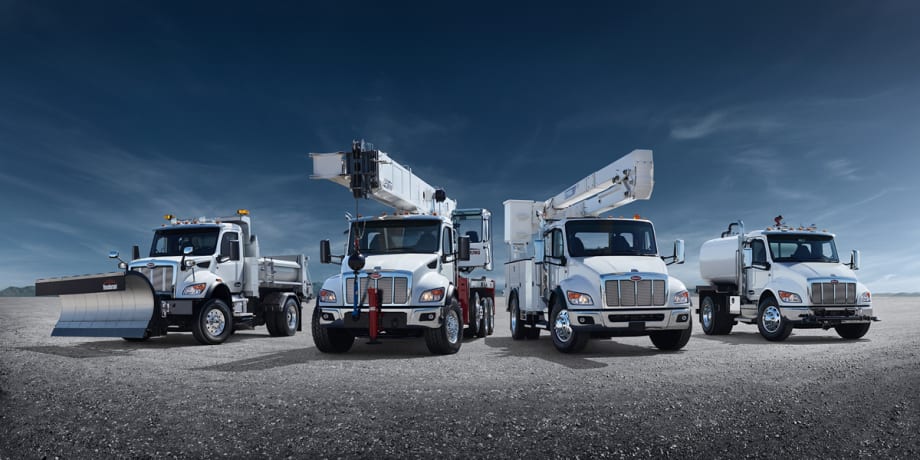
The new Model 537 and Model 548 are built upon a brand-new customizable chassis and multiplex electrical architecture.
Photo: Peterbilt
Peterbilt Motors Co. unveiled their new Model 537 and Model 548 trucks, designed for the Class 7 and 8 segment, during a live video event on April 7. The trucks are now available for order, with deliveries starting in July.
The new Model 537 and Model 548 are built upon a brand-new customizable chassis and multiplex electrical architecture. The trucks deliver seamless body builder integration allowing customers complete customization to spec their truck to fit their needs, Peterbilt officials said.
Two hood options are available for the trucks: a vocational three-piece Metton hood featuring a stationary grille with full through rail; and a three-piece SMC aerodynamic hood for maximum visibility.
Both hood options can use a variety of vocational and front engine power take-off bumpers to fit different applications. The bumper is front mounted to the chassis with a drop-and-go feature for self-locating. Bumper options include two finishes (chrome or painted), three bumper light mounted options (headlight, daytime running lights or fog), two radar options, two tow options (two tow loops or center tow), and two license plate mounting locations (center or offset).
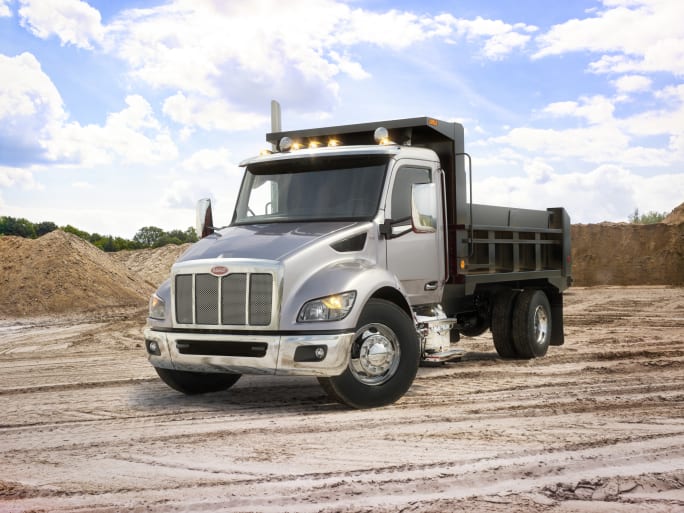
The Model 537 and 548 offer wide or standard track axles featuring wheel cut angles for a shorter turning radius.
Photo: Peterbilt
The Model 537 and 548 offer wide or standard track axles featuring wheel cut angles for a shorter turning radius and mono-leaf or taper-leaf front springs rated from 8,000 up to 20,000 lb. The rear suspension is available with a taper-leaf or air leaf suspension rated from 12,500 to 40,000 lb. depending on a single or tandem drive configuration. The AWD option features a new offset bowl design to offer the lowest possible cab height.
Inside the Cab
A 2.1 meter cab is 8 inches wider inside than the previous generation cab and has room for three adults to seat comfortably, company officials said.
Stair-style steps and knurled grab handles make getting into the trucks easy. The best-in-class
Interior features include 4.6 cubic feet of storage space, three cup holders and a dash layout with available space for optional gauges, switches and ram mounts.
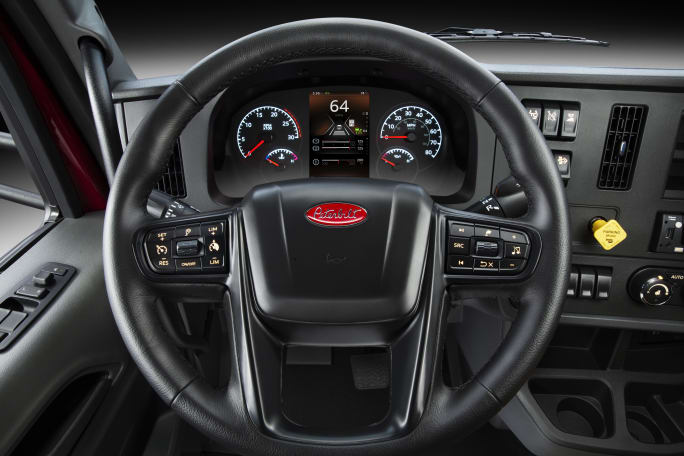
The trucks feature an all-new instrument cluster, featuring an analog speedo and tachometer with a high-resolution, seven-inch digital display which relays key information.
Photo: Peterbilt
The trucks feature an all-new instrument cluster, featuring an analog speedo and tachometer with a high-resolution, seven-inch digital display which relays key information. Drivers are able to toggle through menu cards on the digital display utilizing the new multi-function steering wheel and the display navigation knob. The digital display is deeply integrated into the electronics of the truck with key information like system check, trip summary, power take-off functions, advanced driver-assistance systems and tire pressure monitoring systems all displayed through the menu cards.
Additional Models For Non-CDL Holders
Peterbilt also unveiled its new Model 535 and Model 536 trucks, which are designed for the Class 5/6 non-CDL lease and rental markets.
The trucks feature a robotically-assembled aluminum cab with a width of 2.1 meter, a floor height of 40.5 inches and a roof height of 74 inches.
Ingress and egress is improved with a 3” lower cab height, stair-style steps and knurled grab handles. The all-new, self-closing doors feature larger windows for increased driver visibility and three opening positions. The Bumper to Back-of-Cab measurement can be either 107” or 109” and the trucks offer excellent maneuverability with a turning radius of 51 feet, officials said.
Options available on the Model 535 and Model 536 include two hood lengths, two roof heights, composite and steel bumpers, as well as multiple options of fuel and DEF tanks.
Paccar TX-8 Transmission
Peterbilt announced the all-new Paccar TX-8 Automatic transmission and updated Paccar PX engines are available for order with the new medium-duty lineup.
The 8-speed Paccar TX-8 automatic transmission features the latest technology, Peterbilt officials said. The transmission monitors changes in road grade, vehicle acceleration, torque demand, weight and engine load to keep the truck in the most fuel-efficient gear. The transmission delivers automotive-like shifting with up to 5% better fuel economy, they said.
The Paccar TX-8 incorporates an Auto Park Lock safety feature that automatically engages the park lock should a driver forget. Next, a Twin Torsional Damper enables early first gear lock-up for smoother shifts and faster acceleration. Finally, the Mechatronic unit and Transmission Control Unit are combined into one unit within the oil pan for ease of service.
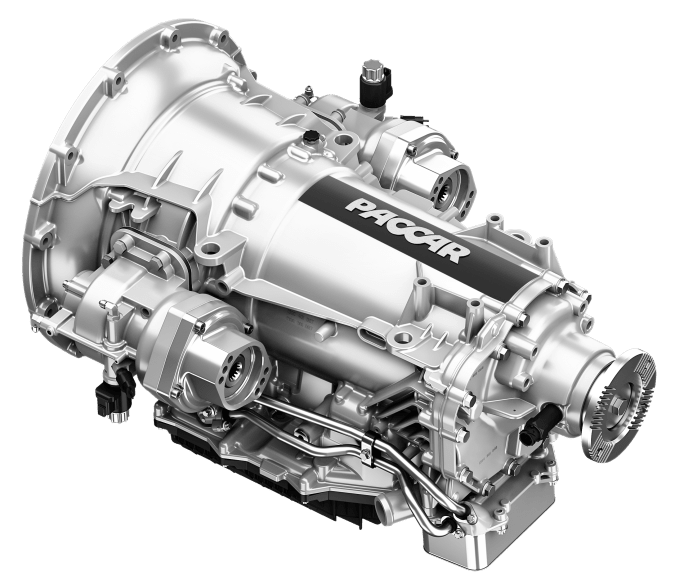
The all-new Paccar TX-8 automatic transmission and updated Paccar PX engines are available for order with the new medium-duty lineup.
Photo: Peterbilt
Peterbilt’s new family of medium-duty trucks is also equipped with Paccar’s updated line of PX engines that will see longer oil and fuel filter service intervals and fuel economy improvements. The updated PX-9 also logs higher torque ratings in the 260, 350 and 360 horsepower versions as well as a lower torque drop-off speed.
In addition, existing Paccar powertrain components will be rebranded to align with the newest member of the family. All PACCAR transmissions will take on the TX designation with the 12-speed being renamed the TX-12. The PACCAR 40K drive axle will become the PACCAR DX-40 and the vocational 20K front steer axle becomes the FX-20.
More Equipment

How Volvo Updated Its D13 for EPA 2027 [Watch]
Volvo’s updated D13 promises lower emissions without sacrificing performance or fuel economy. Take a closer look at what changed inside the engine in this HDT Spotlight video.
Read More →
Michelin Tire Improves Efficiency and Durability for Regional Fleets
The Michelin X Multi Energy D2 is a regional haul drive tire engineered to help fleets improve fuel efficiency, durability and traction in demanding stop-and-go operations.
Read More →
ZF Expands Commercial Vehicle Push in North America
ZF is expanding its North American commercial-vehicle presence with new transmission applications, electrification, trailer technology and autonomous-driving systems.
Read More →
Tesla Wants a Self-Driving Semi. Are Cameras Enough?
Could Tesla’s camera-only autonomous driving technology work on an 80,000-pound Semi? In this commentary, HDT's Deborah Lockridge takes a look at Tesla, Cybercab, and how autonomous trucks see the road.
Read More →
Kodiak: Driverless Long-Haul Truck Launch on Track for 2026
Kodiak AI says its driverless long-haul safety case is 93% complete and it remains on track to begin commercial operations by year-end 2026.
Read More →
What DOT’s Automated Vehicle Strategy Means for Trucking
The U.S. Department of Transportation issued a new automated-vehicle strategy that outlines plans for driverless-truck regulations, cross-state freight corridors, and federal safety standards.
Read More →
East Coast Port Launches $45M Electric Truck Push
The Port Authority of New York and New Jersey announced millions in incentives for zero-emission drayage trucks, yard tractors, and new charging hubs near the port.
Read More →
PlusAI Going Public to Fund Autonomous Truck Launch
A SPAC deal could provide PlusAI with up to $300 million as it works toward a 2027 commercial launch of factory-built autonomous trucks.
Read More →
NHTSA Moves to Rewrite Truck Fuel-Economy Rules
The National Highway Traffic Safety Administration says it lacks authority to regulate medium- and heavy-duty truck engines separately from complete vehicles, but the existing standards have not yet been eliminated.
Read More →
Detroit Opens Orders for EPA 2027 Engines
Detroit isn’t starting from scratch to meet EPA 2027 diesel emissions standards. Its Gen 6 DD13 and DD15 engines keep much of today’s platform while updating the fuel and aftertreatment systems.
Read More →