Nikola to Start Building Fuel-Cell Cabover Prototypes
Nikola said it will start building prototypes of its fuel-cell-electric cabover truck in the second quarter. When will it – and the FCEV sleeper-truck Nikola Two – hit the road?
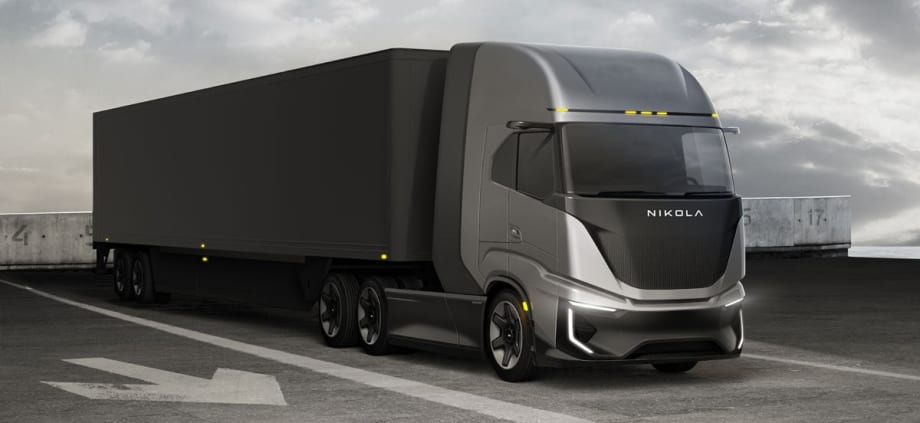
The Nikola Tre fuel-cell-electric cabover is targeted for regional hauls up to 500 miles.
Rendering: Nikola
4 min to read
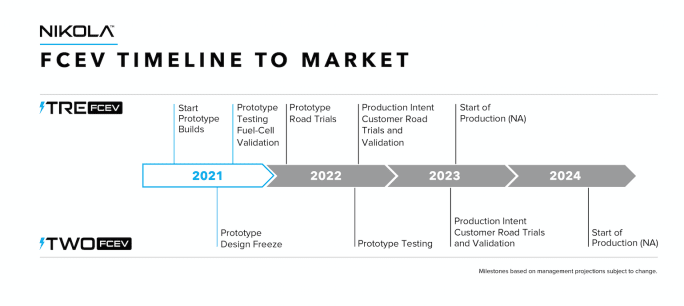
Nikola announced that it plans to start building the first prototypes of its fuel-cell-electric cabover truck in the second quarter with the goal of starting on-road trials in early 2022.
In an update on its North American hydrogen fuel-cell electric vehicle commercial truck program, the company said the fuel-cell variant of the Nikola Tre cabover will follow the launch of North American production of the Tre battery-electric truck.
Ad Loading...
The Tre is based on a Euro-style high cabover, the Iveco S-Way European cabover tractor, unveiled in 2019 as the successor to the long-running Stralis model. Nikola partnered with Italian truck-maker Iveco to gain the advantage of its manufacturing experience. The relationship will see Nikola's battery-electric and hydrogen fuel cell technology sold in Europe in Iveco chassis under the Nikola badge.
Following the FCEV version of the Tre, Nikola plans to launch the long-range Nikola Two FCEV Sleeper for ranges of 300-900 miles in the North American market, possibly as early as late 2024.
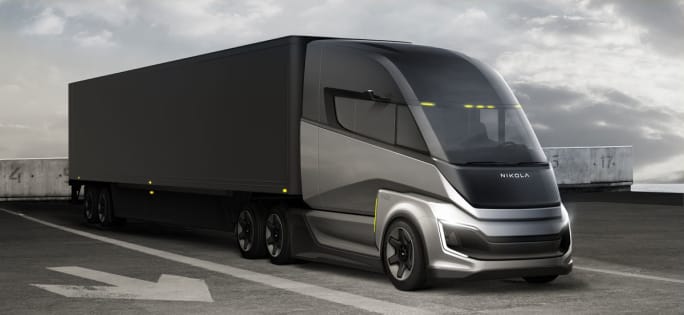
The Nikola Two fuel-cell electric truck will be designed specifically for the North American long-haul market.
Rendering: Nikola
More About Nikola’s Planned Fuel-Cell Trucks
The Nikola Tre FCEV Cabover is targeted for distances up to 500 miles. The company said it is expected to address the majority of the North American regional market, especially use cases where additional freight hauling capacity and quick fueling are required by fleet operators that would make the battery-electric version less desirable.
Ad Loading...
Nikola’s Planned EV Portfolio
Nikola said its plan includes trucks for the entire spectrum of commercial freight:
Metro/Regional: Nikola Tre BEV Cabover for trips up to 300 miles
Regional: Nikola Tre FCEV for longer-range needs of up to 500 miles and for fast fueling/quick turnaround needs
Long-Haul: Nikola Two FCEV Sleeper for longest-range missions up to 900 miles
The Tre FCEV leverages the Tre BEV platform with hydrogen fuel-cell power, while being designed to improve aerodynamics and reduce total vehicle weight, according to the company.
The first Tre FCEV prototype builds are scheduled to begin at Nikola’s facility in Coolidge, Arizona, and Iveco’s facility in Ulm, Germany in the second quarter of 2021. Testing and validation of the vehicles will continue into 2022, with production planned for the second half of 2023.
The Nikola Two FCEV Sleeper is a long-haul freight solution with hydrogen capacity allowing a non-stop range of up to 900 miles, according to the company. The Nikola Two will leverage the weight advantage of hydrogen in long-range, long-haul zero-emission commercial transportation. It will be based on a new chassis custom designed for North American long-haul routes and is anticipated to launch in late 2024.
Fuel-Cell and Hydrogen Storage Systems
The Nikola Tre and Nikola Two FCEVs are expected to use multiple common fuel-cell power modules and scalable hydrogen storage systems. Both systems are currently in development and testing with industry leaders in collaboration with Nikola Engineering, according to the company. The first Tre prototypes using these systems are expected to begin road testing in 2022.
“Our plan is to enter the market in steps,” said Jason Roycht, Nikola’s global head of FCEV. “We are building on the current Tre platform with the planned launch of our fuel-cell and hydrogen storage systems in 2023. These systems are designed to be scalable in order to handle the greater power and longer-range requirements for long-haul, which allows for concurrent integration into the chassis design of the Nikola Two FCEV Sleeper. Utilizing common components and systems for hydrogen propulsion will support greater economies of scale and also allow Nikola to continuously expand and adapt our FCEV truck portfolio to address the diverse requirements of commercial trucking.”
Ad Loading...
Nikola plans to launch the fuel-cell-electric version of the Tre cabover after it starts production on the battery-electric version.
Nikola had a rocky year in 2020. After going public in June, it found itself facing allegations of fraud in its portrayal of the readiness of its battery-electric and hydrogen fuel cell technology as well as overstating the commitments from big customers. The company denied the allegations from short-seller Hindenburg Research, but founder Trevor Milton voluntarily left the company last August amidst allegations of fraud and an investigation by the Justice Department and the SEC.
Nikola did not dispute one of the report’s most explosive claims — that the Nikola One was in fact not driving under its own propulsion in the 2017 “Future of Transportation” video, filmed for a Phillips Industries commercial (an ad you'll be hard-pressed to find today). Nikola said, “It was never described as ‘under its own propulsion’ or ‘powertrain driven.’”
Volvo’s updated D13 promises lower emissions without sacrificing performance or fuel economy. Take a closer look at what changed inside the engine in this HDT Spotlight video.
Energy Vision estimates fleets could recover the higher purchase price of an RNG-fueled Class 8 tractor in 1.3 to 2.8 years under current fuel-price scenarios.
Calstart is now Catalyst Mobility, reflecting the nonprofit’s growing national role in clean transportation, including zero-emission trucks, infrastructure and incentive programs.
Average U.S. diesel prices have climbed to nearly $6 a gallon, surpassing the 2022 record as tight refinery capacity and Middle East disruptions keep fuel costs elevated.
Fuel delivery depends on more than what happens at the injector. For fleet, maintenance and technical professionals, looking at the full path from pump to injector can provide useful context for understanding engine performance.
The Port Authority of New York and New Jersey announced millions in incentives for zero-emission drayage trucks, yard tractors, and new charging hubs near the port.
Why do battery-electric Class 8 trucks remain so expensive? A California bill headed to Gov. Gavin Newsom would give fleets and state agencies more visibility into what manufacturers charge.
Detroit isn’t starting from scratch to meet EPA 2027 diesel emissions standards. Its Gen 6 DD13 and DD15 engines keep much of today’s platform while updating the fuel and aftertreatment systems.
California, Oregon, Washington, British Columbia and Baja California are coordinating plans for truck charging and hydrogen fueling from Canada to Mexico.
Learn more about Kenworth's T880E battery-electric vocational truck at the Paccar Technical Center, including its range, applications, upfitting considerations, and PTO options, in this HDT Spotlight video.