




Caring for the Air System That Feeds Your Brakes
It might not come as a surprise that fleets often overlook brake hoses and tubing that supply air to their trucks' brakes.
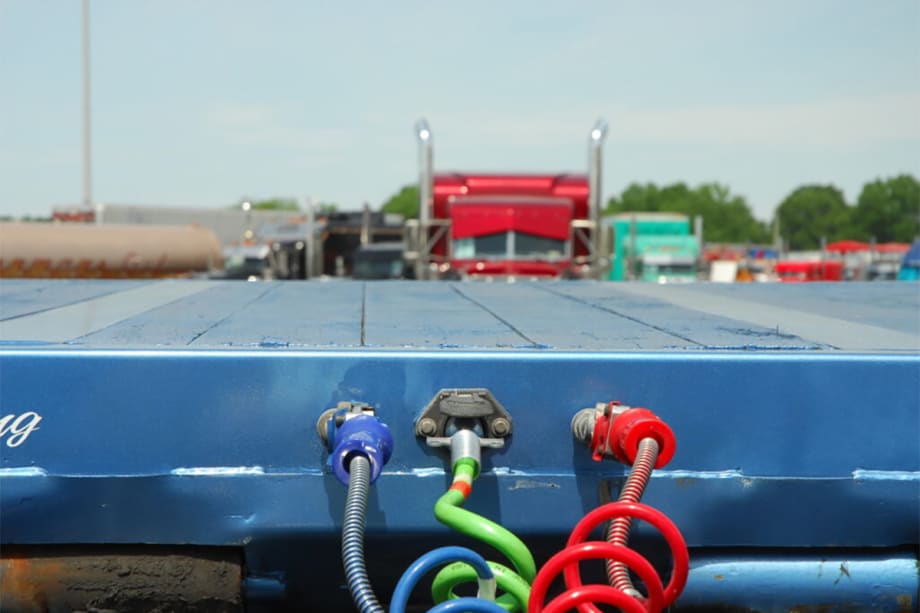
Hose lengths will make a difference when looking to protect against wear and chafing.
Photo: Jim Park
The emergency and supply lines that stretch between a tractor and trailer offer a colorful reminder that compressed air is the lifeblood of your brake system. The hoses are a respective red and blue, like arteries and veins in an anatomical drawing. That would make the compressor your air system’s heart; obstructions in the air lines like plaque that forms on an artery wall.
Maybe there should be little surprise that truck drivers often overlook brake hoses and tubing. People still die of preventable heart attacks.
“Failure of any component of a brake system could be catastrophic,” says Commercial Vehicle Safety Alliance (CVSA) president John Samis, a sergeant with Delaware State Police. “Routine brake system inspections and component replacement are vital to the safety of commercial motor vehicles.”
Even the smallest leaks in the air supply can add up to big problems.
“We’ve had incidents where it’s gotten so bad the system won’t replenish fast enough, and the air loss is so significant you’ll actually partially apply the spring brakes and cause brake drag,” says Randy Petresh, vice-president – technical services at Haldex. “The compressor can only run so long and so fast.”
There are plenty of tools to warn truck drivers about outright failures, of course. The gauge on the dash measures the pressure at hand. Warning lights and buzzers are triggered when pressures drop toward the dangerous territory of 55 psi.
But there are also early warning signs of trouble to come. A frequently cycling compressor, an unusual amount of oil draining from the air tanks, and a worn hose covering are all causes for concern.
Luckily, there are also strategies to help prevent future air system shortcomings, and they’re as effective as low-fat diets and exercise when it comes to ensuring a healthy heart.
Improving Gladhands and Air Lines
Bruce McKie, the president of Tectran – a producer of air, hydraulic, and electrical components – sees plenty of room for improvement where the tractor and trailer join together.
Air lines have been known to kink at the gladhand in the face of multiple hookups, he says as an example, making the case for spec’ing flexible hand grips that can help relieve the stresses. In contrast, a rigid grip will actually create troublesome sharp angles.
“People don’t think enough about the other reason for failure at the gladhand end, which is the stress on that section of the hose during hard right turns,” McKie adds. “Most hose connections are on the driver side of the tractor and trailer, making the distance to the trailer gladhand connection longer than during a left turn, particularly for the red, emergency line.”
Choosing proper hose lengths from a parts counter will clearly make a difference here. Some coiled lines available in today’s market are barely 15 feet long, even though they should measure 17 to 18 feet, he says.
The quality of the hose will make a difference as well. Cheaper versions may carry SAE or DOT markings, but fracture during cold impact tests, McKie says, referring to options that are sometimes made with reground rubber. That makes working with a trusted supplier particularly relevant.
High-quality air lines include multiple plies, which will make a difference in its ability to withstand forces such as temperature, road salt, and road debris, Petresh adds.
Even the newest trucks are not immune from hose-related issues. Some OEMs don’t look at the connections as part of a broader system, McKie insists. The end result can be unmatched tractor lead lengths between air and electrical lines, poorly attached clamps at the end of the spring tender kits, or a spring rate that fails to keep the air lines off the deck.
Issues like those can be solved by spec’ing the related air and electrical components, spring tenders, and gladhands as a complete kit, he says.
The threats of cuts, chafing and wear are not limited to the space between a tractor and trailer, of course. Poorly routed air lines anywhere across the vehicle can rub against all sorts of hard surfaces as equipment bounces and sways down the highway.
Petresh stresses the need to take a close look at the path for any newly installed hoses, and consider how things like suspension components will shift about as a truck rolls down the road.
“Too long, they can contact other parts of the vehicle, whether it’s a frame member or a suspension component,” he says.
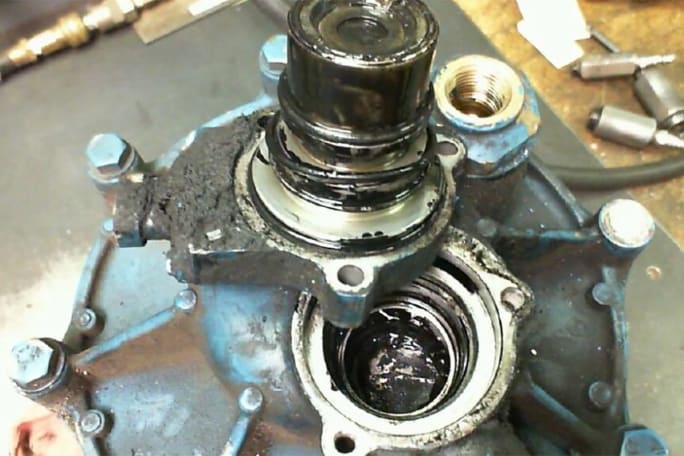
Too much oil passing through the compressor can lead to contamination downstream, as seen in this purge valve.
Photo: Bendix
Bugs, Rust, and Other Debris
The threats are not all external, either.
Disconnected gladhands can open a path for insects that like to crawl inside orifices and make themselves at home. Combine the bugs with dirt and other debris from a fleet yard, and there are plenty of contaminants that can enter an air system and ultimately wear down seals or clog valves.
Gladhand seals that incorporate pie-cut flaps offer a simple line of defence, McKie says. Other options include stainless steel gladhand filters.
Inline trailer filters can also capture contaminants that have entered the system, says Steve Edie, Meritor’s senior manager – air systems. The protective components are simply unscrewed when it’s time for cleaning during a preventive maintenance check.
It’s not the only point where an upgrade might make a difference, especially in the face of aggressive deicing compounds sprayed on today’s highways.
Gladhands with painted clamps have been known to rust, but there are other options such as stainless-steel clamps and gladhands made of anodized aluminum.
Even the air dryers designed to treat the air are under attack.
Full-feature air dryers tend to be mounted somewhere on the frame rail, which subjects them to the corrosive effects of highway de-icing compounds, explains Rich Nagel, Bendix director of marketing and customer solutions – air supply and powertrain. To compound problems, fluctuating temperatures lead to the ongoing freeze and thaw cycle that increases corrosion across the board.
The air dryer bodies can pit and form leaks, he says, adding that related ports and pressure protection valves can be attacked as well.
Then there’s the related wiring to consider.
“There a heater in the dryer,” Nagle says, “and the heater has a harness.”
Wet Air and Winter Woes
That air dryer is in place to help combat another ongoing threat that travels through hoses. Moisture that hangs in the air generated by a compressor will condense as it cools, creating unwanted pools downstream, and even icing in place depending on the weather.
While airline antifreeze can attack such ice, to free locked brakes, its use is discouraged. At the very least, its use should be limited.
“You’re introducing a fluid in there that’s not planned to be there, that’s not designed to be there,” Edie says. The viscous fluid likes to cling to moving parts, and it can wreak havoc with internal seals.
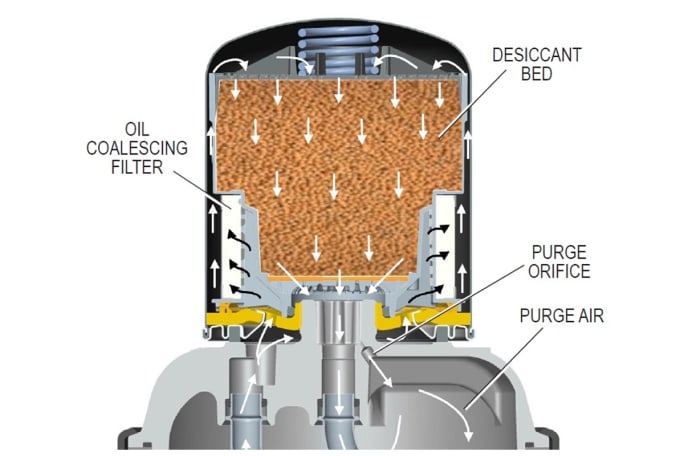
Oil coalescing filters are becoming increasingly popular as a defensive tool to protect everything from transmissions to emissions components that tap into the air system.
Image: Bendix
Oil Coalescing Filters
Meanwhile, oil that passes through the air lines can be a sign of other trouble upstream.
A little bit of oil will pass through even the newest compressors, but the volumes can easily increase to excessive levels – especially as engines run hotter in the name of performance. It can create some costly damage downstream, especially when it comes to the automated transmissions and emission-related components that tap into the same air supply, Edie says.
The attacks don’t end there. The oil can lead to the premature death of brake chamber diaphragms, dash valves, and spring brake modulating valves alike. And every deteriorating seal contributes to leaks that can ultimately ground a tractor-trailer during a brake blitz.
One of the best lines of defense here will come in the form of oil coalescing filters, which Edie says are becoming increasingly popular.
Still, don’t discount problems with the compressor itself.
A compressor that faces an excessive duty cycle will run hot, and the oil will create a buildup of carbon on the discharge line, Nagle says, offering one sign of trouble.
Single-piston compressors may be lighter and less expensive than the dual-piston designs that were commonplace 20 years ago, but they are also more prone to vibration-related wear, he adds.
When it comes time to actually replace a compressor, keep in mind that the quality of remanufactured components will vary as well. A truly remanufactured compressor comes with pistons re-honed to a factory finish, he says as an example. Cheaper versions may simply be cleaned up, and incorporate substandard replacement components.
You get what you pay for.
Valves and Connectors
The path for the air is not limited to the hoses and tubes, of course. It’s directed to good use through a series of valves, and decisions at the parts counter will make a difference here as well.
There are probably 20-30 different part numbers associated with a basic R12 valve, Petresh says, referring to differences that can range from port locations to crack pressures. Reaching for the wrong option can affect brake balance.
Nagle, meanwhile, refers to unwanted restrictions that can be created if someone reaches for a ¼-inch line in place of a 3/8-inch line during a quick repair, or introduces 90-degree fittings to redirect an air line on a new path.
“You’re not going to get the same response,” he says. “People don’t take that into account, and they’ll come up with crazy solutions to overcome an interference.”
“When you change the inside diameter of the hose, you change the length of it, you’re impacting the pressure of the system,” Edie agrees. “That can affect, for instance, the timing and the activation of the brakes and cause uneven braking applications.”
“Should you have a brake problem caused by the air system, replace both sides,” he suggests. “That way you have an equivalent system on both sides, and you don’t take that problem you just fixed and move it to the other side.”
Preventive Maintenance Inspections
Over time, the condition of the related connections and fittings will also need to be inspected.
Little issues like small cracks around the outside diameter of a push-to-connect fitting may not actually shut down a truck on their own, but they can contribute to broader problems, Nagle says. The best way to spot issues like these will involve a simple bubble test, brushing on a layer of dish soap to spot any minor leaks.
Taking the time to watch for such weaknesses will pay dividends in the way systems perform. It’s why Petresh suggests a thorough bubble check every couple of years, perhaps aligning the work with the replacement of the air dryer cartridge.
“Air systems by their very nature leak. They’re not leakproof,” he says. “That’s why you have a renewable power source in the compressor.”
More Maintenance

Mack Expands Extended Coverage With Four Chassis System Plans
Mack Trucks' new system-specific coverage options allow heavy-duty fleets to select protection for driveline, cab, HVAC, electronics, and advanced safety components.
Read More →
What an Out-of-Service Order Really Costs, and How to Plan for One
The repair invoice is the first number you see — and often one of the smallest. Here’s what else an out-of-service order can cost a fleet, and how planning can reduce the damage.
Read More →
International Launches Online Truck Parts Store
Fleetrite.com lets fleets and repair shops find OEM and all-makes parts, check prices and availability, and order without calling a parts counter.
Read More →

Continental Introduces New Regional Truck Tires
Continental says its new Generation 5 steer and drive tires for regional operations offer longer tread life, with estimated mileage gains of 22% and 19%, respectively.
Read More →
How AI Can Help Your Techs’ Efficiency
The technician shortage isn't going away, and no single fix can close the gap on its own. Trent Broberg makes the case that AI's real job in the shop is protecting the billable hours and job satisfaction of the techs you already have, not asking them to work faster.
Read More →
Color Match Smarter: Tools That Restore & Perform
For fleet managers and collision repair professionals keeping heavy-duty trucks on the road, getting the color right the first time isn't just about appearance — it's about efficiency, turnaround time, and bottom-line results. Discover how today's digital color tools are transforming the repair process from guesswork to precision.
Read More →
Wrong Repair Prompts Recall of Freightliner, Western Star 4x2 Trucks
DTNA is recalling more than 2,400 trucks that received an incompatible software fix instead of the hardware repair required to address brake valve corrosion.
Read More →
Truck Drivers Need More Than Another Alert
Fleets have more visibility into truck health, safety events, and driver activity than ever. The next challenge is turning all that information into useful guidance for the person who has to decide what to do next.
Read More →
The Maintenance Checks Trucking Fleets Should Prioritize Before Fall Freight Picks Up
Making it through August isn’t the same as being ready for the next several months of operation. Find out what systems may have suffered from summer heat and need to be checked out before fall.
Read More →
What Three Fleets Are Doing Differently When Buying Truck Parts in 2026
With freight improving but costs still climbing, fleet maintenance executives explain how they're balancing price, quality, and supplier relationships.
Read More →