





Related: Trucking Through the Pandemic
COVID-19 Disruption Continues to Affect Freight, Rates
Pent-up consumer demand from COVID-19 shutdowns continues to buoy spot freight rates, but a still-weak manufacturing sector has experts at FTR cautioning that things could turn downward again.
September 10, 2020
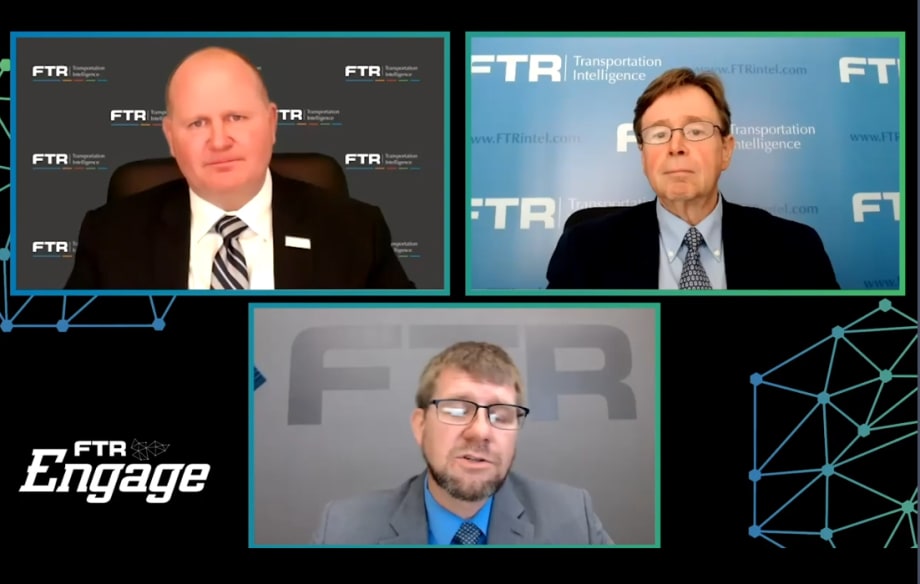
FTR's Eric Starks, Avery Vise, and Jonathan Starks talk trucking's recovery.
Screenshot of FTR Engage virtual event
5 min to read
Pent-up consumer demand from COVID-19 shutdowns continues to buoy spot freight rates, but a still-weak manufacturing sector has experts at FTR cautioning that things could turn downward again.
In a Sept. 10 FTR Engage virtual event, Vice President of Trucking Avery Vise and CEO Eric Starks shared their insights into current trucking and economic numbers and what they may mean in the coming months and into 2021.
The shutdowns caused by the pandemic starting in March caused “an immediate and severe contraction in just about everything” that lasted for four to six weeks, with a rebound starting in May as some states started reopening. Several months later, while there has been a major bounceback in a number of consumer metrics as people released pent-up demand, and spot freight rates are reflecting that, all is not rosy.
“There’s been a clear difference between the consumer and industrial sectors,” explained Vise. Financial help from the federal government, such as extra unemployment benefits, the PPP loans, the CARES Act, and stimulus checks, helped buoy the consumer sector.
“We have much more than fully recovered when you look at new home sales,” Vise said. “In retail, it does seem that the surge has peaked and we’re returning to a more normal environment.”
The industrial sector, however, is still significantly below where it was pre-pandemic. Industrial production and manufacturing are down 8% from February, and durable goods orders are down 6%. Consumer airplanes have taken a huge hit, and numbers are down less if you take those out, “but it’s still down, while consumer metrics are up.”
One of the biggest indicators of the disruption the supply chain has gone through due to Covid-19, Vise said, is the inventory-to-sales ratio. “Inventories relative to sales in retail were the lowest ever in June by a long shot.”
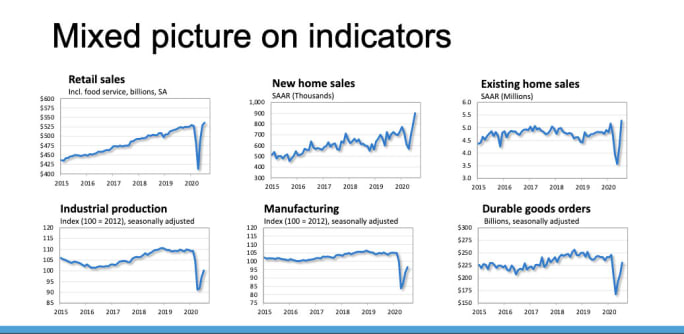
Industrial economic indicators have not bounced back as strongly as consumer indicators.
Credit:
FTR
Starks explained, “When we have such low inventory levels… that puts pressure on the movement of goods. It doesn’t put a lot of pressure on the movement of industrial goods, it’s, ‘How do I get stuff into the retail arena, how do I restock.”
We’ve seen that in the increase in traffic coming into the West Coast ports, which many in the industry had not predicted.
“Structurally, that becomes a question mark – can this kind of strength continue?” Starks said. “I think it’s too early to say. I have been one of the more pessimistic people out there in how I view this pandemic. I’m waiting for the data to show up that says, ‘All’s good we’re back to normal,’ and I think it’s farther out than a lot of people expect.
“Manufacturing is the largest part of freight movements, and that hasn’t turned the corner.”
If we’re fortunate, by the time the retail surge from restocking and stocking for the holidays subsides, manufacturing will have a chance to catch up. “I think that would be fantastic, but I’m not quite there yet,” he added.
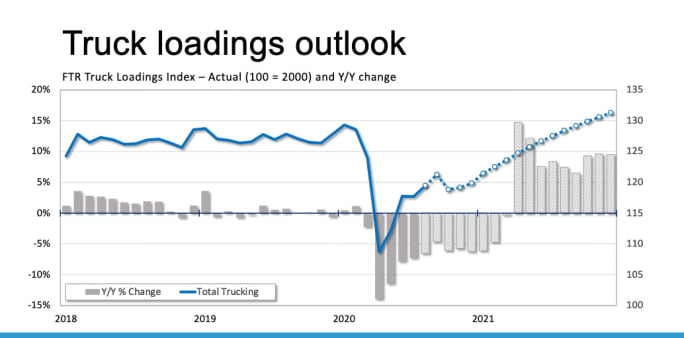
The COVID-19 pandemic has drastically disrupted truck freight.
Credit:
FTR
Freight Rates
“The spot market has been on a wild ride this year,” Vise pointed out. For a few weeks in March, as quarantine demand and panic buying hit groceries and toilet paper and similar products, rates were up for a brief period, “then things fell apart in April. Loads were down almost 60% year over year and rates were down nearly 25% in the middle of April. W’eve seen a pretty dramatic shift the other way, starting in late May and early June.”
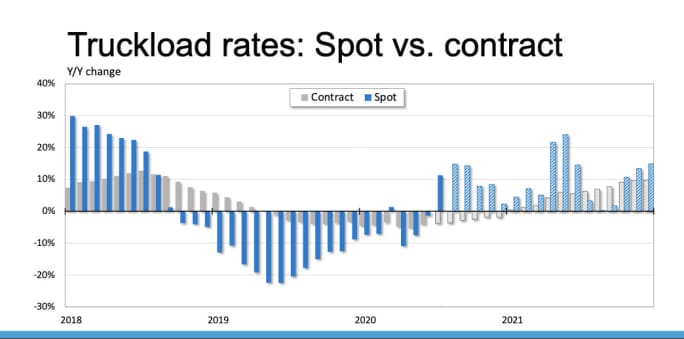
Spot rates are not the same as the entire freight market.
Credit:
FTR
Dry van has been especially strong, he said, with load volume well over twice as strong and rates 40% higher year over year. Much of this is due to the automotive market, which is a big part of dry van, which has been making up for lost time after the spring shutdown.
“But the spot market is not the freight market,” Vise said. “The overall freight market clearly has not recovered to the extent the spot market has. The unprecedentedly lean inventories we had on the retail side were not matched on the manufacturing side.”
FTR’s current forecast for total freight loadings is down just over 6% for 2020 from last year, and for about 6% growth in 2021.
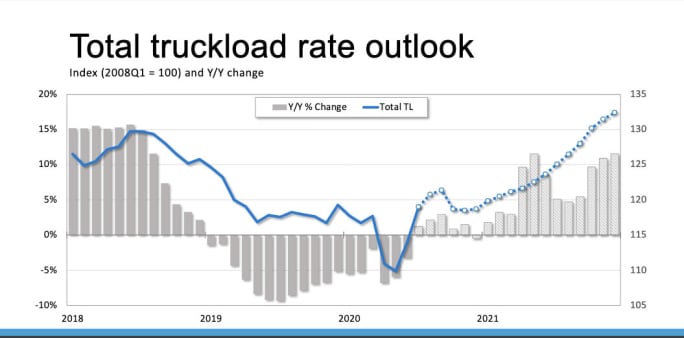
FTR predicts rates will be down this year compared to 2019 but will rise in 2021.
Credit:
FTR
One of the reasons spot rates are currently high is that capacity is currently tight – and that’s because we haven’t brought all the drivers back into the industry, not because of a lack of trucks, many of which Starks said are still parked against the fence.
Vise offered a number of reasons for that:
• Carriers are slow to add back drivers because of uncertainty about whether the current surge in demand will continue
• With federal assistance such as extra unemployment payments, PPP loans, and stimulus checks, some drivers may feel less pressure to get back to work
• The new drug and alcohol clearinghouse that went into effect in January shows that through July, about 29,000 drivers have tested positive or refused tests
• inflow issues – the Commercial Vehicle Training Alliance estimates that social distancing and COVID-19 issues in some states could see 40% fewer commercial drivers’ licenses issued this year. So we may have fewer drivers coming into the market.
• We’ve probably seen some temporary or permanent retirements due to COVID-19 as older drivers who face a higher chance of death from the virus decide it’s not worth the risk.
• The industry is likely seeing some competition for those drivers from the dramatic growth of local delivery, which has grown 9% since February.
However, overall, FTR is projecting that rates will be down roughly 2% year over year for 2020. The latest forecast has refrigerated turning positive by the barest of margins by the end of the year. Looking ahead to next year, FTR sees about 7% rate growth overall.
More Fleet Management

Why Private Fleets Are Taking More Freight
Private fleets are putting their own trucks on demanding customers and high-cost lanes as companies seek greater control over service, costs, and capacity.
Read More →
Sponsored•September 16, 2026
Color Match Smarter: Tools That Restore & Perform
For fleet managers and collision repair professionals keeping heavy-duty trucks on the road, getting the color right the first time isn't just about appearance — it's about efficiency, turnaround time, and bottom-line results. Discover how today's digital color tools are transforming the repair process from guesswork to precision.
Read More →
FMCSA Pauses Biennial-Update Enforcement Amid Motus Transition
Carriers whose updates were due on or after June 1 have more time, while FMCSA works to stabilize its new registration system and warns of phishing sites impersonating its new carrier registration system, Motus.
Read More →


Sponsored•September 14, 2026
2026 Blueprint for Countering Smarter Supply Chain Theft
Cargo theft is no longer just the cost of doing business. It's a multi-billion-dollar criminal enterprise exploiting vulnerabilities across your fleet, drivers, and supply chain.
Read More →
Sponsored•September 1, 2026
How Telematics Improves Visibility, Control, and Performance in Refrigerated Fleets
Explore how telematics help refrigerated fleets improve visibility, uptime, efficiency, compliance, and cargo protection across connected cold chain operations.
Read More →
What the U.S.-Canada Trade War Means for Trucking
Escalating U.S.-Canada tariffs could disrupt cross-border freight, reduce truck volumes, raise costs, and create new uncertainty for carriers on both sides of the border.
Read More →
What Are Trucking’s Top Concerns for 2026?
The American Transportation Research Institute wants to know what's worrying trucking fleet managers, drivers, and other stakeholders in its annual Industry Issues survey.
Read More →
American Trucking Associations Looks for a New Leader
ATA President and CEO Chris Spear abruptly left his job at the association on August 21, at a pivotal time for the trucking industry.
Read More →
Public Wi-Fi Cybersecurity Risks: How Truck Drivers and Fleets Can Protect Their Data
Public Wi-Fi can expose truck drivers and fleets to credential theft, malware, and other cyber threats. Here’s how to reduce the risk on the road.
Read More →
For Nicky Cupp, Fleet Innovation Starts With Frustration
HDT Truck Fleet Innovator Nicky Cupp turns everyday pain points at Fraley & Schilling into opportunities for better technology and smarter processes.
Read More →