




Volvo, Pilot to Build Public Heavy-Duty Truck Charging Network
Pilot intends to install charging infrastructure at travel centers across the U.S. The network will be open to all heavy- and medium-duty trucks.

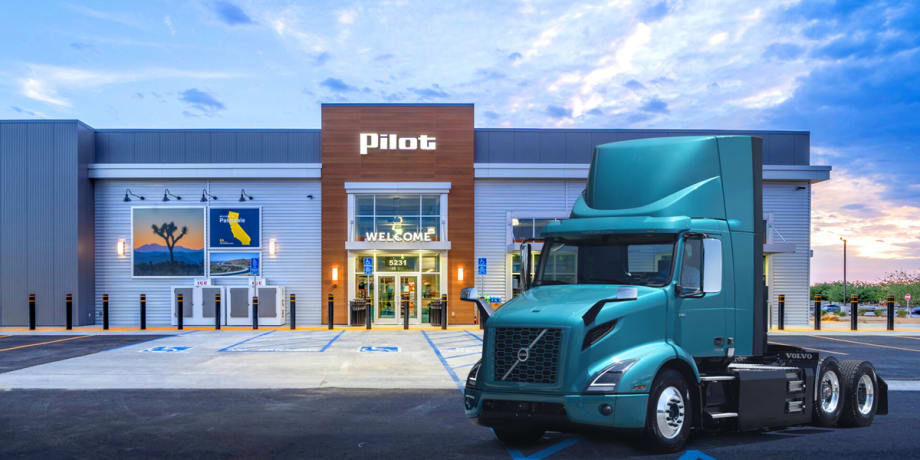
Volvo will help identify which of the existing Pilot and Flying J travel centers should be prioritized for the charging infrastructure based on current and anticipated battery-electric truck deployment volume.
Photo: Volvo
The Volvo Group and Pilot Company signed a letter of intent to develop a national, public charging network to support the scaling of Class 8 battery-electric trucks.
To accelerate development of the charging network, Pilot intends to install high-performance charging infrastructure at selected existing network of Pilot and Flying J travel centers across the U.S. The network will be open to all heavy-duty vehicle brands, and will be able to support medium-duty truck charging as well.
The partnership will address charging infrastructure accessibility and roadblocks, including long project lead times and high installation costs, that can otherwise delay scaled deployment of battery-electric vehicles, Volvo officials said in a press release.
“Our VNR Electric customers, as well as other fleets looking to adopt battery-electric trucks, will have peace of mind that they can access a reliable and robust, publicly accessible charging network strategically located along major transportation corridors, enabling them to extend their operating radius and decarbonize even more of their routes,” said Peter Voorhoeve, president, Volvo Trucks North America.
Volvo will help identify which of the existing Pilot and Flying J travel centers should be prioritized for the charging infrastructure based on current and anticipated battery-electric truck deployment volume, customers charging needs and patterns, and the availability of federal and state funding to support capital costs.
To date, early adopters of Volvo VNR Electric and Mack LR Electric trucks have utilized depot charging to support daily routes, where trucks return to one location to charge. The introduction of public charging infrastructure that can accommodate medium- and heavy-duty fleets goes hand-in-hand with recent bipartisan support of the goal to increase BEV charging capabilities and reduce the carbon footprint of the transportation industry, Volvo officials said.
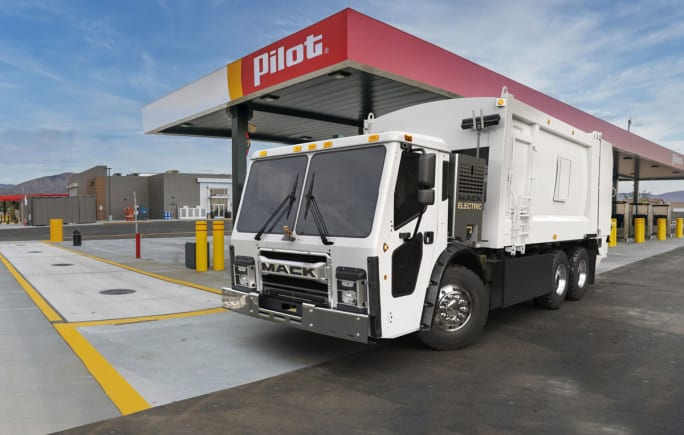
Class 8 Mack LR Electric refuse model.
Photo: Mack Trucks
Pilot operates a network of more than 750 travel centers throughout North America, covering 44 U.S. states and six Canadian provinces.
More Fuel Smarts

How Volvo Updated Its D13 for EPA 2027 [Watch]
Volvo’s updated D13 promises lower emissions without sacrificing performance or fuel economy. Take a closer look at what changed inside the engine in this HDT Spotlight video.
Read More →
Diesel Price Spike Shortens Payback for Natural Gas Trucks, Report Says
Energy Vision estimates fleets could recover the higher purchase price of an RNG-fueled Class 8 tractor in 1.3 to 2.8 years under current fuel-price scenarios.
Read More →
Calstart Becomes Catalyst Mobility, Reflecting Broader Focus
Calstart is now Catalyst Mobility, reflecting the nonprofit’s growing national role in clean transportation, including zero-emission trucks, infrastructure and incentive programs.
Read More →

Record Diesel Prices Squeeze Trucking Fleets
Average U.S. diesel prices have climbed to nearly $6 a gallon, surpassing the 2022 record as tight refinery capacity and Middle East disruptions keep fuel costs elevated.
Read More →
How Fuel Delivery Shapes Engine Performance
Fuel delivery depends on more than what happens at the injector. For fleet, maintenance and technical professionals, looking at the full path from pump to injector can provide useful context for understanding engine performance.
Read More →
East Coast Port Launches $45M Electric Truck Push
The Port Authority of New York and New Jersey announced millions in incentives for zero-emission drayage trucks, yard tractors, and new charging hubs near the port.
Read More →
California Bill Could Shed Light on Electric Truck Prices
Why do battery-electric Class 8 trucks remain so expensive? A California bill headed to Gov. Gavin Newsom would give fleets and state agencies more visibility into what manufacturers charge.
Read More →
Detroit Opens Orders for EPA 2027 Engines
Detroit isn’t starting from scratch to meet EPA 2027 diesel emissions standards. Its Gen 6 DD13 and DD15 engines keep much of today’s platform while updating the fuel and aftertreatment systems.
Read More →
Zero-Emission Truck Corridor Planned for West Coast
California, Oregon, Washington, British Columbia and Baja California are coordinating plans for truck charging and hydrogen fueling from Canada to Mexico.
Read More →
A Closer Look at Kenworth’s Electric T880E Vocational Truck [Video]
Learn more about Kenworth's T880E battery-electric vocational truck at the Paccar Technical Center, including its range, applications, upfitting considerations, and PTO options, in this HDT Spotlight video.
Read More →