




Volvo Issues Upbeat Truck Forecast Heading into Fall
Citing positive North American market trends, Volvo is predicting a Class 8 market of approximately 215,000 units by year's end.


Volvo executives (left to right) John Mies, Rikard Orell, Jason Spence, Magnus Koeck and Göran Nyberg celebrate the launch of the new VNL tractor in New River, VA, on July 12, 2017. Photo: Jack Roberts
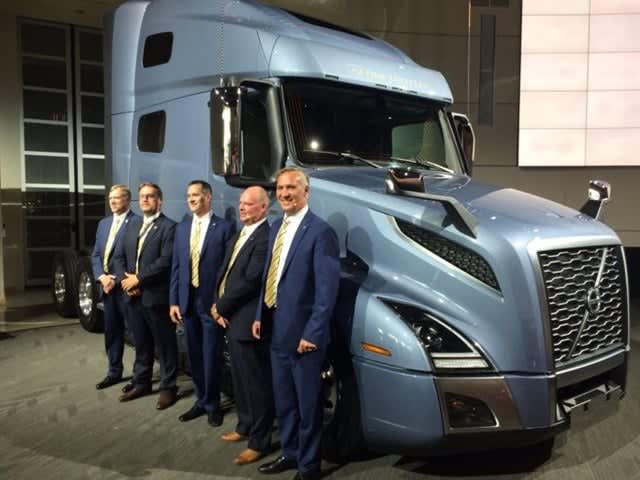
Volvo executives (left to right) John Mies, Rikard Orell, Jason Spence, Magnus Koeck and Göran Nyberg celebrate the launch of the new VNL tractor in New River, VA, on July 12, 2017. Photo: Jack Roberts
By day’s end, with the new VNL launch behind them and the cocktail reception kicking off, the mood among Volvo Trucks North America executives was positively jubilant.
The press debut of the new tractor had gone off without a hitch. And even more exciting, from the executives’ point of view, order books for the new truck had opened earlier in the day to enthusiastic responses from Volvo customers. And while he declined to give specifics, one Volvo official described the response from North American fleets and dealerships as “phenomenal.”
It was a fitting cap to an upbeat day, which included an optimistic update on the state of the North American truck market for the year to date by Claes Nilsson, president of Volvo’s global truck operations.
Because Volvo is one of the largest truck and engine manufacturers in the world today, Nilsson naturally began by looking at global market conditions, citing the company’s current 17% market share in Europe while noting that Volvo is now the “leading” truck OEM in Russia, with 23% share in that market. The United States remains the largest truck market in the world, he added, with Germany in second place.
South American markets are generally strong, Nilsson said, although demand in Brazil is currently weak. Core markets in Asia and Africa, including South Korea, Japan, and South Africa are also strong – although Nilsson said demand in oil-producing countries is flat.
In North America, Nilsson said Volvo feels the market has flattened out and is looking for upward sales pressure moving into the second half of 2017 – a trend he is confident the new VNL tractor will be able to capitalize on.
Volvo’s North America President Göran Nyberg built upon Nilsson’s comments, noting that a strong labor market in the U.S. and a boost in consumer spending is driving Gross Domestic Product growth, which he said points to a rebounding marketing sector as the year closes out and should lead to moderate growth in that sector in 2018.
Other positive trends cited by Nyberg include low diesel prices as well as a domestic construction market currently at an all-time high level and poised for continued, gradual increases in volumes.
Breaking North American trucking market segments down, Nyberg said Volvo sees increased equipment demands in long haul, regional haul, and construction, while demand for natural gas-powered trucks is holding steady at last year’s volumes.
All told, Nyberg said he predicts a “fairly strong” Class 8 market in North America of around 215,000 units for 2017.
Looking at the state of Volvo’s North American operations, Nyberg said that to date, 93% of new Volvo trucks have been spec’d with Volvo engines, while 91% of those trucks rolled off the factory floor fitted with an I-Shift automated manual transmission. Moreover, Volvo now has more than 120,000 “connected” trucks on the road capable of remote programming to update powertrains and after-treatment systems.
Volvo now has 420 dealerships in North America, Nyberg added, and the company has invested more than $600 million in those facilities and personnel since 2010. This figure includes a recent investment of more than $38 million, which includes the new Customer Center in New River, VA, as well as enhancements to the company’s manufacturing facility there.
More Fleet Management

Geotab Links Fleet Card to Vehicle Data
The new card combines fuel discounts with telematics-based purchase controls. Geotab’s analysis also points to potential savings from choosing lower-priced fuel stops.
Read More →
How MFA Helps Protect Trucking Fleets
Multi-factor authentication adds protection when passwords are stolen. Here’s how it works and where fleets should start.
Read More →
How Better Freight Data Helps Trucking Teams Get Ahead of Disruption
Trucking and logistics teams have plenty of data. The problem is getting the right information in front of the right people soon enough to act. Better-connected data can help teams spot trouble earlier and make smarter decisions before small problems become big ones.
Read More →

Trimble: Taking Artificial Intelligence in Trucking Beyond Faster Tasks
At Insight 2026, Trimble executives argued that fleets may need to redesign workflows to get more from AI as it introduced new products and enhancements. AI’s value will depend on how fleets combine automation with their people's knowledge.
Read More →
Build a bulletproof fleet: Uniting ELDs and dash cams for total compliance
An ELD can prove compliance, but it cannot always prove what happened on the road. Discover how uniting accurate ELD data with AI-powered dash cam video can help your fleet strengthen compliance, defend against liability, protect drivers and reduce operational costs.
Read More →
Nominations Open for HDT Emerging Leaders
Heavy Duty Trucking is looking for accomplished trucking fleet professionals under 40 who are making an impact and helping lead the industry forward.
Read More →
Why Private Fleets Are Taking More Freight
Private fleets are putting their own trucks on demanding customers and high-cost lanes as companies seek greater control over service, costs, and capacity.
Read More →
Color Match Smarter: Tools That Restore & Perform
For fleet managers and collision repair professionals keeping heavy-duty trucks on the road, getting the color right the first time isn't just about appearance — it's about efficiency, turnaround time, and bottom-line results. Discover how today's digital color tools are transforming the repair process from guesswork to precision.
Read More →
FMCSA Pauses Biennial-Update Enforcement Amid Motus Transition
Carriers whose updates were due on or after June 1 have more time, while FMCSA works to stabilize its new registration system and warns of phishing sites impersonating its new carrier registration system, Motus.
Read More →
2026 Blueprint for Countering Smarter Supply Chain Theft
Cargo theft is no longer just the cost of doing business. It's a multi-billion-dollar criminal enterprise exploiting vulnerabilities across your fleet, drivers, and supply chain.
Read More →