




Related: Report Reveals Utility Trailer's Environmental and Sustainability Improvements
Utility Trailer’s View of Market Forces, from the Coronavirus to Trade to Technology
Utility Trailer Manufacturing is emerging from a record-breaking year, building 51,911 trailers in 2019. The question now is what the trailer market is expected to do in 2020
by John G. Smith
February 25, 2020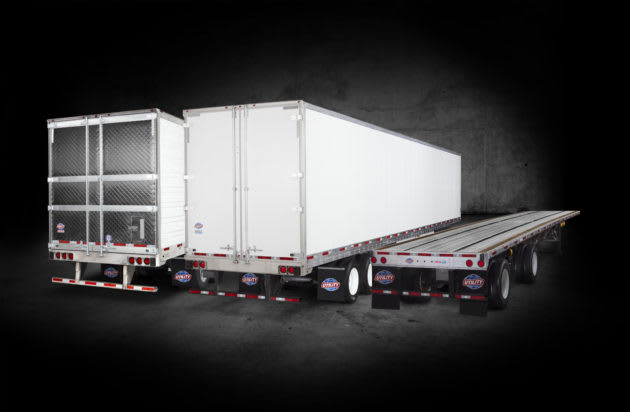
Utility is emerging fom a record-breaking year, building 51,911 trailers in 2019.
Image: Utility Trailer
4 min to read
Utility Trailer Manufacturing is emerging from a record-breaking year, building 51,911 trailers in 2019. The question now is what the trailer market is expected to do in 2020.
“This year is another story,” said senior vice-president of sales and marketing Craig Bennett, referring to a softening market. “We’re all, moving forward, figuring out what 2020 will be like,” he said during a media briefing at February’s annual meeting of the Technology & Maintenance Council in Atlanta.
The questions are not limited to the industry’s thirst for trailers, either.
While the coronavirus has not yet emerged in the U.S., trailer manufacturers rely on offshore suppliers for components like bearings and it’s still unknown how much China’s economy will be affected.
The disruptions in the supply chain have been minimal so far, Bennett said, noting that some suppliers have been looking to diversify their offerings, but that takes time.
Bennett also sees the new United States, Mexico, and Canada (USMCA) trade agreement as a key for economic stability. “[Canada’s Prime Minister Justin] Trudeau hasn’t gotten that done, and we need to get that done,” he said, referring to the fact that Canada is the only one of the three trade partners that has yet to ratify USMCA.
A Banner Year
Still, there’s no denying the strength of 2019.
Utility has never built more than 50,000 trailers in a single year before. Its maximum output of 63,000 units – 32,000 reefers at three plants, 27,000 dry vans from two locations, and 4,000 flatbeds at another facility – would only be met if buyers didn’t request any options. And they always have specific needs.
Its production has also been on a steady rise since a plunge in the North American trailer market in 2009.
Bennett admitted that a 10-year upcycle is “highly unusual,” and that the gains are usually experienced over five years. But that’s a good situation to be in.
“We’re not sure what the size of the replacement market in America really is today,” he added. It continues to fluctuate with trade patterns shifting through e-commerce, and manufacturers changing locations.
Utility now enjoys a 15.7% share of the North American trailer market, excluding chassis and dollies. In Canada, the share is closer to 20%, he noted. Reefers account for 52% of its sales, with 43% including dry vans, and the remainder being flatbeds and Tautliners.
The size of individual orders has also been growing. The average now is 19.9 trailers at a time. Not long ago, those numbers were closer to single digits.
This leaves Utility more exposed to downward shifts in the truckload market, but segments such as food services and leasing have been stable, he said.
Small and mid-sized carriers are feeling their own pressures, particularly when it comes to downward pressure on rates, he added. “When they don’t make a lot of money, guess what? They don’t buy a lot of equipment.”
Technology’s March
In the midst of it all, the equipment continues to evolve.
In the push for better fuel economy, Utility has opted to produce its own aerodynamic devices rather than relying on third-party component suppliers.
“We can be sure the life cycle of the products is tested, so we know the products are going to last as long as the trailer lasts,” Bennett said, referring to Utility’s side skirts and recently introduced aerodynamic tail. “The devices have to be durable and yet flexible, and that’s the trick.”
Its side skirts, for example, will flex 45 degrees, and are held in place by a unique bolted spring-shaped bracket. And the Utility Aerodynamic Tail that runs along the trailer wall and roof will open and close with the doors.
Collectively, they can improve fuel economy by 3.7%, which Utility says is in line with what carriers actually experience on the road, rather than an empty promise.
As this year opened, the company also had to update its foam formulations to satisfy requirements of the California Air Resources Board. It is no small feat considering that the material meets insulating and structural needs, he said.
Outside the trailers themselves, Utility continues to monitor advances in telematics, and is looking for key component suppliers like Bendix, Hendrickson and ConMet to embrace a common platform.
“The challenge still is to pull that information on one platform and get it on one bus,” he said. “We’re really watching and seeing what the users are wanting, and they haven’t really coalesced around one thing.”
Electric Reefers
And while Bennett sees promise in electric refrigeration units, he said the higher cost will still require support from government grants.
It could lead to new players in the market, too. Thermo King and Carrier are both electrifying units, but they are working with systems that were originally designed for diesel power, he observed.
Those with a clean sheet, like Arizona-based Advanced Energy Machines, might be successful in their own right.
“It’s a very clever-looking unit,” he said of that equipment. “The world’s going that way.”
More Equipment

How Volvo Updated Its D13 for EPA 2027 [Watch]
Volvo’s updated D13 promises lower emissions without sacrificing performance or fuel economy. Take a closer look at what changed inside the engine in this HDT Spotlight video.
Read More →
Michelin Tire Improves Efficiency and Durability for Regional Fleets
The Michelin X Multi Energy D2 is a regional haul drive tire engineered to help fleets improve fuel efficiency, durability and traction in demanding stop-and-go operations.
Read More →
ZF Expands Commercial Vehicle Push in North America
ZF is expanding its North American commercial-vehicle presence with new transmission applications, electrification, trailer technology and autonomous-driving systems.
Read More →
Tesla Wants a Self-Driving Semi. Are Cameras Enough?
Could Tesla’s camera-only autonomous driving technology work on an 80,000-pound Semi? In this commentary, HDT's Deborah Lockridge takes a look at Tesla, Cybercab, and how autonomous trucks see the road.
Read More →
Kodiak: Driverless Long-Haul Truck Launch on Track for 2026
Kodiak AI says its driverless long-haul safety case is 93% complete and it remains on track to begin commercial operations by year-end 2026.
Read More →
What DOT’s Automated Vehicle Strategy Means for Trucking
The U.S. Department of Transportation issued a new automated-vehicle strategy that outlines plans for driverless-truck regulations, cross-state freight corridors, and federal safety standards.
Read More →
East Coast Port Launches $45M Electric Truck Push
The Port Authority of New York and New Jersey announced millions in incentives for zero-emission drayage trucks, yard tractors, and new charging hubs near the port.
Read More →
PlusAI Going Public to Fund Autonomous Truck Launch
A SPAC deal could provide PlusAI with up to $300 million as it works toward a 2027 commercial launch of factory-built autonomous trucks.
Read More →
NHTSA Moves to Rewrite Truck Fuel-Economy Rules
The National Highway Traffic Safety Administration says it lacks authority to regulate medium- and heavy-duty truck engines separately from complete vehicles, but the existing standards have not yet been eliminated.
Read More →
Detroit Opens Orders for EPA 2027 Engines
Detroit isn’t starting from scratch to meet EPA 2027 diesel emissions standards. Its Gen 6 DD13 and DD15 engines keep much of today’s platform while updating the fuel and aftertreatment systems.
Read More →