





From the HDT archives: Trailer Maker Says EPA ‘Overstepped’ on GHG/Fuel Economy Proposal
Utility Trailers Reviews 2016, Looks Ahead to 2017 and New Regs
Utility Trailer Manufacturing Co. is “fairly optimistic about 2017,” according to Craig Bennett, senior vice president of sales and marketing. Bennett and his team are moving into 2017 with some new products and an eye on incoming federal regulations.
January 26, 2017
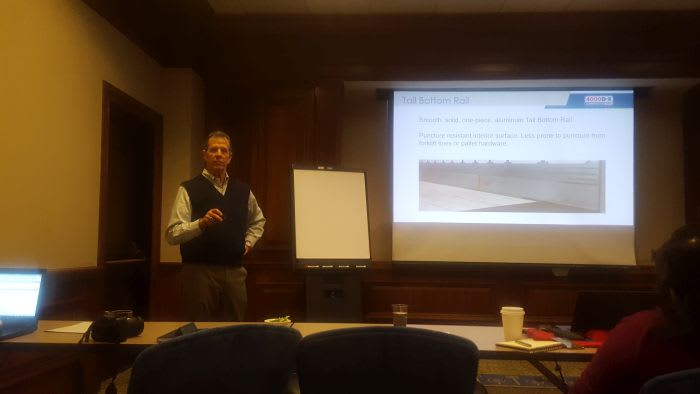
Photo: Stephane Babcock
2 min to read
Photo: Stephane Babcock
Utility Trailer Manufacturing Co. is “fairly optimistic about 2017,” according to Craig Bennett, senior vice president of sales and marketing. After closing out the year with a 15.9% total market share, which includes a 54.2% share in the reefer segment, Bennett and his team are moving into 2017 with some new products and an eye on incoming federal regulations.
Celebrating its 103rd year in the trailer business, Utility is also “seeing some life in the flatbed segment,” he told reporters in a media event at the company's City of Industry headquarters in California. With the introduction of the 4000AE, the company is looking to increase its market share. With predictions for a decrease in the overall trailer market, Bennett is still optimistic.
“The current estimates are showing a 10-15% reduction in trailers this year, and that would be a very manageable level,” said Bennett. “Nothing dropping off a cliff like it did in 2009.”
The trailer manufacturer is hoping that two new trailers it announced last fall -- the 4000D-X TBR, a composite dry van trailer, and the 4000AE, a combo flatbed trailer -- will boost the company’s market share.
The 4000D-X TBR is built to withstand repeated wall impacts and includes a bottom rail that measures 10 inches taller than a standard bottom rail.
“We think this is going to be a real winner for us,” said Bennett.
The 4000AE combines steel and aluminum to reduce weight, while still offering a price close to all-steel flatbeds. The company replaced the steel crossbeams with aluminum, which results in a 536-pound weight reduction.
Utility is also preparing for the incoming GHG Phase 2 regulations, pointing out that this is the first time the fuel economy includes the combination of the tractor and trailer, instead of just the tractor in previous instances.
“It’s going to get increasing more difficult and challenging to achieve,” said Bennett. “We have actually designed a tail device that we have not introduced yet if this keeps going forward. But when it comes to 2024 and 2027, we have no idea yet how to achieve it. And there is no one in the industry right now who knows how to achieve those fuel economy results.”
The company is also conscious of how the Food Safety and Modernization Act (FSMA) affects food transport, manufacturing reefers that minimize any risk of contamination and offer temperature control. The 3000R offers an optional temperature management system that can monitor and record product temperatures.
More Equipment

How Volvo Updated Its D13 for EPA 2027 [Watch]
Volvo’s updated D13 promises lower emissions without sacrificing performance or fuel economy. Take a closer look at what changed inside the engine in this HDT Spotlight video.
Read More →
Michelin Tire Improves Efficiency and Durability for Regional Fleets
The Michelin X Multi Energy D2 is a regional haul drive tire engineered to help fleets improve fuel efficiency, durability and traction in demanding stop-and-go operations.
Read More →
ZF Expands Commercial Vehicle Push in North America
ZF is expanding its North American commercial-vehicle presence with new transmission applications, electrification, trailer technology and autonomous-driving systems.
Read More →
Tesla Wants a Self-Driving Semi. Are Cameras Enough?
Could Tesla’s camera-only autonomous driving technology work on an 80,000-pound Semi? In this commentary, HDT's Deborah Lockridge takes a look at Tesla, Cybercab, and how autonomous trucks see the road.
Read More →
Kodiak: Driverless Long-Haul Truck Launch on Track for 2026
Kodiak AI says its driverless long-haul safety case is 93% complete and it remains on track to begin commercial operations by year-end 2026.
Read More →
What DOT’s Automated Vehicle Strategy Means for Trucking
The U.S. Department of Transportation issued a new automated-vehicle strategy that outlines plans for driverless-truck regulations, cross-state freight corridors, and federal safety standards.
Read More →
East Coast Port Launches $45M Electric Truck Push
The Port Authority of New York and New Jersey announced millions in incentives for zero-emission drayage trucks, yard tractors, and new charging hubs near the port.
Read More →
PlusAI Going Public to Fund Autonomous Truck Launch
A SPAC deal could provide PlusAI with up to $300 million as it works toward a 2027 commercial launch of factory-built autonomous trucks.
Read More →
NHTSA Moves to Rewrite Truck Fuel-Economy Rules
The National Highway Traffic Safety Administration says it lacks authority to regulate medium- and heavy-duty truck engines separately from complete vehicles, but the existing standards have not yet been eliminated.
Read More →
Detroit Opens Orders for EPA 2027 Engines
Detroit isn’t starting from scratch to meet EPA 2027 diesel emissions standards. Its Gen 6 DD13 and DD15 engines keep much of today’s platform while updating the fuel and aftertreatment systems.
Read More →