


Related:
Makers of Collision-Mitigation Systems Say They Pay for Themselves
 MENU
MENU SEARCH
UPS is making collision mitigation technology standard equipment on every new Class 8 tractor the company orders.
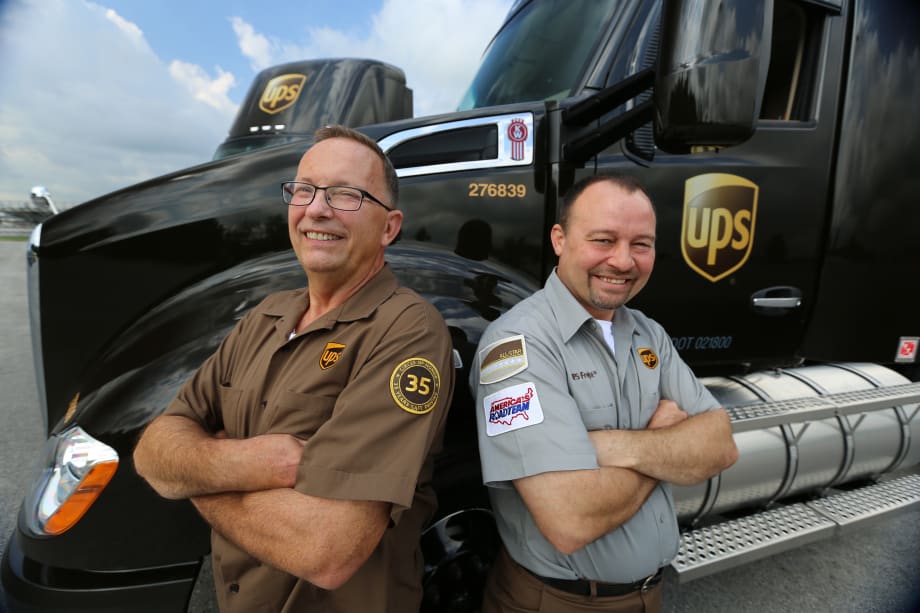
UPS driver Bill Lazarski of Chicago (left) and UPS Freight driver Paul Savill of Cincinnati (right) are fans of the collision mitigation technology that's now standard equipment on every new UPS Class 8 tractor the company orders. Photo courtesy UPS.
UPS driver Bill Lazarski of Chicago (left) and UPS Freight driver Paul Savill of Cincinnati (right) are fans of the collision mitigation technology that's now standard equipment on every new UPS Class 8 tractor the company orders.Photo courtesy UPS.
UPS is making collision mitigation technology standard equipment on every new Class 8 tractor the company orders.
Each of the more than 2,600 new heavy-duty tractors that UPS takes delivery of in 2015 will feature Bendix Wingman Advanced systems that alert drivers to moving and stationary objects in front of the tractor and moving objects surrounding the vehicle.
The collision mitigation system also features adaptive cruise control, which maintains a constant distance behind the vehicle in front of the UPS tractor. With the adaptive cruise control turned on, the UPS tractor will automatically slow to avoid a collision.
“Collision mitigation systems make good drivers even better,” says Paul Savill, UPS Freight driver and a captain for the American Trucking Associations' America’s Road team. “Traffic conditions can change quickly as other vehicles change lanes. These technologies are an excellent complement to safe driving techniques.”
Bill Lazarski, a UPS Circle of Honor driver who has driven without an accident for 36 years, says he "can’t say enough good things about the collision mitigation technology" – but he didn't start out feeling that way.
"I was a little hesitant at first, but adapted very quickly and easily," he says. "After using the technology for more than a year, I’m convinced collision mitigation systems can make a positive impact on road safety.”
The National Transportation Safety Board recently recommended that all passenger and commercial vehicles use collision avoidance technology. The suppliers of the technology prefer the term "collision mitigation," because it's impossible to avoid all accidents but it can lessen the severity.
Secondary benefits include reducing the accordion effect caused by traffic and, from that, enhanced fuel economy, notes UPS.
The collision mitigation systems on UPS’s new Class 8 tractors also feature Bendix AutoVue lane departure warning system, Blindspotter side detection radar; Bendix ESP electronic stability control, and anti-lock air disc brakes.
In fact, each new UPS Class 8 tractor since 2012 has featured stability control, a foundational technology for collision mitigation systems, for more stable turning, shorter stopping distances, and reduced buffeting. The National Highway Traffic Safety Administration last month mandated that all Class 8 tractors include electronic stability control within the next two years.
At a demonstration highlighting UPS' decision this week, Bendix offered participants a chance to experience the latest version of this technology, Bendix Wingman Fusion, which combines radar sensing with camera views of what’s ahead, and will apply service brakes if the driver doesn’t.
“Safety is of the utmost importance to UPS," says Randy Stashick, president of engineering for UPS. "We’re investing in technology that provides UPS drivers with opportunities to increase visibility of their surroundings in constantly changing environments."

Carriers whose updates were due on or after June 1 have more time, while FMCSA works to stabilize its new registration system and warns of phishing sites impersonating its new carrier registration system, Motus.
Read More →
ZF is expanding its North American commercial-vehicle presence with new transmission applications, electrification, trailer technology and autonomous-driving systems.
Read More →
Fleets have more visibility into truck health, safety events, and driver activity than ever. The next challenge is turning all that information into useful guidance for the person who has to decide what to do next.
Read More →
Could Tesla’s camera-only autonomous driving technology work on an 80,000-pound Semi? In this commentary, HDT's Deborah Lockridge takes a look at Tesla, Cybercab, and how autonomous trucks see the road.
Read More →
The U.S. Department of Transportation issued a new automated-vehicle strategy that outlines plans for driverless-truck regulations, cross-state freight corridors, and federal safety standards.
Read More →
New York City is expanding intelligent speed assistance and pedestrian-alert systems across its municipal fleet, moving the technologies from pilot programs into vehicle procurement and retrofit requirements.
Read More →
Federal regulators also are targeting more than 160 additional training providers and launching a nationwide audit of third-party CDL skills testers as part of a broader crackdown on trucking fraud.
Read More →
A trucking fleet can follow every rule and still make unsafe decisions. The real test comes when safety conflicts with freight, productivity, or cost.
Read More →
Two pilot programs could eventually reshape hours-of-service rules, giving truck drivers options to pause their 14-hour clock or use longer split sleeper rest periods.
Read More →
Hundreds of thousands of pets travel in truck cabs. A new safety guide from Volvo Trucks and the Center for Pet Safety offers practical advice for truck drivers who bring dogs and cats along for the ride.
Read More →