




U.S. Roads Get a ‘D’ on Engineers’ Report Card
The American Society of Civil Engineers’ 2021 Report Card for America's Infrastructure found that roads in the U.S. were frequently underfunded.

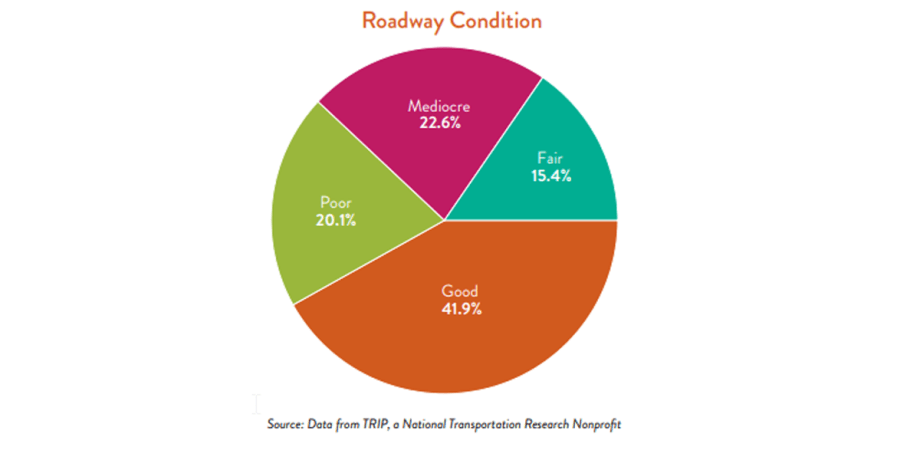
The vast majority of roads in poor and mediocre condition tend to be on the non-interstate system, while the interstate system tends to be in good condition, ASCE’s study found.
Graph: ASCE
While U.S. infrastructure as a whole received an overall ‘C-‘ grade on the American Society of Civil Engineers’ latest quadrennial assessment of the nation’s infrastructure, an improvement over previous reports, roads received a ‘D’ grade.
ASCE’s 2021 Report Card for America's Infrastructure, which evaluates 17 categories of infrastructure, including roads, bridges and ports, found that, on average, the country's infrastructure is in mediocre condition, has deficiencies and needs attention. The study also found that the country is spending just over half of what is required to support the backbone of the economy.
Roads (Grade: D)
America’s roads are frequently underfunded, and 43% of the system is now in poor or mediocre condition, a number that has remained stagnant over the past several years, according to the ASCE report.
The vast majority of roads in poor and mediocre condition tend to be on the non-interstate system, while the interstate system tends to be in good condition, the report found.
The underfunding of roadway maintenance over the years has resulted in a $786 billion backlog of road and bridge capital needs. The bulk of the backlog ($435 billion) is in repairing existing roads. In addition, $125 billion is needed for bridge repair, $120 billion for targeted system expansion, and $105 billion for targeted system enhancements such as safety, operational and environment projects.
Funding required to rehabilitate pavement and other operational conditions will average $53 billion annually. The nation needs to increase current spending levels by 29% to address the current and anticipated backlogs, according to the report.
Federal investment in roads has historically been paid for from a dedicated, user fee-funded source, the Highway Trust Fund. The Highway Trust Fund has been teetering on the precipice of insolvency for nearly 15 years due to the limitations of its primary funding source, the federal motor fuels tax. The tax of 18.4 cents per gallon for gasoline and 24.4 cents for diesel has not been raised since 1993, and inflation has cut its purchasing power by 40%. Additionally, better vehicle fuel economy has further reduced revenue, ASCE officials noted in the report.
The Congressional Budget Office estimates that by, 2022 the Highway Trust Fund is projected to have a $15 billion deficit as current spending levels exceed revenues from user fees that supply the fund.
To raise the road grade, the ASCE recommends the nation:
Focus resources on preserving a state of good repair. Policies and efforts focused on improving travel time reliability will need to be implemented to maximize the capacity of the existing road network.
Increase funding from all levels of government and the private sector to address the condition and operations of the roadway system.
Fix the federal Highway Trust Fund by raising the federal motor fuels tax by 5 cents each year over five years. To ensure long-term, sustainable funding for the federal surface transportation program, the current user fee on gasoline and diesel should be tied to inflation to restore its purchasing power, fill the funding deficit, and ensure reliable funding for the future.
Develop state and local level comprehensive transportation asset management plans that link asset management efforts to long-term transportation planning and incorporate the use of life-cycle cost analysis.
Create dedicated federal investments to build resilience into the nation’s road and bridge infrastructure and integrate resilience planning into State Transportation Asset Management Plans.
Bridges (Grade: C)
One infrastructure category – bridges – saw a decrease in grade to ‘C,’ in part because of the number of bridges that slipped to "fair" condition from "good."
Currently, 42% of the nation’s 617,084 highway bridges are over 50 years old, an increase from 39% in 2016. Notably, 12% of highway bridges are aged 80 years or older.
On the other hand, as of 2019, just one in 13, or 7.5%, of highway bridges were designated structurally deficient, or poor, representing a significant improvement from 12.1% recorded a decade ago.
Ports (Grade: B-)
Due to increased investment and federal funding through multimodal competitive grant programs, the grade of ports improved to a B-.
However, the study found that intermodal connectors, or portions of roadways that link the National Highway System to ports and other modes, are traditionally underfunded. One reason for this is that the segments have historically not fit neatly into existing funding programs, ASCE officials said in the report.
For example, 9% of intermodal connector pavement are in good or very good condition.
Long-Term Infrastucture Investment
Overall, the long-term infrastructure investment gap continues to grow. That gap has risen from $2.1 trillion over 10 years in the last report to $2.59 trillion in the latest study, meaning a funding gap of $259 billion per year. If the U.S. does not pay its overdue infrastructure bill, ASCE said by 2039 the U.S. economy will lose $10 trillion in growth and exports will decline by $2.4 trillion.
"We have not made significant enough investments to maintain infrastructure that in some cases was built more than 50 years ago. As this study shows, we risk significant economic losses, higher costs to consumers, businesses and manufacturers – and our quality of life – if we don't act urgently. When we fail to invest in infrastructure, we pay the price,” said ASCE Executive Director Thomas Smith in a press release.
More Fleet Management

Color Match Smarter: Tools That Restore & Perform
For fleet managers and collision repair professionals keeping heavy-duty trucks on the road, getting the color right the first time isn't just about appearance — it's about efficiency, turnaround time, and bottom-line results. Discover how today's digital color tools are transforming the repair process from guesswork to precision.
Read More →
FMCSA Pauses Biennial-Update Enforcement Amid Motus Transition
Carriers whose updates were due on or after June 1 have more time, while FMCSA works to stabilize its new registration system and warns of phishing sites impersonating its new carrier registration system, Motus.
Read More →
2026 Blueprint for Countering Smarter Supply Chain Theft
Cargo theft is no longer just the cost of doing business. It's a multi-billion-dollar criminal enterprise exploiting vulnerabilities across your fleet, drivers, and supply chain.
Read More →


How Telematics Improves Visibility, Control, and Performance in Refrigerated Fleets
Explore how telematics help refrigerated fleets improve visibility, uptime, efficiency, compliance, and cargo protection across connected cold chain operations.
Read More →
What the U.S.-Canada Trade War Means for Trucking
Escalating U.S.-Canada tariffs could disrupt cross-border freight, reduce truck volumes, raise costs, and create new uncertainty for carriers on both sides of the border.
Read More →
What Are Trucking’s Top Concerns for 2026?
The American Transportation Research Institute wants to know what's worrying trucking fleet managers, drivers, and other stakeholders in its annual Industry Issues survey.
Read More →
American Trucking Associations Looks for a New Leader
ATA President and CEO Chris Spear abruptly left his job at the association on August 21, at a pivotal time for the trucking industry.
Read More →
Public Wi-Fi Cybersecurity Risks: How Truck Drivers and Fleets Can Protect Their Data
Public Wi-Fi can expose truck drivers and fleets to credential theft, malware, and other cyber threats. Here’s how to reduce the risk on the road.
Read More →
For Nicky Cupp, Fleet Innovation Starts With Frustration
HDT Truck Fleet Innovator Nicky Cupp turns everyday pain points at Fraley & Schilling into opportunities for better technology and smarter processes.
Read More →
Adam Buttgenbach’s Approach to Electric Trucks: Start With Where They Fit
HDT Truck Fleet Innovator Adam Buttgenbach helped PepsiCo build one of North America’s largest EV fleets by focusing on where electric trucks make operational sense.
Read More →