




Related: When the Road Meets the Rubber
Truck-Mounted Instruments to Measure Pavement Friction
The project will help states develop pavement friction management programs and demonstrate measuring equipment.
by Staff
July 13, 2015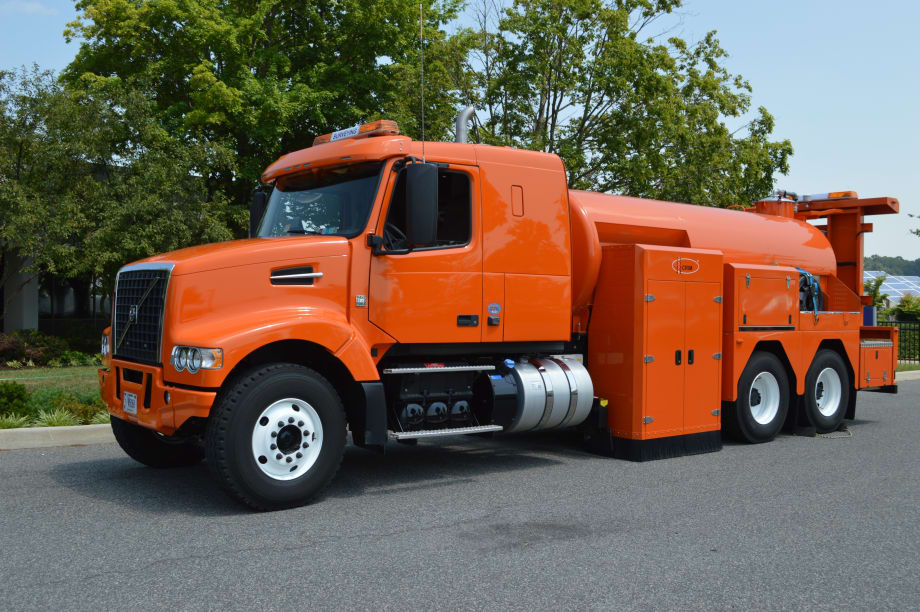
A specially equipped Volvo VHD 430 totes a Sideway-force Coefficient Routine Investigation Machine (SCRIM) – to evaluate friction on roadways to determine whether highway improvements could reduce crashes. Photo: Volvo Trucks
2 min to read
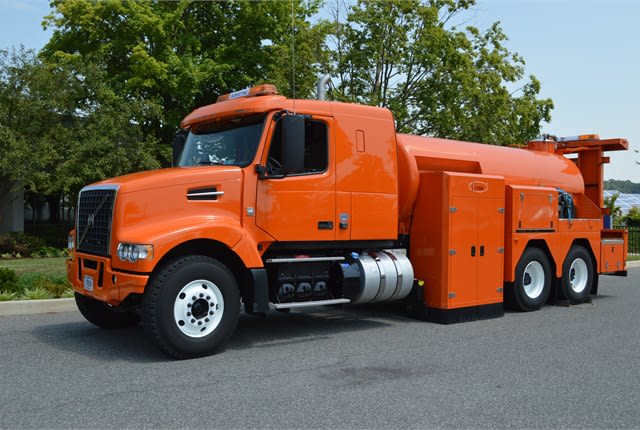
A specially equipped Volvo VHD 430 totes a Sideway-force Coefficient Routine Investigation Machine (SCRIM) – to evaluate friction on roadways to determine whether highway improvements could reduce crashes. Photo: Volvo Trucks
The Virginia Tech Transportation Institute will use a truck-mounted Sideway-force Coefficient Routine Investigation Machine, or SCRIM, to measure pavement friction and possible slick spots on U.S. highways.
In a project funded by the Federal Highway Administration, a special truck body and instruments were mounted aboard a Volvo VHD 430 chassis that will drive thousands of miles through Florida, Texas, Indiana, and Washington, collecting data.
The equipment will continuously measure friction, cross-slope values, minute textures, grades, temperatures, and curvature while driving at up to 50 mph. These various measurements will be cross-referenced with crash data to identify potentially high-risk friction areas that can be treated.
“The continuous friction measurement equipment has the potential to pinpoint pavement sections where the probability of crashes is greater,” said Gerardo Flintsch, director of the institute’s Center for Sustainable Transportation Infrastructure and a VT civil engineering professor.
“This system is unique because with one data collection pass on the road, we will collect data that allows us to segment the road network into friction demand categories,” said Andrew Mergenmeier, senior pavement and materials engineer for FHWA.
“For example, in areas where the potential for conflict is greater, such as tight horizontal curves, this data can inform the need for a countermeasure.”
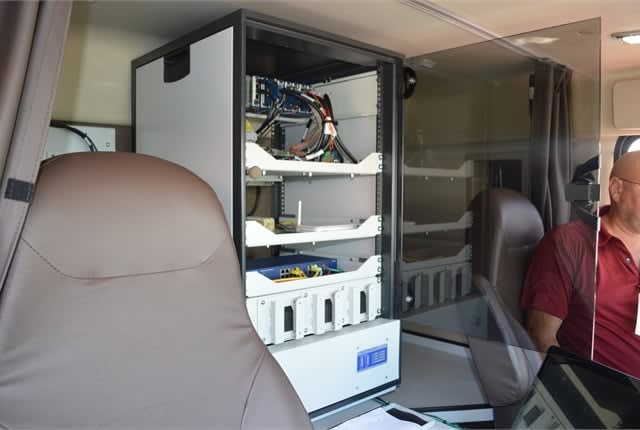
Sleeper compartment houses the information hub, gathering data from various sensors and an in-cab video camera and matching it with satellite positioning data as the truck moves along a highway. Photo: Volvo Trucks
Pavement friction can sometimes be the difference between life and death on roadways. The higher the friction, the better grip a vehicle’s tires will have with the road. Higher friction can help a vehicle stop or maneuver its way out of a crash. The data collection phase begins this summer, a VT announcement said.
Volvo Trucks North America’s plant at Dublin, Va., built the VHD chassis, and it was shipped to the United Kingdom, where the instrumentation was installed and certified by the Transport Research Laboratory. The lab recommended the chassis because of the “build quality” of European-built Volvo trucks, the company said.
The project objective is to assist states in the development of pavement friction management programs and demonstrate measuring equipment.
More Safety & Compliance
PrePass, Kodiak Connect Driverless Trucks to Roadside Enforcement
The system will allow enforcement agencies to verify Enhanced Inspection information and decide whether Kodiak’s autonomous trucks can bypass roadside screening sites.
Read More →
From One Generation to the Next: How Mentorship Builds Safer Truck Drivers
After three decades in trucking, Harold Perry shares what he's learned about driver safety, mentorship, and helping the next generation build confidence behind the wheel.
Read More →
FMCSA Pauses Biennial-Update Enforcement Amid Motus Transition
Carriers whose updates were due on or after June 1 have more time, while FMCSA works to stabilize its new registration system and warns of phishing sites impersonating its new carrier registration system, Motus.
Read More →
ZF Expands Commercial Vehicle Push in North America
ZF is expanding its North American commercial-vehicle presence with new transmission applications, electrification, trailer technology and autonomous-driving systems.
Read More →
Truck Drivers Need More Than Another Alert
Fleets have more visibility into truck health, safety events, and driver activity than ever. The next challenge is turning all that information into useful guidance for the person who has to decide what to do next.
Read More →
Tesla Wants a Self-Driving Semi. Are Cameras Enough?
Could Tesla’s camera-only autonomous driving technology work on an 80,000-pound Semi? In this commentary, HDT's Deborah Lockridge takes a look at Tesla, Cybercab, and how autonomous trucks see the road.
Read More →
What DOT’s Automated Vehicle Strategy Means for Trucking
The U.S. Department of Transportation issued a new automated-vehicle strategy that outlines plans for driverless-truck regulations, cross-state freight corridors, and federal safety standards.
Read More →
NYC Expands Speed, Pedestrian Safety Tech Across Fleet
New York City is expanding intelligent speed assistance and pedestrian-alert systems across its municipal fleet, moving the technologies from pilot programs into vehicle procurement and retrofit requirements.
Read More →
FMCSA Removes 110 Truck Driver Training Schools from Certified ELDT List
Federal regulators also are targeting more than 160 additional training providers and launching a nationwide audit of third-party CDL skills testers as part of a broader crackdown on trucking fraud.
Read More →
Beyond DOT Compliance: What Makes a Trucking Fleet Truly Safe?
A trucking fleet can follow every rule and still make unsafe decisions. The real test comes when safety conflicts with freight, productivity, or cost.
Read More →