




When the Road Meets the Rubber
Irregular or accelerated tire wear is annoying and expensive, but there's something else eating away at your expensive assets: the pavement itself.


The very pavement you drive upon is chewing away at your tires, mile after mile. Photo by Jim Park

The very pavement you drive upon is chewing away at your tires, mile after mile. Photo by Jim Park
When the topic of conversation turns to accelerated and premature tire wear, the usual culprits cited are alignment, balance, inflation and mechanical deficiencies. One topic that hardly ever comes up is the type of pavement we operate on.
It wouldn't do much good to whine about it anyway; we can't route our trucks based on a pavement preference. Too bad, though, because it seems certain types of surfaces are easier on tires than others.
Much of the Interstate Highway System is constructed of Portland Cement Concrete, for a number of good reasons, not the least of which is durability. A PCC surface has an estimated lifespan of about 25 years, more than double that of an asphalt surface. As well, PCC is regarded as less susceptible to rutting, frost heaves in colder climates and stresses related to the constant pounding it takes from heavy loads.
But asphalt has its advantages too. It's less expensive initially, while the lifecycle cost is generally regarded as about the same (depending on the price of oil at the time the roadway is constructed). Asphalt is also said to be more tolerant of the bending stresses imposed by vehicles than PCC, so it gives a bit and remains slightly pliable over its lifespan. It's also less disruptive to traffic when it comes to repairs and resurfacing.
A great deal more goes into the choice of pavements used on a given roadway, including availability of materials, local contractors' expertise and of course the pork-barrel considerations.
With that said, there's a third type of pavement in common use today that is in many ways better than the other too, and better for tires as well: (Asphalt-Rubber) Asphaltic Concrete Friction Course (AR-ACFC). AR-ACFC contains a percentage of chipped rubber recovered from, ironically, scrap tires. It's said to offer better drainage characteristics, quieter operation, and it's easier on tires because its less abrasive.
A pavement research study called "Tire Wear Emissions for Asphalt Rubber and Portland Cement Concrete Pavement Surfaces," conducted in 2005 by the University of Arizona for the Arizona Department of Transportation found that AR-ACFC surfaces produce fewer PM10-sized rubber particles than a PCC road surface, which can be construed to mean, the rubberized asphalt surface causes less tire wear.
As you might imagine, official interest in tire wear rates isn't out of sympathy for the trucking industry or the motoring public. Officials are concerned with the amount of fine particulate matter worn away from tires that is cast into the air and eventually winds up in our lungs.
Estimates made in 1974 concluded that the amount of rubber loss averaged approximately 90 mg per kilometer (0.25 oz/mile), or about 1.3 million metric tons (1.4 million tons) per year for the entire U.S. Of course, a lot has changed since 1974; tires are more durable so they wear longer, but there are many, many more vehicles on the road today than there were in 1974. So the problem is considerably worse.
Experts today estimate the average tire tread wear rate for a single passenger car tire is between 6 and 900 mg/km (0.003 oz- 0.05/mile), depending on the road surface type (e.g., asphalt vs. concrete), coupled with other factors such as driving conditions (acceleration, abrupt deceleration, speeding, etc.) and tire conditions (tire pressure, vehicle load, etc.).
The U of A tire wear study showed that passenger vehicles are estimated to emit 13 mg/km (o.0046 oz/mile) of PM10 on the rubberized asphalt surface. It did not provide a measurement for the PCC surface, but it did note that tire wear rates were substantially greater.
Traction Equals Wear
We need a rough-ish surface on the roads for traction. There are several design criteria for just how rough the surface needs to be, and different types of pavement and different application techniques can affect how abrasive the surface will be to tires.
According to Imad Al-Qadi, director of the Illinois Center for Transportation, it’s not just a question of concrete versus asphalt – tire wear has more to do with texture of the pavement.
"The texture of the surface has a lot to do with the traction between the tire and the pavement," he says. Usually, there are two parts of the texture; the micro is the one that is related to the aggregate itself, while the macro is the one that allows the water to drain from the surface. "Both are necessary for traction, but the different types of surface textures we see today can impact tire wear in different measure."
Al-Qadi says pavement engineers have historically not paid a lot of attention to the tire-wearing properties of pavement surfaces, focusing their attention instead on durability, traction and among other factors, noise reduction.
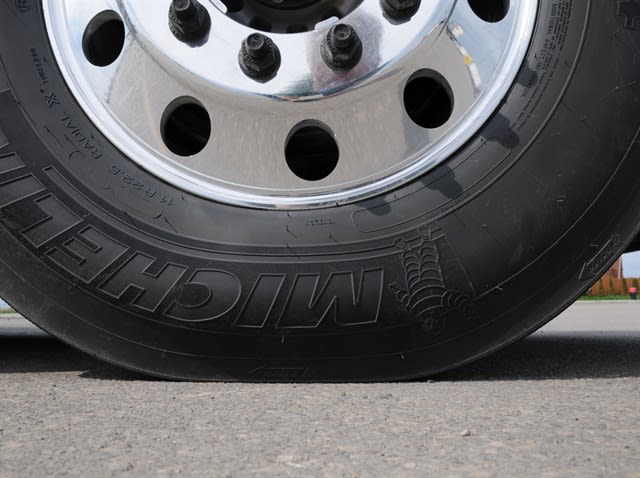
Pavement surfaces are designed for load bearing, traction, noise reduction and soon, for reduced tire wear.Photo by Jim Park
"The surface of the pavement can and should be engineered in order to reduce the noise and to reduce the wear of the tires," he says. "Many states are looking into engineering the surface to reduce the noise, but there is much less attention paid to the wear rares of tires. Historically it has been the tire industry that worries about that."
There's good news on this front; that two-camp approach is changing. The Pavements Group at the University of Illinois and the Illinois Center for Transportation are now working more closely with the tire industry in order to optimize the contact surfaces of the pavement and the interface between the pavement and the tire.
"We are working now to engineer both the tire and the pavement surface," says Al-Qadi. "This kind of collaboration will make a big difference. Pavement engineers will be working to design better pavement while the tire industry optimizes the design of the tire for the pavement."
What you don't want to do, of course, is sacrifice pavement integrity or traction in order to reduce noise and tire wear. The way Al-Qadi explains it, the goal is to optimize the surface so it will allow vehicles to drive safely with proper traction. To do that you need to have the proper contact stresses coming from the tire and at the same time have the proper surface friction that will afford the best traction.
"We’re the people who can design the pavement surface better while the tire industry can design the tire better," Al-Qadi points out. "Now we have a very close relationship with the tire industry in order to optimize the design of the tire and the pavement in order to make it more beneficial and more optimized."
More Maintenance

Color Match Smarter: Tools That Restore & Perform
For fleet managers and collision repair professionals keeping heavy-duty trucks on the road, getting the color right the first time isn't just about appearance — it's about efficiency, turnaround time, and bottom-line results. Discover how today's digital color tools are transforming the repair process from guesswork to precision.
Read More →
Wrong Repair Prompts Recall of Freightliner, Western Star 4x2 Trucks
DTNA is recalling more than 2,400 trucks that received an incompatible software fix instead of the hardware repair required to address brake valve corrosion.
Read More →
Truck Drivers Need More Than Another Alert
Fleets have more visibility into truck health, safety events, and driver activity than ever. The next challenge is turning all that information into useful guidance for the person who has to decide what to do next.
Read More →
The Maintenance Checks Trucking Fleets Should Prioritize Before Fall Freight Picks Up
Making it through August isn’t the same as being ready for the next several months of operation. Find out what systems may have suffered from summer heat and need to be checked out before fall.
Read More →
What Three Fleets Are Doing Differently When Buying Truck Parts in 2026
With freight improving but costs still climbing, fleet maintenance executives explain how they're balancing price, quality, and supplier relationships.
Read More →
Paccar Recalls 2027 Trucks Built This Summer for Possible Electrical Problem
The nearly 6,000 Kenworth and Peterbilt trucks in the recall could potentially lose engine power, among other things.
Read More →
Will API PC-12 Oil Change Trucking Fleet Maintenance?
The new API PC-12 heavy-duty engine oil category reflects the changing demands of modern diesel engines. But fleets like Foodliner are looking to getting their own data before making decisions on adopting the new oils and questions such as extending oil drain intervals.
Read More →
Brake Safety Week to Focus on Drums and Rotors
Commercial vehicle inspectors are focusing on truck brakes during CVSA's Brake Safety Week, August 23-29.
Read More →
Possible Battery-Cable Fires Prompt Recall of 15,000+ International MV and HV Trucks
On the recalled vehicles, manufacturing variations can cause the battery interconnect cable to contact the auxiliary stud and hold down the bracket.
Read More →
Rush, MCT Team Up to Grow Refrigeration Service Network
The joint venture will operate MCT's network of Carrier Transicold dealerships and mobile service locations, with the companies promising greater service capacity and uptime for refrigerated fleets.
Read More →