




Truck Driver Detention Study Shows Some Improvement
In 2023, drivers reported being detained in 39% of all stops. In 9.9% of stops – one in every 10 – drivers experienced more than two hours of detention, according to a study from the American Transportation Research Institute.


Excessive waits to load or unload trucks is called driver detention.
Image: HDT Graphic
The total time lost to truck driver detention in for-hire trucking was more than 135 million hours in 2023. That’s among the findings in a new report from the American Transportation Research Institute.
The report quantifies the major consequences that truck driver detention at customer facilities has on industry productivity and safety. The research quantifies the direct costs for fleets, truck drivers and supply chains in general. It also corroborates previous research that detained truckers drive faster both before and after they’re detained.
Truck driver detention is the additional time a commercial motor vehicle driver must wait at a customer facility to pick up or deliver freight beyond their scheduled appointment time.
Driver detention is regularly voted as a top issue in the industry, and in 2023 it was the fifth- highest issue for drivers specifically. The Federal Motor Carrier Safety Administration has also repeatedly identified detention as an area of concern over the past decade, including an audit as part of 2015’s Fixing America’s Surface Transportation Act (FAST Act) a new study being conducted on the impact of detention time on safety and operations.
Comparing the new study's data with an ATRI 2018 detention survey, researchers found that while driver detention has decreased slightly in the last few years, the overall costs of being detained at customer facilities for more than two hours is substantial.
Driver Detention Findings
In 2023, drivers reported being detained in 39% of all stops. In 9.9% of stops – one in every 10 – drivers experienced more than two hours of detention.
The frequency of detention was even higher among some groups:
Women drivers (49%)
Refrigerated trailer drivers (56%)
Fleets that operate in the spot market (43%).
Based on industry-reported data, truck drivers were detained between 117 and 209 hours per year, depending on the sector.
The good news is, significant detention of two hours or more became considerably less common, dropping by 11.4 percentage points between 2014 and 2023. At the same time, however, detention times of two hours or less rose by 4.9 percentage points between 2014 and 2023.
Data from ATRI’s three driver surveys suggest moderate improvements in detention over the past decade. Altogether, the frequency of stops with detention dropped by 6.5 percentage points between 2014 and 2023.
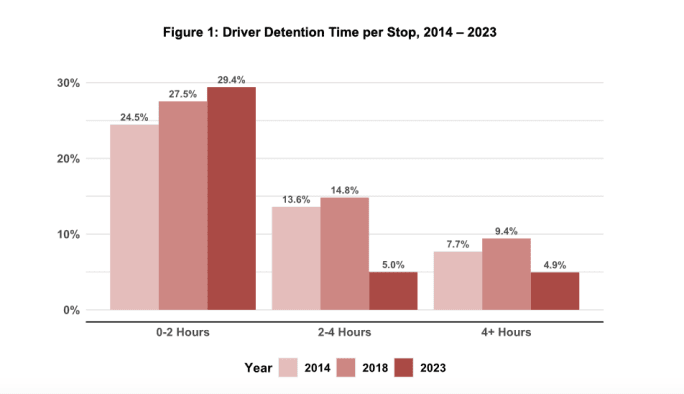
A drop in the number of detentions over two hours has been accompanied by an increase in shorter waits.
Source: ATRI
A majority of truckload drivers – 57% – were late to or had to cancel a pick-up or delivery due to detention at the previous customer’s facility at least once in 2023.
Furthermore, a majority of truckload drivers – 52% – ran out of available hours-of-service on-duty time at a customer facility due to detention.
How Detention Affects Truck Drivers
Detention presents more problems for drivers beyond scheduling. Drivers reported an average of half of customer facilities do not allow drivers to park in the facility while waiting to load or unload.
Without space to park, drivers may be forced to burn unnecessary fuel idling in both hot and cold weather conditions, park in undesignated or potentially unsafe areas, and lose valuable on-duty time seeking parking elsewhere.
On top of that, an average of 44% of customer facilities do not allow drivers to use bathroom facilities of any kind while waiting to load or unload.
In 2023, 35% of drivers reported that they had left a previous driving job in the past as a result of excessive or undercompensated detention time — although this percentage is partly skewed by years of experience in the industry.
Excessive detention times also cut into drivers’ income. A large majority of surveyed carriers – 97% – offer detention pay to their drivers to address this fact, but driver detention pay often does not fully compensate drivers for the per-mile pay they could have otherwise received.
Tracking and Charging for Detention
Most carriers, ATRI found, don’t track the amount of true detention time at each stop. Carriers do, however, possess accurate data on the total amount of total dwell time at each stop via GPS or electronic logging device data.
67% of carriers that charge detention fees do so starting at the two-hour mark. This report used the definition of detention time as all delay in excess of two hours.
Nearly 95% of fleets charge detention fees, which is an increase from 2018, when 80% of carriers charged detention fees.
However, collecting those fees is another story.
ATRI found carriers charging detention fees are paid for less than half of those invoices. As a result, the trucking industry lost $3.6 billion in direct expenses and $11.5 billion in lost productivity from driver detention in 2023.
Even when customers pay detention invoices, detention fees do not fully cover the revenue that might have been earned during the same time. Surveyed carriers reported increasing their detention fees by a median of just 3% over the past five years (2018 to 2023). This rate of increase is well below that of inflation and of the hourly cost of trucking during the same period, which rose by 21.4%.
Driver Detention Contributes to Higher Truck Speeds
An analysis of ATRI’s large truck GPS data at different customer facility types found that detention contributes to higher truck speeds.
Trucks that were detained drove nearly 15% faster on average than trucks that were not detained.
Trucks also drove faster on trips to facilities where they were detained, indicating that truck drivers know which firms and facilities will likely detain them.
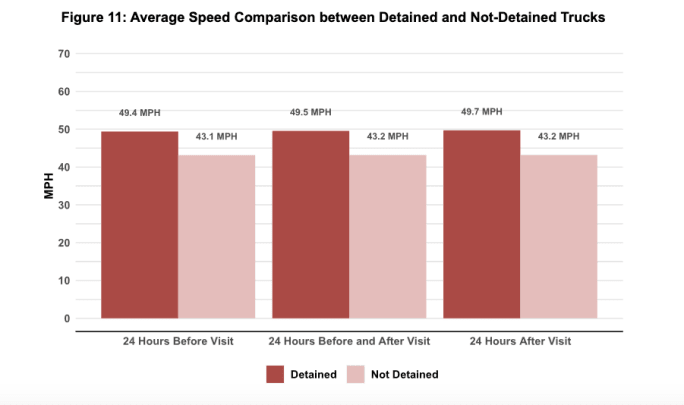
ATRI worked closely with its research partner North Carolina State University to develop a sound methodology for understanding the relationship between detention and truck speeds.
Source: ATRI
“Detention is so common that many industry professionals have accepted it as inevitable without realizing the true extent of its costs,” said Chad England, C.R. England CEO. “ATRI’s report puts real-world numbers to the true impact that truck driver detention has on trucking and the broader economy.”
The report also discussed strategies to reduce driver detention, such as drop-and-hook freight, arriving early to appointments, and improved customer communication.
A full copy of the report is available through ATRI’s website.
More Drivers

From One Generation to the Next: How Mentorship Builds Safer Truck Drivers
After three decades in trucking, Harold Perry shares what he's learned about driver safety, mentorship, and helping the next generation build confidence behind the wheel.
Read More →
Truck Drivers Need More Than Another Alert
Fleets have more visibility into truck health, safety events, and driver activity than ever. The next challenge is turning all that information into useful guidance for the person who has to decide what to do next.
Read More →
FMCSA Removes 110 Truck Driver Training Schools from Certified ELDT List
Federal regulators also are targeting more than 160 additional training providers and launching a nationwide audit of third-party CDL skills testers as part of a broader crackdown on trucking fraud.
Read More →
Hours of Service Pilot Programs: FMCSA Readies for 2027 Rollout
Two pilot programs could eventually reshape hours-of-service rules, giving truck drivers options to pause their 14-hour clock or use longer split sleeper rest periods.
Read More →
Medical Cards, English Proficiency Reshape Roadcheck Violations
Medical-card violations jumped to the top of the driver out-of-service list during CVSA’s 2026 International Roadcheck, while English-language proficiency violations appeared among the leading violations for the first time.
Read More →
Driver Trust Can Make or Break the Success of Fleet Safety Technology
New Teletrac Navman research suggests that onboarding, transparency about driver data, and positive feedback can play a significant role in how commercial drivers respond to safety and coaching technology.
Read More →
EEOC Sues KLLM Over Alleged Sex Discrimination in Driver Training
KLLM is facing a federal sex-discrimination lawsuit over policies the EEOC alleges put female truck driver trainees at a disadvantage.
Read More →
FMCSA Moves to Codify English Language Requirements for Commercial Drivers
By changing regulations on English-language proficiency requirements for commercial drivers, rather than relying on a guidance memo, the FMCSA said future administrations won't be able to walk back the Trump administration's stricter enforcement with just a memo.
Read More →
Drivers Put Western Star Trucks to the Test at Star Nation Experience
Watch to get an inside look at the Western Star trucks, technology, and community behind the Star Nation Experience 2026!
Read More →
Trump Administration Looks to Put More Veterans Behind the Wheel
The Freedom Haulers program pulls together existing and expanded programs at several federal agencies to recruit veterans to drive commercial heavy-duty trucks and cut the red tape for them to get a CDL, training, and employment.
Read More →