




Tico Unveils More Flexible Electric Yard Tractor
Tico's Next-Gen Pro-Spotter battery-electric terminal tractor delivers 160,000-pound-GCW capacity with up to 15 hours run time on a 312 kWh battery.

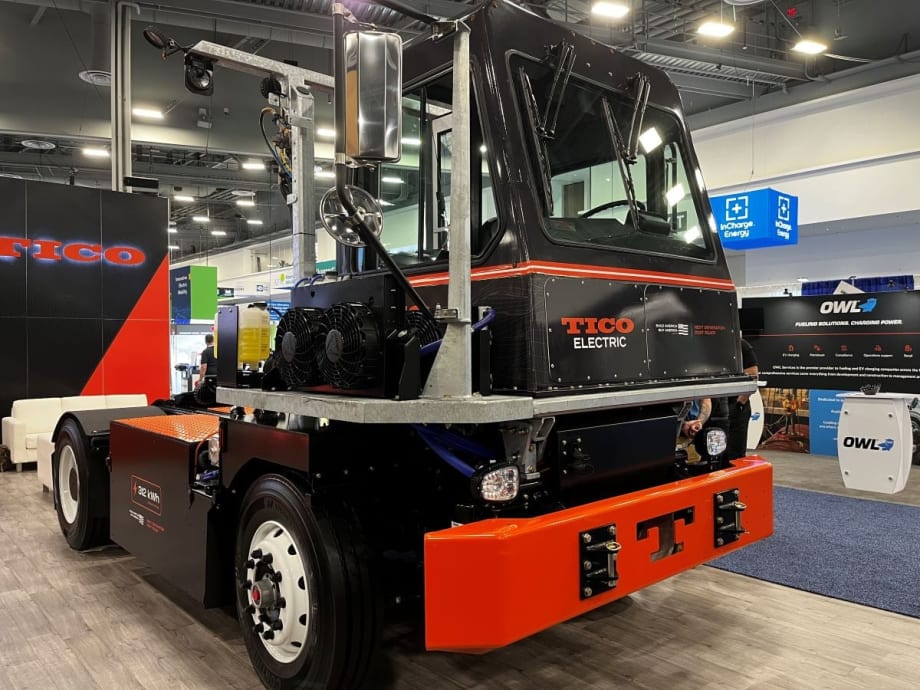
Tico's Pro-Spotter terminal tractor is BABA Compliant (Build America, Buy America Compliant), qualifying for the major grant funding programs such as the Clean Ports Program.
Photo: Jim Park
The next-generation Pro-Spotter electric terminal tractor from Tico (Terminal Investment Corporation) Manufacturing offers a range of onboard energy levels and wheelbase configurations, and five different e-axle options tailored for port or distribution operations.
Tico launched the truck at ACT Expo in Las Vegas.
The truck is built on a scalable, modular platform in 116- and 128-inch wheelbases with battery capacity of 104, 208 and 312 kWh.
"It was designed to be modular from the start, so if a customer changed their application or the size of the truck, we can simply send them an extra set of batteries and a junction box," said Chad Burchett, Tico's EV program manager.
"They can plug and play, flash the software, and the truck is capable of twice the operational time."
Tico Electric Terminal Tractor Offers up to 15 Hours of Run Time
Burchett said the 312-kWh hour battery offers 15 hours of runtime pulling double-stack containers on bomb carts.
"That's just the beginning of life. That guarantees by the end of life when you reach 70% state of health, you still have over 10 hours of operational capacity," he added.
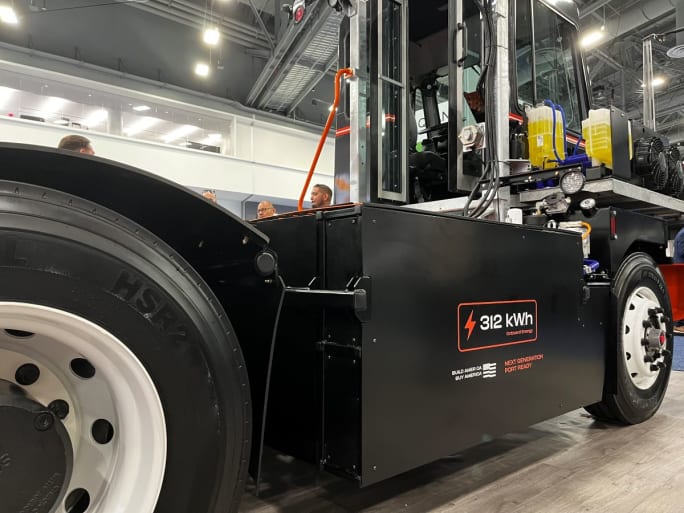
The Pro-Spotter terminal tractor offers scalable battery capacity options, including 104, 208 and 312 kWh. Batteries are plug and play and are easily upgraded.
Photo: Jim Park
Customers also have five different e-axle combinations, including standard 82,000-lb GCW for distribution or other light-duty operations to 160,000-lb GCW for port and drayage applications.
“It was clear that the market demanded more flexibility in electric terminal tractors," said Mallery Pindar, Tico’s senior director of sales and marketing.
"End users should not have to change their entire operations to meet sustainability initiatives and requirements. We set out to tailor our next-generation terminal tractor to meet each set of customer requirements and have succeeded in establishing an all-new benchmark for the industry.”
Key Features of Tico's Pro-Spotter Electric Terminal Tractor:
Scalable range of onboard energy levels, with top end of 312 kWh
Top end unit GCWR of 160,000 lbs. plus 61,000 ft-lbs. of wheel end torque tailored to the port operator
175 kWh max fast charge or inductive charging adaptable
Customizable charge port locations
Smart low-voltage battery has auto shut off feature to ensure adequate voltage to engage the high-voltage batteries
BABA Compliance (Build America, Buy America Compliant), qualifying for the nation’s major grant funding programs such as the Clean Ports Program.
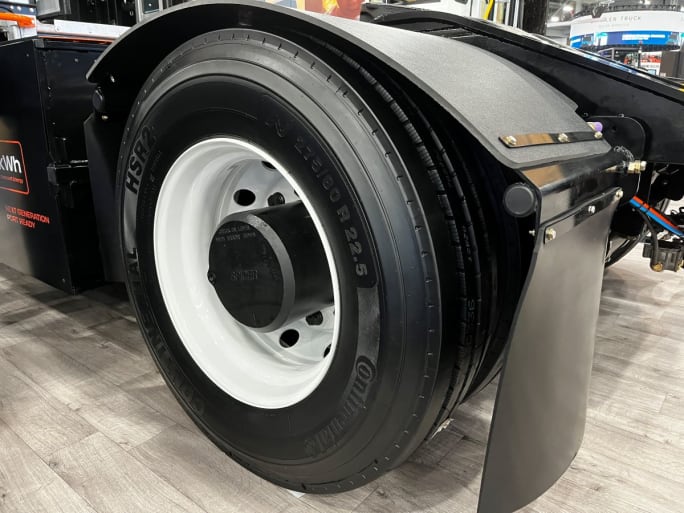
Tico's e-axle delivers 61,000 foot pounds of torque through hub-reduction wheel-ends and a double-reduction axle with a GCWR of 160,000 pounds.
Photo: Jim Park
Tico announced production of its first-generation electric terminal tractor in 2023 with its partnership with Volvo Penta, leveraging the Volvo electric technology into its terminal tractor design. Recognizing the additional requirements that many terminal tractor users have, Tico’s new Pro-Spotter Electric incorporates additional battery and driveline options from a diverse set of suppliers.
Full production will start in 2025, the company said.
More Fuel Smarts

New California Law Could Shed Light on Electric Truck Prices
Why do battery-electric Class 8 trucks remain so expensive? A California bill signed by Gov. Gavin Newsom would give fleets and state agencies more visibility into what manufacturers charge.
Read More →
How Volvo Updated Its D13 for EPA 2027 [Watch]
Volvo’s updated D13 promises lower emissions without sacrificing performance or fuel economy. Take a closer look at what changed inside the engine in this HDT Spotlight video.
Read More →
Diesel Price Spike Shortens Payback for Natural Gas Trucks, Report Says
Energy Vision estimates fleets could recover the higher purchase price of an RNG-fueled Class 8 tractor in 1.3 to 2.8 years under current fuel-price scenarios.
Read More →

Calstart Becomes Catalyst Mobility, Reflecting Broader Focus
Calstart is now Catalyst Mobility, reflecting the nonprofit’s growing national role in clean transportation, including zero-emission trucks, infrastructure and incentive programs.
Read More →
Record Diesel Prices Squeeze Trucking Fleets
Average U.S. diesel prices have climbed to nearly $6 a gallon, surpassing the 2022 record as tight refinery capacity and Middle East disruptions keep fuel costs elevated.
Read More →
How Fuel Delivery Shapes Engine Performance
Fuel delivery depends on more than what happens at the injector. For fleet, maintenance and technical professionals, looking at the full path from pump to injector can provide useful context for understanding engine performance.
Read More →
East Coast Port Launches $45M Electric Truck Push
The Port Authority of New York and New Jersey announced millions in incentives for zero-emission drayage trucks, yard tractors, and new charging hubs near the port.
Read More →
Detroit Opens Orders for EPA 2027 Engines
Detroit isn’t starting from scratch to meet EPA 2027 diesel emissions standards. Its Gen 6 DD13 and DD15 engines keep much of today’s platform while updating the fuel and aftertreatment systems.
Read More →
Zero-Emission Truck Corridor Planned for West Coast
California, Oregon, Washington, British Columbia and Baja California are coordinating plans for truck charging and hydrogen fueling from Canada to Mexico.
Read More →
A Closer Look at Kenworth’s Electric T880E Vocational Truck [Video]
Learn more about Kenworth's T880E battery-electric vocational truck at the Paccar Technical Center, including its range, applications, upfitting considerations, and PTO options, in this HDT Spotlight video.
Read More →