




Third-Party CDL Testing From Trainers OK, Says FMCSA
The Federal Motor Carrier Safety Administration has OK’d a practice that it previously banned because of concerns it could allow unqualified truck drivers to get commercial licenses.

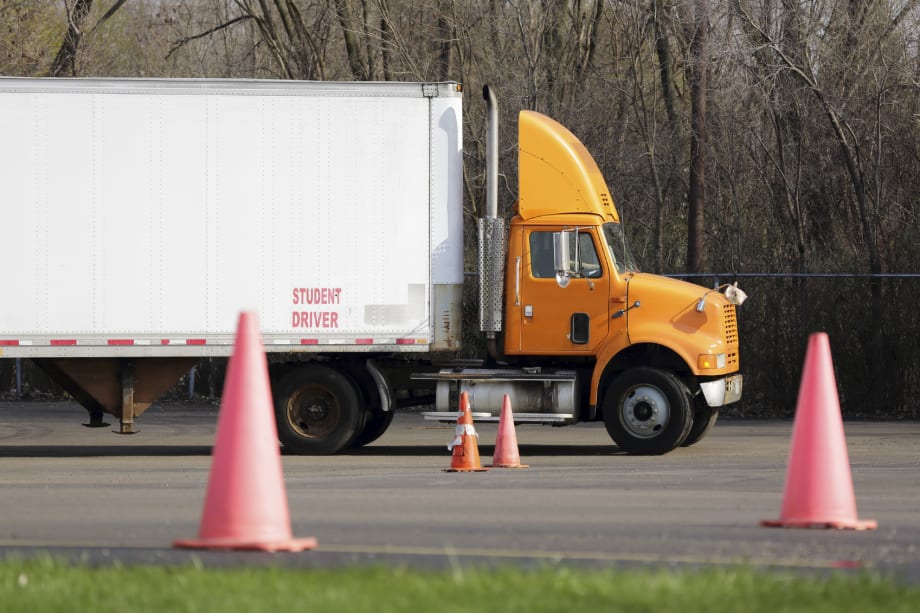
Should the same person who trained a truck driver be allowed to administer the driver's CDL test?
File photo
The Federal Motor Carrier Safety Administration has OK’d a practice that it previously banned because of concerns it could allow unqualified truck drivers to get commercial licenses.
The new rule will allow states to permit a third-party skills test examiner to administer the commercial driver’s license skills test to applicants the examiner has also trained.
The agency says the final rule will “streamline the process for men and women interested in entering the trucking workforce.” The rule change is effective 60 days from publication in the Federal Register.
Third-party testing allows companies outside the state's licensing system, such as driving schools or trucking companies, to test their students or employees and certify them for commercial driver's licenses.
Federal rules previously prohibited a third-party CDL skills instructor who is also authorized by the state to administer the CDL skills test from performing both the instruction and the qualifying testing for the same applicant. The new rule eliminates that restriction and permits states, at their discretion, to allow qualified third-party skills trainers to also conduct the skills testing for the same individual.
This new rule is designed to alleviate testing delays and eliminate needless inconvenience and expense to the CDL applicant, said the FMCSA in a Dec.. 16 press release. The agency believes the change will not compromise safety.
Where Did the Third-Party CDL Testing Restriction Come From?
In 2011, after a three-year review of shortcomings in the CDL system, the FMCSA posted a rule that, among other reforms, prohibited third parties from administering skills tests to the applicants they have trained. The agency put in the prohibition as protection against a possible conflict of interest arising from a trainer at a commercial training school also acting as a state-certified test examiner.
In 2013, the agency loosened that to allow the school to do the testing, as long as the actual trainer was not the one doing the testing.
In 2017, as part of the Trump administration’s efforts to reduce regulation, DOT published a Notification of Regulatory Review seeking input on existing rules and other agency actions. Sage Truck Driving Schools recommended that FMCSA eliminate the third-party tester prohibition, saying it made the process to obtain a CDL more difficult and costly, exacerbating the driver shortage and contributing to delays in some states. Sage argued that states have other tools to detect and prevent fraud in CDL skills testing.
FMCSA agreed, publishing a notice of proposed rulemaking in July of 2019 to drop the provision.
In its final rule, FMCSA pointed to the state measures that Sage cited. It also said that another fraud detection tool will be available when the Entry Level Driver Training regulations are implemented on Feb. 7, 2022.
The agency also emphasized that the rule only allows states to lift the restriction; it does not require them to do so. States that do not currently allow third-party testers are not required to do so as a result of this rule. Lifting the restriction simply permits states that already authorize third-party testing to allow skills test examiners to train and test the same individual.
FMCSA received 95 comments on the proposal, including individuals who were trainers, testers, or drivers, and organizations such as the Commercial Vehicle Training Association, Truckload Carriers Association, and American Trucking Associations. A number of state driver license agencies also commented.
Most commenters opposed the proposal, FMCSA said, citing concerns about fraud, conflict of interest, or examiner bias, if the restriction were lifted. Several individuals argued that lifting the restriction would lead to abuses by trucking companies with in-house training programs, which are already under economic pressure to increase the number of CDL holders.
Those supporting the proposal cited other available fraud detection resources, a potential reduction in skill testing delays, and increased flexibility and efficiencies for both applicants and third-party testers. Most of the organizations that commented believe that lifting the restriction would not compromise safety, due to extensive fraud detection resources already in place.
Trainers bristled at the notion that they would put drivers on the road who were unsafe, with one commenter saying the restriction presumes that “all teachers are frauds and not trustworthy to test their own students.”
However, there have been numerous cases in the past where third-party testers did put unqualified drivers on the road, which is what led to the restriction in the first place.
Third-Party CDL Testers
Third-party testers in general, not only those testing their own students, came under fire in the late 1990s after numerous scams were uncovered involving bribes in exchange for an easy pass of a “driving test” by some testers.
In 1999, Illinois announced changes in third-party CDL testing rules in the wake of a huge CDLs-for-bribes scandal that saw at least 30 people convicted.
A 2000 DOT report investigated the Illinois CDL scandal, as well as a similar one in Florida, and came up with 34 recommendations for actions states should take to prevent the same thing from happening elsewhere – including to consider whether a single employee should be allowed to complete the entire application process, from taking the application, to administering the knowledge and skills tests, to issuing the license.
In 2002, the DOT inspector general’s office issued a report on its investigation into this and other CDL problems. Since 1998, the report noted, suspected fraud in the testing and licensing of commercial drivers had been identified in 16 states.
For instance, during a DOT Inspector General’s audit, in a covert review, an Arkansas state trooper took the driving tests at three of the state’s 31 third-party testers. At one, the trooper passed the driving test even though his "driving test" consisted mainly of a conversation on the trooper's Army experience.
In a December 2008 report to Congress, a CDL Task Force, called for in the Safe, Accountable, Flexible, Efficient Transportation Equity Act: A Legacy for Users (SAFETEA-LU), reported that during a three-year investigation, FMCSA identified more than 15,000 people who were suspected of obtaining their CDL fraudulently. Third-party testers were the primary source of the frauds uncovered by FMCSA.
More Drivers

Truck Drivers Need More Than Another Alert
Fleets have more visibility into truck health, safety events, and driver activity than ever. The next challenge is turning all that information into useful guidance for the person who has to decide what to do next.
Read More →
FMCSA Removes 110 Truck Driver Training Schools from Certified ELDT List
Federal regulators also are targeting more than 160 additional training providers and launching a nationwide audit of third-party CDL skills testers as part of a broader crackdown on trucking fraud.
Read More →
Hours of Service Pilot Programs: FMCSA Readies for 2027 Rollout
Two pilot programs could eventually reshape hours-of-service rules, giving truck drivers options to pause their 14-hour clock or use longer split sleeper rest periods.
Read More →
Medical Cards, English Proficiency Reshape Roadcheck Violations
Medical-card violations jumped to the top of the driver out-of-service list during CVSA’s 2026 International Roadcheck, while English-language proficiency violations appeared among the leading violations for the first time.
Read More →
Driver Trust Can Make or Break the Success of Fleet Safety Technology
New Teletrac Navman research suggests that onboarding, transparency about driver data, and positive feedback can play a significant role in how commercial drivers respond to safety and coaching technology.
Read More →
EEOC Sues KLLM Over Alleged Sex Discrimination in Driver Training
KLLM is facing a federal sex-discrimination lawsuit over policies the EEOC alleges put female truck driver trainees at a disadvantage.
Read More →
FMCSA Moves to Codify English Language Requirements for Commercial Drivers
By changing regulations on English-language proficiency requirements for commercial drivers, rather than relying on a guidance memo, the FMCSA said future administrations won't be able to walk back the Trump administration's stricter enforcement with just a memo.
Read More →
Drivers Put Western Star Trucks to the Test at Star Nation Experience
Watch to get an inside look at the Western Star trucks, technology, and community behind the Star Nation Experience 2026!
Read More →
Trump Administration Looks to Put More Veterans Behind the Wheel
The Freedom Haulers program pulls together existing and expanded programs at several federal agencies to recruit veterans to drive commercial heavy-duty trucks and cut the red tape for them to get a CDL, training, and employment.
Read More →
Putting Mack’s Command Steer to the Test
A test drive of Mack’s Command Steer active steering system evaluates how it can make truck driving easier and less tiring.
Read More →