




TFI International Adding Open-Deck Giant Daseke to its Truckload Business
Montreal-based TFI International Inc. announced it is acquiring Daseke Inc., one of the biggest flatbed and specialized transportation and logistics companies in North America, for more than $1 billion.

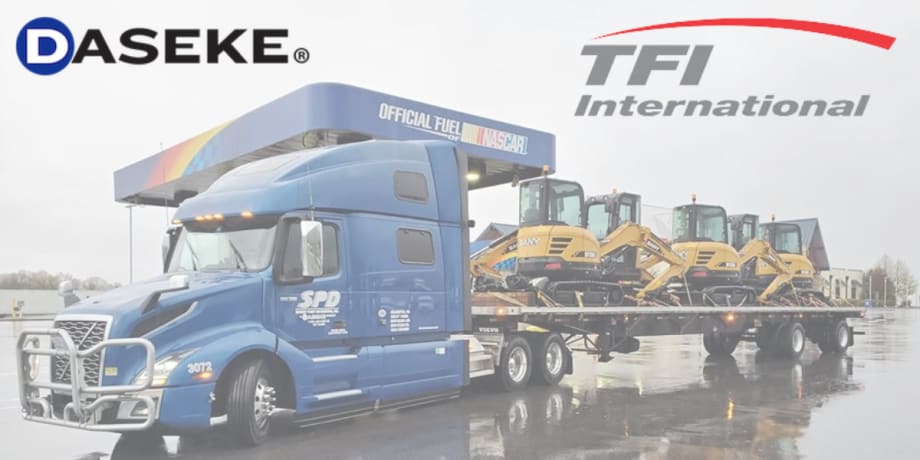
Don Daseke got into the trucking business in 2008 with the purchase of Smokey Point Distributing.
HDT graphic from Daseke Image
Montreal-based TFI International Inc. announced it is acquiring Daseke Inc., one of the biggest flatbed and specialized transportation and logistics companies in North America, for more than $1 billion, which eventually could lead to a spin-off of TFI's truckload business.
Daseke’s operations include approximately 4,900 tractors, 11,000 flatbed and specialized trailers, and 1 million square feet of industrial warehousing space.
After the merger, Daseke will continue to operate its portfolio of brands as part of TFI’s Truckload segment.
TFI said it will evaluate the potential benefits of separating into two distinct public companies — one comprising the Truckload segment, and one comprising the LTL, P&C, and Logistics segments.
The transportation analysts at Stifel alled the deal "a win-win outcome for both parties." In a Jan. 3 email to investors, they wrote, "TFI gets to purchase a business that we think is ripe for optimization at a very reasonable multiple.
"DSKE shareholders, who have endured a tough ride since the company went public as one the first SPACs back in early 2017, ultimately get a nice premium and liquidity event. Significant runway exists to improve Daseke operations, in our view, largely due to the firm's aggressive roll-up strategy which really lacked the integration necessary to drive economies of scale."
Daseke and TFI's Truckload Segment
According to TFI, with the addition of Daseke, its Truckload segment is expected to generate approximately $3.6 billion in annual total revenue, making it of the largest comprehensive truckload businesses in Canada, and one of the largest participants in the less-commoditized specialized equipment truckload marketplace in the United States.
“This attractive acquisition is highly complementary to our existing operations and scales our Truckload segment into a leading North American truckload transportation and logistics business,” said Alain Bédard, chairman, president and CEO of TFI International, in a news release.
“Our immediate focus will be on improving Daseke’s financial results, with the strategic consideration to follow and be ongoing," he said.
About the TFI-Daseke Deal
TFI is paying $8.30 in cash per common share. The total enterprise value of the transaction is approximately $1.1 billion, including the merger consideration for the common stock, retirement of Daseke’s outstanding preferred stock, payoff or assumption of outstanding debt, net of cash, and estimated transaction fees and expenses.
TFI International expects to fund the transaction using cash balances and available financing sources and expects to seek to retain in place certain of Daseke’s existing equipment financing arrangements.
The transaction is subject to customary closing conditions, including regulatory approvals, and is expected to close during the second quarter of 2024.
Don Daseke’s Dream
Daseke was the brainchild of Don Daseke, who bought his first trucking company in 2008 after a career in computers, real estate and telecom. At a point in his career when a lot of people would be thinking about retiring, he got into trucking with the purchase of Washington-based Smokey Point Distributing. A few years later, he added North Dakota-based E.W. Wylie. He soon decided to build a nationwide company focusing on flat deck and heavy haul, adding companies such as Boyd Bros., Bulldog Hiway Express, and Hornady Transportation.
As Daseke explained when HDT spoke to him in 2015, he had a different model for building a nationwide flatdeck presence. He preferred to call his deals mergers rather than acquisitions, leaving each motor carrier in the hands of its proven leadership and sharing best practices among the companies, rather than the typical model where the purchaser cuts costs and eliminates jobs by consolidating functions such as accounting or dispatch or purchasing.
“My philosophy has been to invest in people. Anybody can buy equipment or assets or terminals or trucks. In any business, people can buy assets. The difference between success and failure are the people, and I believed in those people.”
Daseke Runs Into Financial Trouble
In 2017, Daseke went public via a SPAC (special-purpose acquisition company). But the new public company was slow out of the gate, reporting losses its first two quarters.
In 2018, Don Daseke stepped back from his role as president, and in 2019, he stepped down as CEO. The publicly traded company saw its stock drop from a high of $5.56 per share that year to $1.80 at the time Daseke handed over the reins. Chris Easter was named interim CEO. He later told HDT that when he took over, the operating ratio was near 100.
Under Easter, in the year following his appointment as interim CEO, the company focused on integration, reducing the number of operating companies from 16 down to nine. In February 2020, Daseke elevated Chris Easter to permanent CEO. However, at the end of 2020, Easter retired, citing family obligations.
TFI's North American Expansion
The Daseke deal is hardly the first big acquisition for the Canadian trucking giant In 2021, UPS sold its UPS Freight less-than-truckload division to TFI for $800 million.
In 2016, TFI bought CFI (then Con-Way Truckload) from XPO as part of its strategy to expand further into the U.S. But in 2022, it appeared that it might be stepping away from the truckload business when it sold CFI’s irregular-route truckload operations to Heartland Express. At the time, Bedard explained, “the U.S. irregular route truckload business has become a small part of our portfolio.”
Updated Jan. 4, 2024, to add comment from Stifel.
More Fleet Management

Color Match Smarter: Tools That Restore & Perform
For fleet managers and collision repair professionals keeping heavy-duty trucks on the road, getting the color right the first time isn't just about appearance — it's about efficiency, turnaround time, and bottom-line results. Discover how today's digital color tools are transforming the repair process from guesswork to precision.
Read More →
FMCSA Pauses Biennial-Update Enforcement Amid Motus Transition
Carriers whose updates were due on or after June 1 have more time, while FMCSA works to stabilize its new registration system and warns of phishing sites impersonating its new carrier registration system, Motus.
Read More →
2026 Blueprint for Countering Smarter Supply Chain Theft
Cargo theft is no longer just the cost of doing business. It's a multi-billion-dollar criminal enterprise exploiting vulnerabilities across your fleet, drivers, and supply chain.
Read More →


How Telematics Improves Visibility, Control, and Performance in Refrigerated Fleets
Explore how telematics help refrigerated fleets improve visibility, uptime, efficiency, compliance, and cargo protection across connected cold chain operations.
Read More →
What the U.S.-Canada Trade War Means for Trucking
Escalating U.S.-Canada tariffs could disrupt cross-border freight, reduce truck volumes, raise costs, and create new uncertainty for carriers on both sides of the border.
Read More →
What Are Trucking’s Top Concerns for 2026?
The American Transportation Research Institute wants to know what's worrying trucking fleet managers, drivers, and other stakeholders in its annual Industry Issues survey.
Read More →
American Trucking Associations Looks for a New Leader
ATA President and CEO Chris Spear abruptly left his job at the association on August 21, at a pivotal time for the trucking industry.
Read More →
Public Wi-Fi Cybersecurity Risks: How Truck Drivers and Fleets Can Protect Their Data
Public Wi-Fi can expose truck drivers and fleets to credential theft, malware, and other cyber threats. Here’s how to reduce the risk on the road.
Read More →
For Nicky Cupp, Fleet Innovation Starts With Frustration
HDT Truck Fleet Innovator Nicky Cupp turns everyday pain points at Fraley & Schilling into opportunities for better technology and smarter processes.
Read More →
Adam Buttgenbach’s Approach to Electric Trucks: Start With Where They Fit
HDT Truck Fleet Innovator Adam Buttgenbach helped PepsiCo build one of North America’s largest EV fleets by focusing on where electric trucks make operational sense.
Read More →