





HDT's editor on the misclassification Issue:
Owner-Operator Model in Trucking Continues to Face Challenges
Teamsters Target XPO Independent Contractor Drivers at California Ports
Port and rail truck drivers working for XPO Logistics in Southern California filed for an election to form a union — even though federal law prohibits them, as independent contractors, from organizing.
January 20, 2022
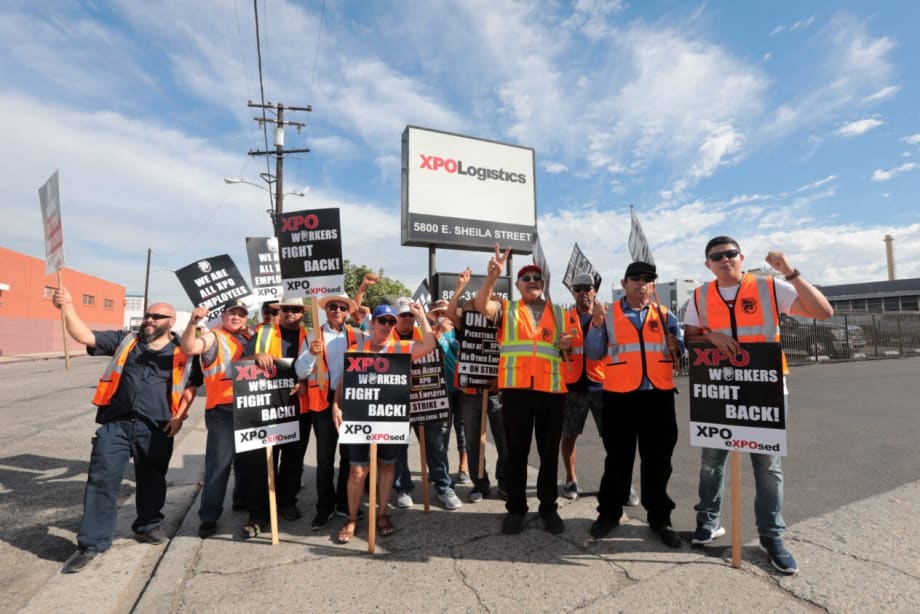
Some XPO independent contractors want to unionize.
Photo: Teamsters
4 min to read
Port and rail truck drivers working for XPO Logistics in Southern California filed for an election to form a union Wednesday — even though federal law prohibits them, as independent contractors, from organizing.
The International Brotherhood of Teamsters contends the drivers are “misclassified” by XPO as independent contractors and in reality are company employees. According to an announcement from the union, the move sets up “the first-ever National Labor Relations Board election involving misclassified port and rail truck drivers.”
Last week, XPO drivers seeking to form a union sent a letter to their employer demanding recognition of their union. XPO Logistics has so far failed to recognize that demand, according to the Teamsters.
XPO Logistics recently agreed to pay nearly $30 million to settle two class-action lawsuits filed on behalf of purportedly misclassified truck drivers working at the Ports of Los Angeles and Long Beach, alleging the company paid them less than a minimum wage.
The combined settlements addressed allegations that two XPO subsidiaries, XPO Logistics Cartage in Commerce and San Diego and XPO Port Service in Rancho Dominguez, improperly classified drivers as independent contractors.
The Teamsters union hailed the settlements as a victory in its decades-long effort to organize drivers at the ports. However, those settlements did not require XPO to reclassify its drivers as employees.
XPO: Most Independent Contractors Don't Want to be Employee Drivers
In a statement provided to HDT, XPO noted that many of the independent small business owners who contract with XPO prefer to be independent contractors because of the flexibility it provides to set their own schedules and choose their work.
“They can grow their business by hiring others and running multiple trucks and the freedom to offer their services to multiple companies,” said the statement. “We believe we adhere to all federal, state, and local laws, and we believe we properly classify all individuals and businesses that perform work on behalf of XPO.”
XPO also pointed out that independent contractors who would rather be full-time employee drivers are welcome to apply for truck driver openings at the company. “We currently employ approximately 12,000 full-time truck drivers and we’re recruiting more.”
Independent contractors only make up a small percentage of XPO’s driver force, according to the company. XPO has approximately 360 in the state of California. A predominant number of its drivers are full-time employees in its less-than-truckload division, but the company uses independent contractors in some parts of its business, including last-mile delivery as well as port drivers.
As of November 2021, fewer than 200 U.S. employees at a total of four XPO locations are represented by the Teamsters, out of an eligible population of 28,000 employees.
At two of those locations, XPO and the Teamsters agreed to contracts, according to the company, and at the other two locations, negotiations are in progress on the first contract.
Over the past two years, employees at three other XPO locations voted to decertify the Teamsters as their bargaining representative, according to XPO. And at two other locations, the company said, the Teamsters walked away after employees rejected contracts that the union had negotiated with XPO.
Labor-Friendly Administration
XPO drivers also filed an unfair labor practice charge with the National Labor Relations Board, according to the Teamsters, alleging that XPO’s practice of misclassifying drivers as independent contractors interferes with those drivers’ right to organize and therefore violates federal labor law.
Under current federal law, the National Labor Relations Act prohibits independent contractors from organizing. However, under the current labor-friendly administration, it’s likely the Teamsters believe there’s potential to get that changed. Last year, Biden administration appointments to the National Labor Relations Board gave the board a Democratic majority. That development prompted the labor attorneys at Fisher Phillips to write, "you can expect to see seismic changes take place when it comes to national workplace relations policy."
In addition, the PRO Act introduced in the U.S. House of Representatives early last year would deem independent contractors employees for purposes of federal labor law, which would allow unions to organize them. That bill passed the House but appears to be going nowhere in the Senate.
More Drivers

Truck Drivers Need More Than Another Alert
Fleets have more visibility into truck health, safety events, and driver activity than ever. The next challenge is turning all that information into useful guidance for the person who has to decide what to do next.
Read More →
FMCSA Removes 110 Truck Driver Training Schools from Certified ELDT List
Federal regulators also are targeting more than 160 additional training providers and launching a nationwide audit of third-party CDL skills testers as part of a broader crackdown on trucking fraud.
Read More →
Hours of Service Pilot Programs: FMCSA Readies for 2027 Rollout
Two pilot programs could eventually reshape hours-of-service rules, giving truck drivers options to pause their 14-hour clock or use longer split sleeper rest periods.
Read More →
Medical Cards, English Proficiency Reshape Roadcheck Violations
Medical-card violations jumped to the top of the driver out-of-service list during CVSA’s 2026 International Roadcheck, while English-language proficiency violations appeared among the leading violations for the first time.
Read More →
Driver Trust Can Make or Break the Success of Fleet Safety Technology
New Teletrac Navman research suggests that onboarding, transparency about driver data, and positive feedback can play a significant role in how commercial drivers respond to safety and coaching technology.
Read More →
EEOC Sues KLLM Over Alleged Sex Discrimination in Driver Training
KLLM is facing a federal sex-discrimination lawsuit over policies the EEOC alleges put female truck driver trainees at a disadvantage.
Read More →
FMCSA Moves to Codify English Language Requirements for Commercial Drivers
By changing regulations on English-language proficiency requirements for commercial drivers, rather than relying on a guidance memo, the FMCSA said future administrations won't be able to walk back the Trump administration's stricter enforcement with just a memo.
Read More →
Drivers Put Western Star Trucks to the Test at Star Nation Experience
Watch to get an inside look at the Western Star trucks, technology, and community behind the Star Nation Experience 2026!
Read More →
Trump Administration Looks to Put More Veterans Behind the Wheel
The Freedom Haulers program pulls together existing and expanded programs at several federal agencies to recruit veterans to drive commercial heavy-duty trucks and cut the red tape for them to get a CDL, training, and employment.
Read More →
Putting Mack’s Command Steer to the Test
A test drive of Mack’s Command Steer active steering system evaluates how it can make truck driving easier and less tiring.
Read More →