




Talks Begin for West Coast Dockworker Contact, Deadline June 30
UPDATED -- The contract is between employers who operate port terminals and shipping lines, represented by the Pacific Maritime Association, and dockworkers represented by the International Longshore and Warehouse Union.
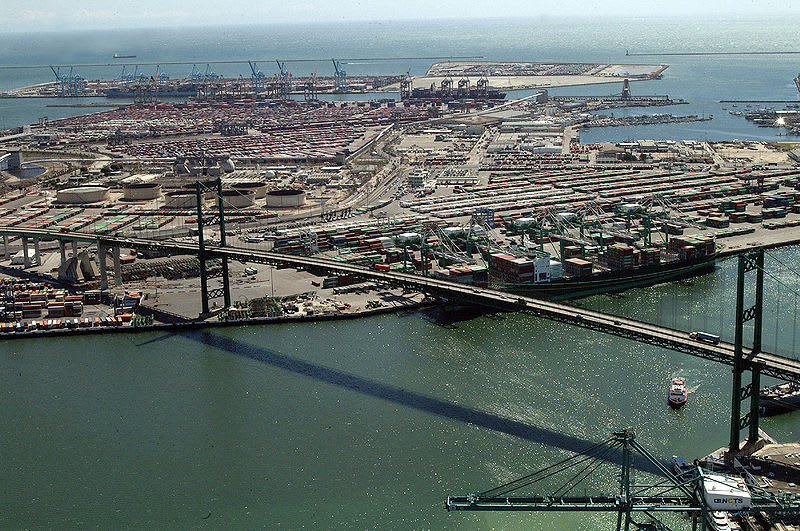
Port of Los Angeles. Credit: Wikimedia Commons.
Port of Los Angeles.
Wikimedia Commons.
UPDATED --Negotiations for a new labor contract covering nearly 20,000 dockworkers at 29 West Coast ports began Monday in San Francisco in hopes of meeting a June 30 deadline.
The contract is between employers who operate port terminals and shipping lines, represented by the Pacific Maritime Association, and dockworkers represented by the International Longshore and Warehouse Union.
Business groups ranging from the American Trucking Associations, the National Retail Federation and others are hoping the two sides will reach a tentative agreement well before the current contract expires to ease fears of any possible work stoppage by dockworkers or a lockout by port terminal operators.
“With the expiration of the current contract a mere eight weeks away, and recognizing that there are a number of challenging issues that need to be addressed, retailers remain hopeful that a new long-term agreement can be reached before the deadline,” said the Retail Industry Leaders Association President Sandy Kennedy, in the letter to the presidents of the PMA and ILWU earlier this month.
Talks are scheduled to continue on a daily basis until an agreement is reached. If an agreement is not reached well ahead of the deadline, it is expected shippers could start making alternate plans for freight that enters or leaves the U.S. from West Coast ports, affecting some truck movements.
“West Coast ports have lost significant market share in recent years, and face renewed competition from Canada, Mexico, the Panama Canal and other domestic ports for cargo that has powered job and economic growth in local port communities and beyond,” said PMA President Jim McKenna. “With these stakes in mind, PMA and its members are focused on delivering a contract that ensures the West Coast’s standing as the gateway of choice for goods sent to and from Asia.”
Meantime, a new poll by the Journal of Commerce shows two-thirds of shippers plan to divert at least some cargo away from U.S. West Coast ports. The reason is to avoid any service disruptions that could emerge from contract negotiations between the International Longshore and Warehouse Union and West Coast employers, especially if there is a strike or lockout of if it appears there will be one.
Update adds JOC poll.
More Fleet Management

Nominations Open for HDT Emerging Leaders
Heavy Duty Trucking is looking for accomplished trucking fleet professionals under 40 who are making an impact and helping lead the industry forward.
Read More →
Why Private Fleets Are Taking More Freight
Private fleets are putting their own trucks on demanding customers and high-cost lanes as companies seek greater control over service, costs, and capacity.
Read More →
Color Match Smarter: Tools That Restore & Perform
For fleet managers and collision repair professionals keeping heavy-duty trucks on the road, getting the color right the first time isn't just about appearance — it's about efficiency, turnaround time, and bottom-line results. Discover how today's digital color tools are transforming the repair process from guesswork to precision.
Read More →


FMCSA Pauses Biennial-Update Enforcement Amid Motus Transition
Carriers whose updates were due on or after June 1 have more time, while FMCSA works to stabilize its new registration system and warns of phishing sites impersonating its new carrier registration system, Motus.
Read More →
2026 Blueprint for Countering Smarter Supply Chain Theft
Cargo theft is no longer just the cost of doing business. It's a multi-billion-dollar criminal enterprise exploiting vulnerabilities across your fleet, drivers, and supply chain.
Read More →
How Telematics Improves Visibility, Control, and Performance in Refrigerated Fleets
Explore how telematics help refrigerated fleets improve visibility, uptime, efficiency, compliance, and cargo protection across connected cold chain operations.
Read More →
What the U.S.-Canada Trade War Means for Trucking
Escalating U.S.-Canada tariffs could disrupt cross-border freight, reduce truck volumes, raise costs, and create new uncertainty for carriers on both sides of the border.
Read More →
What Are Trucking’s Top Concerns for 2026?
The American Transportation Research Institute wants to know what's worrying trucking fleet managers, drivers, and other stakeholders in its annual Industry Issues survey.
Read More →
American Trucking Associations Looks for a New Leader
ATA President and CEO Chris Spear abruptly left his job at the association on August 21, at a pivotal time for the trucking industry.
Read More →
Public Wi-Fi Cybersecurity Risks: How Truck Drivers and Fleets Can Protect Their Data
Public Wi-Fi can expose truck drivers and fleets to credential theft, malware, and other cyber threats. Here’s how to reduce the risk on the road.
Read More →