





Related: IIHS Urges Caution on Younger Truck Driver Pilot Programs
IIHS: Front Crash Prevention Works for Large Trucks
A study by the Insurance Institute for Highway Safety found that trucks equipped with forward collision warning had 22% fewer crashes and trucks with AEB had 12% fewer crashes than those without either technology.
September 3, 2020
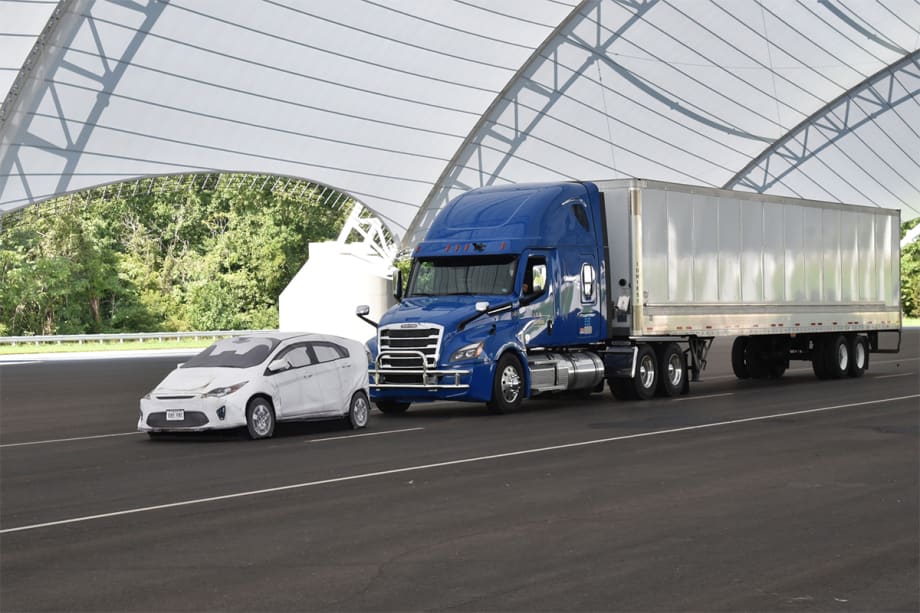
Photo: IIHS
4 min to read
Equipping large trucks with forward collision warning and automatic emergency braking systems could eliminate more than 2 out of 5 crashes in which a truck rear-ends another vehicle. A new study from the Insurance Institute for Highway Safety found that trucks equipped with forward collision warning had 22% fewer crashes and trucks with AEB had 12% fewer crashes than those without either technology.
IIHS drew on data compiled by SmartDrive Systems, a video-based safety program for commercial fleets. SmartDrive collected detailed information about crashes from trucks equipped with forward collision warning and AEB. IIHS director of statistical services, Eric Teoh, looked at some 2,000 crashes that occurred over more than 2 billion vehicle miles traveled during 2017-19, and found that forward collision warning and AEB systems reduced rear-end crashes — the specific type of collision they’re designed to prevent — by 44% and 41%, respectively.
"This study provides evidence that forward collision warning and AEB greatly reduce crash risk for tractor-trailers and other large trucks," said Teoh. "That’s important information for trucking companies and drivers who are weighing the costs and benefits of these options on their next vehicles."
Front crash prevention systems use cameras, radar or other sensors to monitor the roadway ahead. Some include only forward collision warning, which alerts the driver to obstacles in the roadway. AEB systems automatically applying the brakes to prevent the collision or reduce its severity.
“The transportation intelligence we’ve gathered over the past 15 years provides unique and deep insights on the trucking industry,” said Jason Palmer, chief operating officer of SmartDrive Systems. “We’re proud to put this data to use to support IIHS with this important and timely study of the benefits of front crash prevention.”
The European Union has required AEB with forward collision warning on most new heavy trucks since November 2013, but in the U.S., neither truck nor passenger-vehicle manufacturers are required to equip vehicles with any kind of front crash prevention.
Beginning in September 2022, 20 automakers that account for 99% of the U.S. market will move toward making AEB standard on virtually all new passenger vehicles under a voluntary commitment brokered by IIHS and the National Highway Traffic Safety Administration.
AEB Halves Crash Rates in Pass Cars
The effectiveness of automatic emergency braking in passenger cars equipped with the systems is well understood. An IIHS study of police-reported crashes showed that front AEB cuts rear-end crash rates in half and rear-end crashes involving injuries by 56%. Meanwhile, the Highway Loss Data Institute has found that AEB cuts property damage liability claims, as well as claims for injuries to people in other vehicles.
While forward collision warning and AEB systems are both intended to prevent or reduce the severity of rear-end collision, AEB has proven more effective in passenger cars than warning-only systems. In heavy trucks however, the systems proved almost equally effective: forward collision warning and AEB systems reduced rear-end crashes by 44% and 41%, respectively.
"I was a little surprised that the effects of both systems were so similar in heavy trucks, which was different than what we saw in passenger cars where the automatic braking was much more effective than warning only systems," Teoh told HDT. "There may be different things going on there, such as the pool of drivers we're looking at. These are professional drivers operating in a slightly different environment."
The differences might also be connected to variations among the specific systems used by each carrier, the study notes.
"Regardless of what's behind the specific differences, IIHS feels that having the automatic braking functionality is really important," he said. "You can't overlook the crash mitigation potential. We know that both systems prevent around 40% or rear-end crashes, but we think that the crashes that are still happening are less severe."
With both systems, there was a reduction in speed of about 50% between the time of the intervention and impact. This is true whether it’s the automated system applying the brakes or a human driver who has more time to react because of a warning. Additionally, the AEB systems studies were found to intervene more frequently in such crashes, 43% for AEB versus 31% for the warning-only systems.
“The potential benefits are great enough that these crash avoidance systems should be standard equipment on all new large trucks,” said IIHS President David Harkey.
More Safety & Compliance

FMCSA Pauses Biennial-Update Enforcement Amid Motus Transition
Carriers whose updates were due on or after June 1 have more time, while FMCSA works to stabilize its new registration system and warns of phishing sites impersonating its new carrier registration system, Motus.
Read More →
ZF Expands Commercial Vehicle Push in North America
ZF is expanding its North American commercial-vehicle presence with new transmission applications, electrification, trailer technology and autonomous-driving systems.
Read More →
Truck Drivers Need More Than Another Alert
Fleets have more visibility into truck health, safety events, and driver activity than ever. The next challenge is turning all that information into useful guidance for the person who has to decide what to do next.
Read More →
Tesla Wants a Self-Driving Semi. Are Cameras Enough?
Could Tesla’s camera-only autonomous driving technology work on an 80,000-pound Semi? In this commentary, HDT's Deborah Lockridge takes a look at Tesla, Cybercab, and how autonomous trucks see the road.
Read More →
What DOT’s Automated Vehicle Strategy Means for Trucking
The U.S. Department of Transportation issued a new automated-vehicle strategy that outlines plans for driverless-truck regulations, cross-state freight corridors, and federal safety standards.
Read More →
NYC Expands Speed, Pedestrian Safety Tech Across Fleet
New York City is expanding intelligent speed assistance and pedestrian-alert systems across its municipal fleet, moving the technologies from pilot programs into vehicle procurement and retrofit requirements.
Read More →
FMCSA Removes 110 Truck Driver Training Schools from Certified ELDT List
Federal regulators also are targeting more than 160 additional training providers and launching a nationwide audit of third-party CDL skills testers as part of a broader crackdown on trucking fraud.
Read More →
Beyond DOT Compliance: What Makes a Trucking Fleet Truly Safe?
A trucking fleet can follow every rule and still make unsafe decisions. The real test comes when safety conflicts with freight, productivity, or cost.
Read More →
Hours of Service Pilot Programs: FMCSA Readies for 2027 Rollout
Two pilot programs could eventually reshape hours-of-service rules, giving truck drivers options to pause their 14-hour clock or use longer split sleeper rest periods.
Read More →
New Guide Offers Pet Safety Tips for Truck Drivers
Hundreds of thousands of pets travel in truck cabs. A new safety guide from Volvo Trucks and the Center for Pet Safety offers practical advice for truck drivers who bring dogs and cats along for the ride.
Read More →