




Spot Flatbed Rates Continue Increasing as Vans, Reefers Remain Stable
Flatbed load availability and rates made big gains and the flatbed load-to-truck ratio hit a new record during the week ending March 10, according to DAT Solutions and its network of load boards, while a separate report for last month showed a drop in rates but they remained above year-ago levels.

Flatbed load availability and rates made big gains and the flatbed load-to-truck ratio hit a new record during the week ending March 10, according to DAT Solutions and its network of load boards, while a separate report for last month showed a drop in rates but they remained above year-ago levels.
The number of flatbed load posts increased 10.8% while truck posts dipped 1% compared to the previous week. There were 88.5 available loads for every flatbed truck posted on DAT load boards, up 11%. It was 61.8 a month ago and below 30 in November.
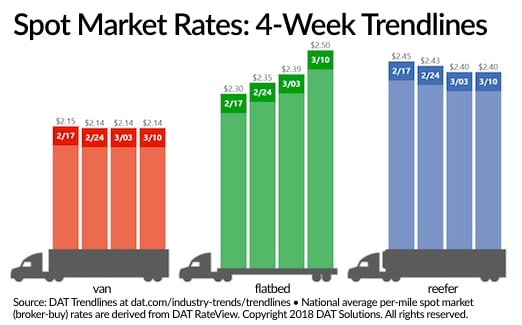
Flatbed freight includes construction materials, machinery, and other heavy loads. The national average flatbed rate was $2.50 per mile, 11 cents higher compared to the previous week and compared to $2.30 per mile three weeks earlier. All reported weekly rates include fuel surcharges.
Houston was the largest market in terms of outbound flatbed freight volume. The number of available loads in Houston jumped 11.4% and the average outbound rate was up 6 cents to $2.70 per mile.
Meantime, in the van sector, after two weeks of rising volumes, the number of loads slipped 0.6% last week while truck posts increased 3.1%. The result was a mostly neutral week in terms of rates, as the national average spot van rate was $2.14 per mile, unchanged for the third straight week. The van load-to-truck ratio was down slightly to 6.8 loads per truck.
Reefer load posts increased 4% while truck posts increased 5%. That caused the national load-to-truck ratio for reefers to decline from 10.6 to 10.5 loads per truck. The national average reefer rate held steady at $2.40 per mile for the second week in a row.
During this time period the national average retail prices of diesel fell 0.3% to $2.98 per gallon.
DAT North American Freight Index Posts February Drop
This followed the release earlier in the week of a report from DAT that showed spot truckload freight volume and rates declined seasonally in February, which is typically the slowest month for freight.
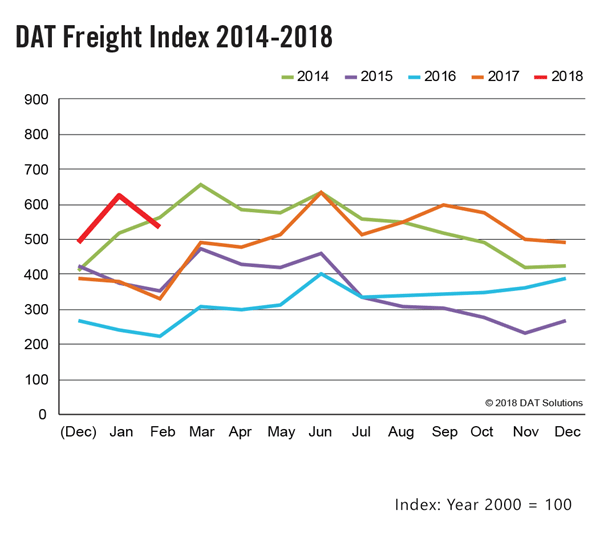
The DAT North American Freight Index fell 14% compared to January but this was the second-strongest February in 20 years. The index of available loads rose 62% compared to February 2017.
Spot market rates for van, refrigerated, and flatbed freight slipped lower month-over-month but continued to exceed 2017 levels.
The national average spot van rate was $2.13 per mile in February, down 11 cents compared to January but 52 cents higher than February 2017.
At $2.42 per mile, the national average spot reefer rate was 22 cents lower month-over-month but 56 cents higher compared to February 2017. The spot rate for reefers exceeded the average contract rate for the sixth consecutive month, indicating extraordinary pressure on reefer capacity nationwide, according to DAT.
The national average flatbed spot rate was $2.36 per mile, 1 cent lower than the January peak, but 40 cents higher year-over-year. The spot rate for flatbeds matched the average contract rate in February.
Increased volume at the end of the month and the first few days of March signaled an early start to the spring freight season, according to DAT.
“We expect rates to rebound well before the end of March,” said DAT Industry Analyst Mark Montague. “The end of the month and quarter coincide with Easter weekend as well as the start of the full penalty phase of the Electronic Logging Device (ELD) mandate on April 1. Shippers will want to move freight ahead of these key dates, and the additional demand will intensify the strain on capacity, driving rates up.”
Referenced rates for the monthly index are based on $45 billion of annual transactions with DAT, that include fuel surcharges, but not accessorials or other fees.
More Fleet Management

Nominations Open for HDT Emerging Leaders
Heavy Duty Trucking is looking for accomplished trucking fleet professionals under 40 who are making an impact and helping lead the industry forward.
Read More →
Why Private Fleets Are Taking More Freight
Private fleets are putting their own trucks on demanding customers and high-cost lanes as companies seek greater control over service, costs, and capacity.
Read More →
Color Match Smarter: Tools That Restore & Perform
For fleet managers and collision repair professionals keeping heavy-duty trucks on the road, getting the color right the first time isn't just about appearance — it's about efficiency, turnaround time, and bottom-line results. Discover how today's digital color tools are transforming the repair process from guesswork to precision.
Read More →


FMCSA Pauses Biennial-Update Enforcement Amid Motus Transition
Carriers whose updates were due on or after June 1 have more time, while FMCSA works to stabilize its new registration system and warns of phishing sites impersonating its new carrier registration system, Motus.
Read More →
2026 Blueprint for Countering Smarter Supply Chain Theft
Cargo theft is no longer just the cost of doing business. It's a multi-billion-dollar criminal enterprise exploiting vulnerabilities across your fleet, drivers, and supply chain.
Read More →
How Telematics Improves Visibility, Control, and Performance in Refrigerated Fleets
Explore how telematics help refrigerated fleets improve visibility, uptime, efficiency, compliance, and cargo protection across connected cold chain operations.
Read More →
What the U.S.-Canada Trade War Means for Trucking
Escalating U.S.-Canada tariffs could disrupt cross-border freight, reduce truck volumes, raise costs, and create new uncertainty for carriers on both sides of the border.
Read More →
What Are Trucking’s Top Concerns for 2026?
The American Transportation Research Institute wants to know what's worrying trucking fleet managers, drivers, and other stakeholders in its annual Industry Issues survey.
Read More →
American Trucking Associations Looks for a New Leader
ATA President and CEO Chris Spear abruptly left his job at the association on August 21, at a pivotal time for the trucking industry.
Read More →
Public Wi-Fi Cybersecurity Risks: How Truck Drivers and Fleets Can Protect Their Data
Public Wi-Fi can expose truck drivers and fleets to credential theft, malware, and other cyber threats. Here’s how to reduce the risk on the road.
Read More →