




Siemens Begins Zero-Emissions Highway Testing in California
Overhead power lines deliver electric power to test trucks on a stretch of zero-emissions highway being evaluated by Siemens and the South Coast Air Quality Management District near Long Beach, California.
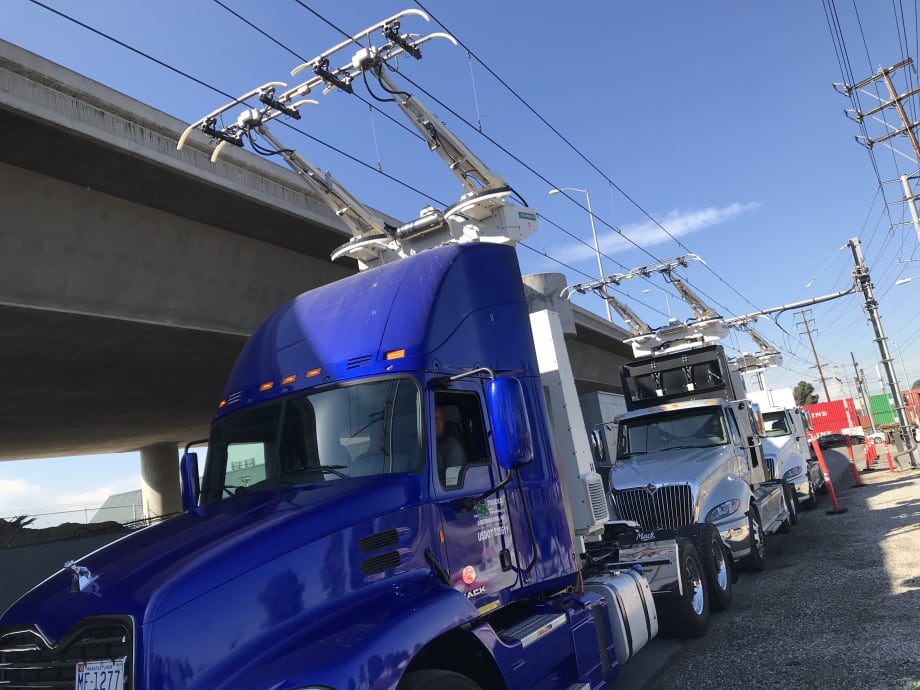
Three different types of trucks are being tested: one battery-electric truck, a clean natural-gas hybrid-electric truck, and a diesel-hybrid truck. Photo: Siemens
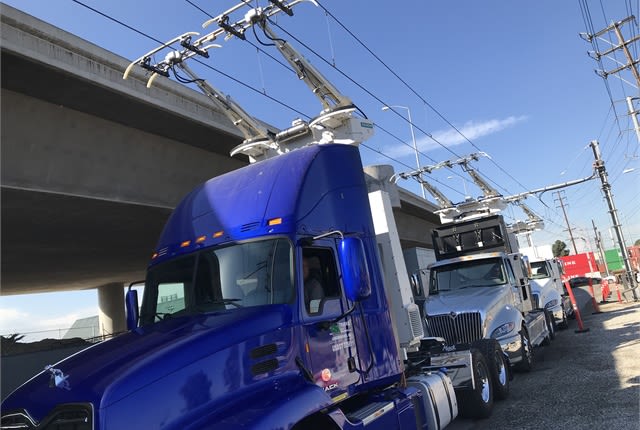
Three different types of trucks are being tested: one battery-electric truck, a clean natural-gas hybrid-electric truck, and a diesel-hybrid truck. Photo: Siemens
A new, zero-emission highway concept for moving freight is undergoing testing near Long Beach, California.
German technology giant Siemens and the South Coast Air Quality Management District are conducting a one-mile, zero-emission eHighway demonstration in Carson, California, to determine the feasibility of a dedicated electric highway. The test involves three big-rig trucks hauling freight along a stretch of highway that uses Siemens technology to electrify select highway lanes via an overhead catenary system. This catenary system supplies the trucks with electric power, similar to how modern-day trolleys or streetcars are powered on many city streets, but the system also allows for truck operation outside the electrified sections of infrastructure.
Currently, one battery-electric truck, a clean natural-gas hybrid-electric truck, and a diesel-hybrid truck are driving on the mile-long catenary system on the north- and south-bound lanes of South Alameda Street from East Lomita Boulevard to the Dominguez Channel in Carson. The demonstration system features an overhead contact line that makes power available to trucks along the road. An active pantograph on top of the eHighway trucks transfers energy from the overhead lines to the trucks' electric motors, allowing them to operate with zero emissions while on the catenary system.
The pantograph can connect and disconnect automatically with the contact line via a sensor system while the trucks are moving. This allows the eHighway trucks to easily switch lanes or pass other vehicles without being permanently fixed to the overhead systems. To further ensure the same flexibility as conventional trucks, the eHighway vehicles use an electric-hybrid drive system, which can be powered by diesel, compressed natural gas, battery or other on-board energy source, when driving outside of the catenary lines.
The system is expected to lower fossil fuel consumption, reduce truck operating costs, substantially reduce smog-forming, toxic and CO2 emissions, and help accommodate a growing reliance on freight transportation. The aim of this specific project is to demonstrate the eHighway system applied in truck operation on public roads in an urban U.S. setting and to further prepare applications for larger scale initiatives in the future.
Under a separate contract with SCAQMD, the air pollution control agency for Orange County and major portions of Los Angeles, San Bernardino and Riverside counties, the natural-gas hybrid and battery-electric trucks have been developed by Escondido-based TransPower. The diesel hybrid was developed by Mack Trucks, a part of the Volvo Group.
The $13.5 million project is funded by $2.5 million from SCAQMD, as well as $4 million from a settlement with China Shipping, $3 million from the California Energy Commission, $2 million from the Port of Long Beach, and $2 million from LA Metro. In addition, Siemens provided a $1.3 million in-kind contribution. SCAQMD is providing an additional $2.1 million, and the federal EPA is providing $500,000 for the TransPower contract.
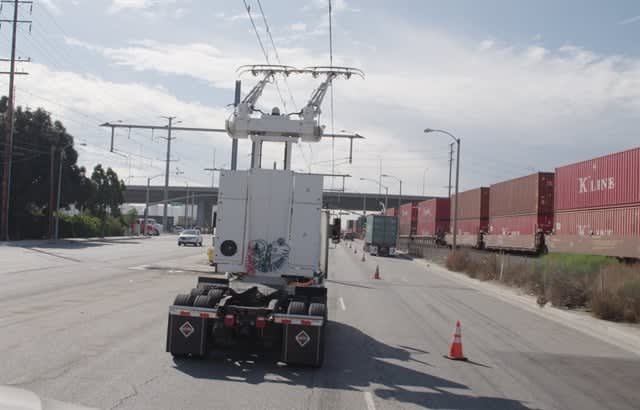
The mile-long catenary system runs on the north- and south-bound lanes of South Alameda Street from East Lomita Boulevard to the Dominguez Channel in Carson. Photo: Siemens
In June 2016, Siemens launched the world’s first eHighway system on public roads in Sweden. The eHighway is running on a two-kilometer section of the E16 highway north of Stockholm through 2018. Two biodiesel-hybrid vehicles from truck-maker Scania, subsidiary of Volkswagen, are being used for the project. In addition, three field trials of the eHighway technology on German highways are planned to start operation in 2019.
“This project will help us evaluate the feasibility of a zero-emission cargo movement system using overhead catenary wires,” said Wayne Nastri, SCAQMD’s executive officer. “This demonstration could lead to the deployment of eHighway systems that will reduce pollution and benefit public health for residents living near the ports.”
Related: TransPower's Totally Electric Class 8 Tractor [Video]
More Fuel Smarts

How Volvo Updated Its D13 for EPA 2027 [Watch]
Volvo’s updated D13 promises lower emissions without sacrificing performance or fuel economy. Take a closer look at what changed inside the engine in this HDT Spotlight video.
Read More →
Diesel Price Spike Shortens Payback for Natural Gas Trucks, Report Says
Energy Vision estimates fleets could recover the higher purchase price of an RNG-fueled Class 8 tractor in 1.3 to 2.8 years under current fuel-price scenarios.
Read More →
Calstart Becomes Catalyst Mobility, Reflecting Broader Focus
Calstart is now Catalyst Mobility, reflecting the nonprofit’s growing national role in clean transportation, including zero-emission trucks, infrastructure and incentive programs.
Read More →

Record Diesel Prices Squeeze Trucking Fleets
Average U.S. diesel prices have climbed to nearly $6 a gallon, surpassing the 2022 record as tight refinery capacity and Middle East disruptions keep fuel costs elevated.
Read More →
How Fuel Delivery Shapes Engine Performance
Fuel delivery depends on more than what happens at the injector. For fleet, maintenance and technical professionals, looking at the full path from pump to injector can provide useful context for understanding engine performance.
Read More →
East Coast Port Launches $45M Electric Truck Push
The Port Authority of New York and New Jersey announced millions in incentives for zero-emission drayage trucks, yard tractors, and new charging hubs near the port.
Read More →
California Bill Could Shed Light on Electric Truck Prices
Why do battery-electric Class 8 trucks remain so expensive? A California bill headed to Gov. Gavin Newsom would give fleets and state agencies more visibility into what manufacturers charge.
Read More →
Detroit Opens Orders for EPA 2027 Engines
Detroit isn’t starting from scratch to meet EPA 2027 diesel emissions standards. Its Gen 6 DD13 and DD15 engines keep much of today’s platform while updating the fuel and aftertreatment systems.
Read More →
Zero-Emission Truck Corridor Planned for West Coast
California, Oregon, Washington, British Columbia and Baja California are coordinating plans for truck charging and hydrogen fueling from Canada to Mexico.
Read More →
A Closer Look at Kenworth’s Electric T880E Vocational Truck [Video]
Learn more about Kenworth's T880E battery-electric vocational truck at the Paccar Technical Center, including its range, applications, upfitting considerations, and PTO options, in this HDT Spotlight video.
Read More →