




Scania Hails Positioning Accuracy Breakthrough for Autonomous Vehicles
Scania says new positioning technology leveraging the capabilities of the Galileo global navigation satellite system has achieved accuracy down to centimeter-scale levels for autonomous vehicles, allowing tricky maneuvers like merging.

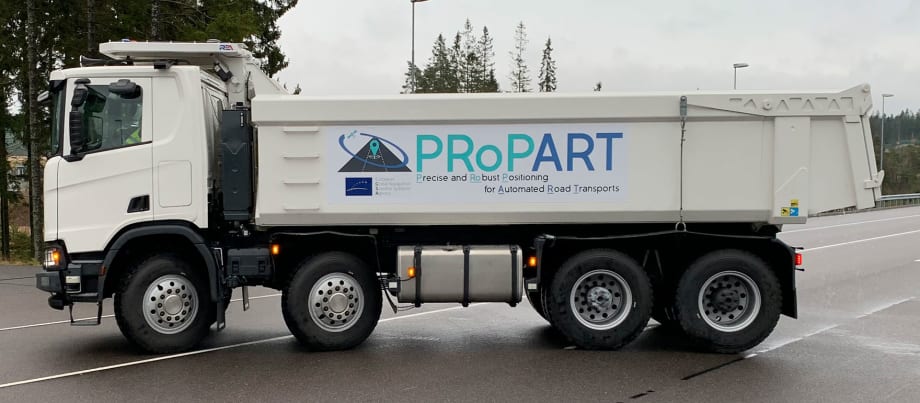
Scania said new technology tested in Europe has lead to a breakthrough in safely merging trucks under autonomous control.
Photo: Scania
Autonomous vehicles and advanced driver assistance systems need robust and precise positioning to enable reliable operations. This is especially important in the early transitional phase of the technology, when other vehicles on the road will not be automated.
Swedish truck maker Scania said that working with technology partners in Europe, it has achieved a breakthrough in enhanced positioning accuracy for autonomous vehicles, using the Galileo global navigation satellite system in combination with other positioning and sensor technologies.
This solution was developed as part of Europe’s Propart project – The Precise and Robust Positioning for Automated Road Transports research effort – which involves Scania and six partners.
The Propart technology project combines Real Time Kinematic positioning software from Waysure (Sweden) with satellite measurements from Fraunhofer IIS (Germany). The satellite positioning was augmented with an ultra-wideband ranging solution from Spanish research institution Ceit-IK4.
The company said it believes this technology could eventually become a key enabler for autonomous trucks in the future.
Centimeter-Level Positioning
The project’s vehicle positioning solution was recently demonstrated in a recreated motorway situation at the AstaZero test area in Sweden, with a connected autonomous truck and two unconnected manned cars.
The self-driving truck was supplied by Scania, with Hungary-based vehicle-to-everything communications company Commsignia providing the short-range communication technology. Baselabs from Germany provided sensor data fusion of onboard and roadside sensors and developed a situational assessment for the automated lane change maneuver. The project has received funding from the European GNSS Agency under the European Union’s Horizon 2020 innovation program.
As part of the test, a Scania self-driving truck executed a safe and efficient lane change in traffic. The maneuver was managed by the new system, relying on centimeter-level positioning combined with collaborative perception sensor data.
Scania said the project demonstrated that it was possible to pinpoint the position with 10-centimeter accuracy. The truck could execute the maneuver due to the precise positioning and an accurate representation of the whole surrounding environment. This was achieved by fusing data from the truck’s camera and front and side radars combined with radars mounted on roadside units.
Infrastructure-to-Vehicle Communications
“In addition to positioning, we’ve also added infrastructure-to-vehicle communications,” said Stefan Nord, project coordinator with Rise, a Swedish Research Institute, which coordinated the demonstration.
Ordinarily, Nord added, autonomous vehicles rely on their own sensors to interpret and process data on the surrounding environment. “If vehicles share information, you can extend their horizon and benefit from data from another vehicle to also look around the corner and thereby gather more data as a basis for manoeuvring decisions,” he said.
“In the project, we focused on achieving a positioning error below 20 centimeters in combination with an ambitious target integrity risk – that is, the probability of the position error exceeding this error limit," explained Fredrik Hoxell, development engineer for Scania Intelligent Transport Systems. “However, for deployment in real-life traffic situations, which tend to be much more dynamic and unstructured, there are of course many more vehicle and system characteristics and possible sources of errors that need to be handled.”
Hoxell noted that Scania is presently investigating several different positioning solutions. “Reliable and high-integrity navigation is absolutely essential when operating autonomous vehicles in uncontrolled environments. These trials offer one possible facet of the overall challenge related to navigation support on the journey towards safe and sustainable autonomous transport,” he said.
The merging demo is featured in this video from Propart partner The Fraunhofer Institute for Integrated Circuits.
More Safety & Compliance

FMCSA Pauses Biennial-Update Enforcement Amid Motus Transition
Carriers whose updates were due on or after June 1 have more time, while FMCSA works to stabilize its new registration system and warns of phishing sites impersonating its new carrier registration system, Motus.
Read More →
ZF Expands Commercial Vehicle Push in North America
ZF is expanding its North American commercial-vehicle presence with new transmission applications, electrification, trailer technology and autonomous-driving systems.
Read More →
Truck Drivers Need More Than Another Alert
Fleets have more visibility into truck health, safety events, and driver activity than ever. The next challenge is turning all that information into useful guidance for the person who has to decide what to do next.
Read More →
Tesla Wants a Self-Driving Semi. Are Cameras Enough?
Could Tesla’s camera-only autonomous driving technology work on an 80,000-pound Semi? In this commentary, HDT's Deborah Lockridge takes a look at Tesla, Cybercab, and how autonomous trucks see the road.
Read More →
What DOT’s Automated Vehicle Strategy Means for Trucking
The U.S. Department of Transportation issued a new automated-vehicle strategy that outlines plans for driverless-truck regulations, cross-state freight corridors, and federal safety standards.
Read More →
NYC Expands Speed, Pedestrian Safety Tech Across Fleet
New York City is expanding intelligent speed assistance and pedestrian-alert systems across its municipal fleet, moving the technologies from pilot programs into vehicle procurement and retrofit requirements.
Read More →
FMCSA Removes 110 Truck Driver Training Schools from Certified ELDT List
Federal regulators also are targeting more than 160 additional training providers and launching a nationwide audit of third-party CDL skills testers as part of a broader crackdown on trucking fraud.
Read More →
Beyond DOT Compliance: What Makes a Trucking Fleet Truly Safe?
A trucking fleet can follow every rule and still make unsafe decisions. The real test comes when safety conflicts with freight, productivity, or cost.
Read More →
Hours of Service Pilot Programs: FMCSA Readies for 2027 Rollout
Two pilot programs could eventually reshape hours-of-service rules, giving truck drivers options to pause their 14-hour clock or use longer split sleeper rest periods.
Read More →
New Guide Offers Pet Safety Tips for Truck Drivers
Hundreds of thousands of pets travel in truck cabs. A new safety guide from Volvo Trucks and the Center for Pet Safety offers practical advice for truck drivers who bring dogs and cats along for the ride.
Read More →