




Ryder Opens Two Natural Gas Fueling Stations in California
Ryder System has opened the first natural gas fueling stations in its North American network to serve both the general public and Ryder lease and rental customers, located in Orange and Fontana, Calif.
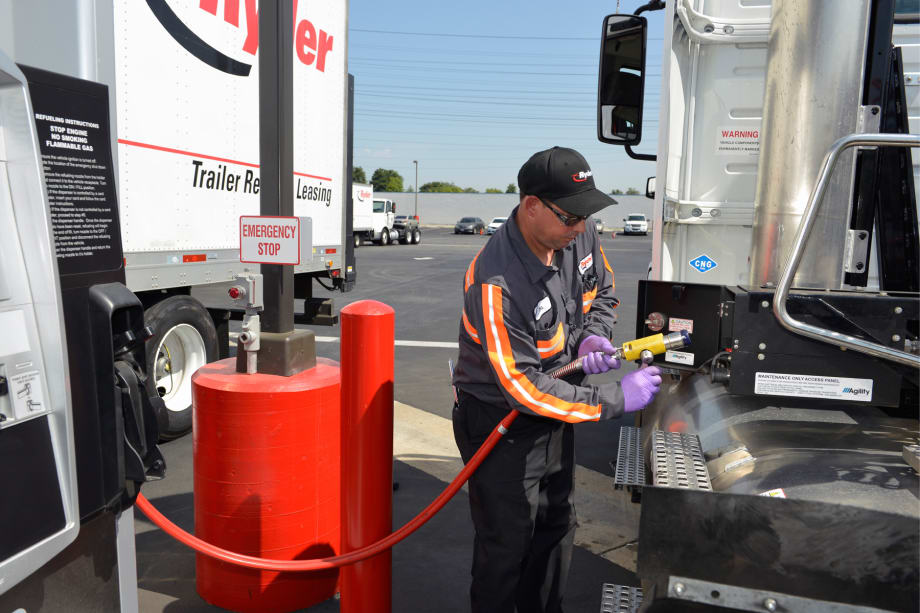
A Ryder technician fuels a CNG vehicle at Ryder's new natural gas fuel station in Fontana, Calif.
Ryder System has opened the first natural gas fueling stations in its North American network to serve both the general public and Ryder lease and rental customers.
The Liquefied to Compressed Natural Gas (LCNG) stations are located at two of Ryder’s maintenance and fueling facilities in Orange, Calif., and Fontana, Calif., two key facilities serving the Southern California region.
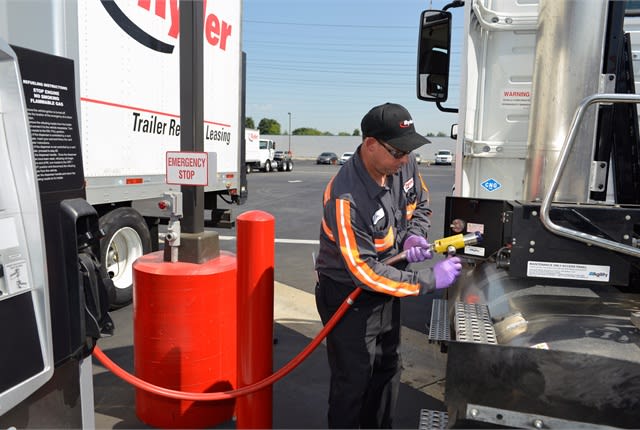
A Ryder technician fuels a CNG vehicle at Ryder's new natural gas fuel station in Fontana, Calif.
Each Ryder fueling location has three pumps – two Compressed Natural Gas (CNG) and one Liquefied Natural Gas (LNG). Ryder’s contractual customers will be able to access the LNG and CNG pump areas of Ryder’s facilities specifically configured for large commercial vehicles. Passenger vehicles and light-duty trucks will also be able to access CNG pumps in a separate area easily accessible to the general public.
LCNG stations rely on LNG delivered via tanker trailers. As a cryogenic liquid, and due to the extremely cold temperatures of liquefied natural gas, LNG is stored on-site in specially insulated cryogenic tanks. The liquid is then either dispensed as an on-highway fuel for LNG vehicles, or warmed, vaporized, and compressed for fueling of CNG vehicles. Not only does this process produce the cleanest CNG fuel, Ryder says, it also keeps the fuel colder and therefore results in a better fill and faster dispensing – both crucial for efficient fueling and operation of commercial fleet applications.
The two facilities are part of a larger project which will displace more than 1.5 million gallons of diesel annually with domestically produced low-carbon natural gas.
“The completion of these two LCNG fueling stations is a critical milestone demonstrating Ryder’s commitment to the deployment of alternative fuel vehicles,” says Robert Sanchez, chairman and CEO for Ryder. “As a provider of full service lease, commercial rental fleet, and third party logistics services, our business model puts us in a unique position to enable more fleets to convert to natural gas and realize the benefits of this cost-effective, clean, and domestic energy source. We are proud to make this investment in fueling infrastructure, which will further support the wider adoption of natural gas vehicles for commercial transportation.”
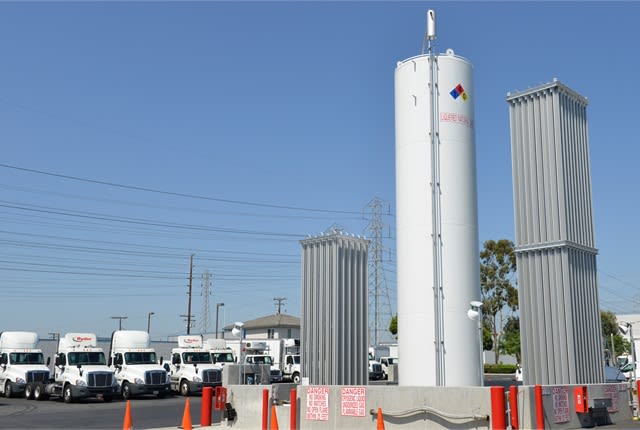
Ryder LNG fuel station in Orange, Calif.
The opening of these stations is the culmination of a commitment under the Ryder/SANBAG Natural Gas Vehicle project, a $38.7 million project funded as part of a joint public/private industry partnership between the San Bernardino Associated Governments (SANBAG), the Southern California Association of Governments (SCAG), the U.S. Department of Energy, the California Energy Commission, and Ryder.
The Mobile Source Air Pollution Reduction Review Committee (MSRC) also provided $350,000 toward the new fueling stations in the form of grants.
In addition to the fuel stations, the Ryder/SANBAG project included upgrades to three Ryder maintenance facilities – in Rancho Dominguez, Orange, and Fontana – as well as the deployment of 202 heavy-duty natural gas vehicles in the region.
Ryder has deployed more than 300 CNG and LNG vehicles into the fleets of more than 40 Ryder customers in California, Michigan, Arizona, and Louisiana.
More Fuel Smarts

Diesel Price Spike Shortens Payback for Natural Gas Trucks, Report Says
Energy Vision estimates fleets could recover the higher purchase price of an RNG-fueled Class 8 tractor in 1.3 to 2.8 years under current fuel-price scenarios.
Read More →
Calstart Becomes Catalyst Mobility, Reflecting Broader Focus
Calstart is now Catalyst Mobility, reflecting the nonprofit’s growing national role in clean transportation, including zero-emission trucks, infrastructure and incentive programs.
Read More →
Record Diesel Prices Squeeze Trucking Fleets
Average U.S. diesel prices have climbed to nearly $6 a gallon, surpassing the 2022 record as tight refinery capacity and Middle East disruptions keep fuel costs elevated.
Read More →

How Fuel Delivery Shapes Engine Performance
Fuel delivery depends on more than what happens at the injector. For fleet, maintenance and technical professionals, looking at the full path from pump to injector can provide useful context for understanding engine performance.
Read More →
East Coast Port Launches $45M Electric Truck Push
The Port Authority of New York and New Jersey announced millions in incentives for zero-emission drayage trucks, yard tractors, and new charging hubs near the port.
Read More →
California Bill Could Shed Light on Electric Truck Prices
Why do battery-electric Class 8 trucks remain so expensive? A California bill headed to Gov. Gavin Newsom would give fleets and state agencies more visibility into what manufacturers charge.
Read More →
Detroit Opens Orders for EPA 2027 Engines
Detroit isn’t starting from scratch to meet EPA 2027 diesel emissions standards. Its Gen 6 DD13 and DD15 engines keep much of today’s platform while updating the fuel and aftertreatment systems.
Read More →
Zero-Emission Truck Corridor Planned for West Coast
California, Oregon, Washington, British Columbia and Baja California are coordinating plans for truck charging and hydrogen fueling from Canada to Mexico.
Read More →
A Closer Look at Kenworth’s Electric T880E Vocational Truck [Video]
Learn more about Kenworth's T880E battery-electric vocational truck at the Paccar Technical Center, including its range, applications, upfitting considerations, and PTO options, in this HDT Spotlight video.
Read More →
Kenworth T880E Brings EV Power to Vocational Trucks
A closer look at the Kenworth T880E’s range, charging, powertrain and upfit options — and where fleets are showing the most interest.
Read More →