




Rush Truck Centers Tech Rodeo Rocks San Antonio
Each year for the past decade Rush Truck Centers has sent its best technicians to compete hear to head in the Tech Skills Rodeo. This year 300 techs from across the network tested for a chance to make the trip to the finals in San Antonio. More than 160 techs and parts specialists made the trip.


A contestent and an official discuss a problem at the Rush Truck Centers 10th annual Tech Skills Rodeo in San Antonio. Photo by Jim Park
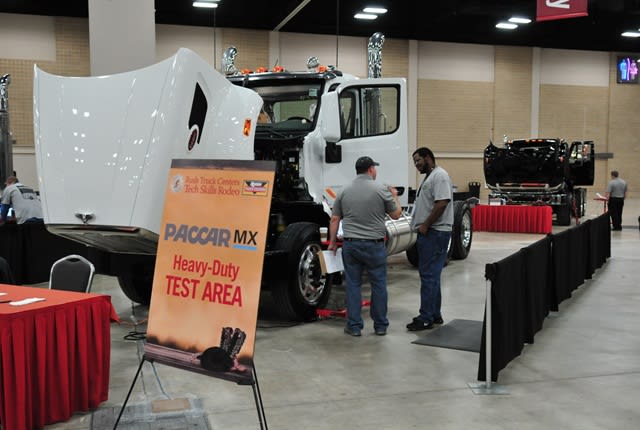
A contestent and an official discuss a problem at the Rush Truck Centers 10th annual Tech Skills Rodeo in San Antonio. Photo by Jim Park
While Rush Truck Centers celebrates its 50th year in business, the company's annual Tech Skills Rodeo competition is 10 years old this year. A field of more than 160 technicians and parts specialists, along with their spouses and partners, from the company's 120 dealerships descended on San Antonio, Texas on Sunday. The competition began bright and early Monday morning.
Mike Beeson, managing vice-president of service operations and customer solutions at Rush Truck Centers says over 300 techs and parts specialists tested at their home dealers just for the privilege of going to San Antonio. By the end of Day 1, the field had been whittled down to just 25.
"Over the past several months, techs from across the chain have been studying and writing tests back home to qualify for Monday's semi-final round," he says.
Techs are competing in medium- and heavy-duty chassis-specific categories. The medium-duty division features Hino, International, Isuzu and Peterbilt chassis. The heavy-duty competition features International and Peterbilt chassis, as well as powertrain components from Cummins, Eaton, Paccar MX and International.
New this year is the Rush Rising Star competition. It's limited to level 1 and 2 technicians and is intended to showcase the up and coming talent within the organization and to give the new techs a taste of the competition.
Phil Adams, a Paccar MX specialist from Albuquerque, NM, told truckinginfo.com that this year's competition seemed a little more straight forward than last year.
"They threw us a lot of curve balls last year; lots of clues that led nowhere and that got me lost a few times," he says. "I was able to sort out the problem more easily this year, but I think there were still a few wrinkles."
Techs who qualified for the competition following the in-house testing were able to compete in their specialities, which include all the truck brands in the RTC network (Peterbilt, International Navistar, Isuzu, Ford and Hino). Many of the competitors also have component specialities, such Cummins, Navistar, Paccar and Eaton.
At the end of Day 1, the list of competitors who made the cut and will advance to the finals was whittled down to just 30. They will go on to compete on Day 2 in the finals with a chance to improve their scores with some wildcard testing, which could be just about anything, not necessarily their speciality.
Congratulations to this year's semi-finalists:
Ford Parts: Ronald Hall, RTC Dallas
Isuzu Parts: John OBrien, RTC Orlando
Hino Parts: David Zainfeld, RTC Houston
IH Parts: Alex Kujawski, RTC Findlay
Paccar Parts: Joe Acosta, RTC Dallas
Medium Duty Supplier Divisions
Isuzu: Kory Sangster, RTC Dallas
Isuzu: Levar Parish, RTC Dallas
Hino: Steven Brain, RTC Dallas
Hino: Tyler VanOrman, RTC Fontana
International: Michael Pritchett, RTC Quincy
International: Lucas Manlief, RTC Indianapolis
Peterbilt: Dustin Ebert, RTC Phoenix
Peterbilt: Jose Garza, RTC Pharr
Heavy Duty Supplier Divisions
Eaton: Paul Serr, RTC Denver
Eaton: Erick Lincoln, RTC Albuquerque
Eaton: Jason Swann, RTC Dallas
Cummins: Christopher Jordan, RTC Effingham
Cummins: Matthew Chilson, RTC Houston
Cummins: Sigifredo Gandaria, RTC Corpus Christi
Navistar Engine: Derik Frazier, RTC Cincinnati
Navistar Engine: Dylan Moser, RTC Hickory
Navistar Engine: Rick Schaddelee, RTC Joliet
Paccar MX: Travis Graham, RTC Orlando
Paccar MX: Glenn Boothe, RTC Nashville
Paccar MX: Travis Roark, RTC Oklahoma City
More Fleet Management

Color Match Smarter: Tools That Restore & Perform
For fleet managers and collision repair professionals keeping heavy-duty trucks on the road, getting the color right the first time isn't just about appearance — it's about efficiency, turnaround time, and bottom-line results. Discover how today's digital color tools are transforming the repair process from guesswork to precision.
Read More →
FMCSA Pauses Biennial-Update Enforcement Amid Motus Transition
Carriers whose updates were due on or after June 1 have more time, while FMCSA works to stabilize its new registration system and warns of phishing sites impersonating its new carrier registration system, Motus.
Read More →
2026 Blueprint for Countering Smarter Supply Chain Theft
Cargo theft is no longer just the cost of doing business. It's a multi-billion-dollar criminal enterprise exploiting vulnerabilities across your fleet, drivers, and supply chain.
Read More →


How Telematics Improves Visibility, Control, and Performance in Refrigerated Fleets
Explore how telematics help refrigerated fleets improve visibility, uptime, efficiency, compliance, and cargo protection across connected cold chain operations.
Read More →
What the U.S.-Canada Trade War Means for Trucking
Escalating U.S.-Canada tariffs could disrupt cross-border freight, reduce truck volumes, raise costs, and create new uncertainty for carriers on both sides of the border.
Read More →
What Are Trucking’s Top Concerns for 2026?
The American Transportation Research Institute wants to know what's worrying trucking fleet managers, drivers, and other stakeholders in its annual Industry Issues survey.
Read More →
American Trucking Associations Looks for a New Leader
ATA President and CEO Chris Spear abruptly left his job at the association on August 21, at a pivotal time for the trucking industry.
Read More →
Public Wi-Fi Cybersecurity Risks: How Truck Drivers and Fleets Can Protect Their Data
Public Wi-Fi can expose truck drivers and fleets to credential theft, malware, and other cyber threats. Here’s how to reduce the risk on the road.
Read More →
For Nicky Cupp, Fleet Innovation Starts With Frustration
HDT Truck Fleet Innovator Nicky Cupp turns everyday pain points at Fraley & Schilling into opportunities for better technology and smarter processes.
Read More →
Adam Buttgenbach’s Approach to Electric Trucks: Start With Where They Fit
HDT Truck Fleet Innovator Adam Buttgenbach helped PepsiCo build one of North America’s largest EV fleets by focusing on where electric trucks make operational sense.
Read More →