





Dig Deeper: When Labor Rules and Trucker Hours of Service Collide
Residence Alone Doesn't Make Driver Subject to Washington Wage Laws
A court ruling was good news for fleets that don't operate in Washington State but do employ drivers who live there. However, part of the case regarding federal rules about sleeper pay was not dismissed.
June 3, 2022

Photo: Sang Hyun Cho from Pixabay
5 min to read
A court ruling was good news for fleets that don't operate in Washington State but do employ drivers who live there. However, part of the case regarding federal rules about sleeper pay was not dismissed.
A federal court in Washington state has dismissed part of a lawsuit from a driver who sued a motor carrier under Washington law for unpaid minimum wage, overtime, and rest breaks.
Washington is one of a few states that does not exempt interstate over-the-road truck drivers from state overtime laws.
Richard Sanders, a former employee over-the-road truck driver for national motor carrier Western Express Inc., was seeking to represent a class of Washington-resident drivers. Western Express moved for summary judgment, saying the plaintiff was not a Washington-based employee because his only connections to the state were his residence and the roughly 8% of the miles that he drove in Washington state.
The U.S. District Court for the Eastern District of Washington agreed with Western and issued an order granting summary judgment, finding that the former driver was not a Washington-based employee, even though he resides in the state.
According to Scopelitis, Garvin, Light, Hanson & Feary, which represented the defendant motor carrier, this is the first decision adjudicating whether residence alone, along with minimal in-state driving work, is enough to label an employee a “Washington-based” employee entitled to recover under Washington’s wage and hour laws.
“Although non-binding, this decision provides important guidance to national carriers who hire Washington-resident over-the-road drivers that record few miles in Washington,” the legal firm said in an email “Law Alert.”
Western is incorporated and headquartered in Tennessee, with no executives or managers or dispatchers in Washington. Western does not conduct orientation for employees in Washington, has no recurring dedicated routes in Washington, and has little business in the state. It does not maintain any terminals, administrative offices, or facilities in Washington — nor does it own property or have bank accounts in the state.
The court noted in making its decision that the parties’ contract was formed outside of Washington; Sanders attended orientation and training outside of Washington; and the employment agreement that Sanders signed expressly said that Tennessee law applied to his employment.
Federal Labor Complain Not Dismissed
However, the court did not grant summary judgment on part of the lawsuit dealing with federal labor regulations.
Sanders testified that while on long-haul trips, whether in off-duty or sleep berth mode, he was unable to use his time effectively for his own purposes like he would be able to if he were off duty at home.
A key dispute in the case is whether Sanders was responsible for his truck and trailer while he was on off-duty time. The driver said he was solely responsible and thus was not free to do as he wished during his off-duty time. Because he was actually “on duty” for 24 hours during, his mileage pay divided over 24 hours did not equal minimum wage.
Western said that it did not require him to stay with the truck and that he could park his truck in a safe location, leave the truck alone, and do whatever he pleased during his off-duty time. Since Sanders was not entitled to compensation for 24 hours a day every day that he was working over-the-road, Western claimed he was not underpaid.
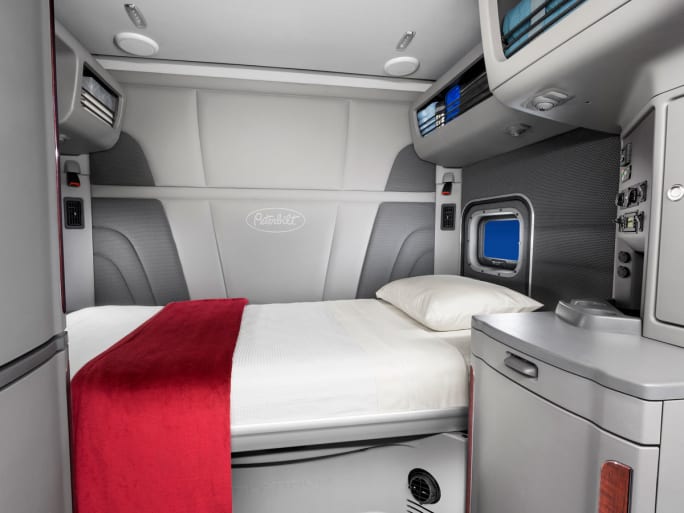
How much sleeper time is exempt from minimum-wage laws?
Photo: Peterbilt
Sanders stressed 29 C.F.R. § 785.22(a), which says, “Where an employee is required to be on duty for 24 hours or more, the employer and the employee may agree to exclude ... meal periods and a ... regularly scheduled sleeping period of not more than 8 hours from hours worked, provided adequate sleeping facilities are furnished by the employer and the employee can usually enjoy an uninterrupted night’s sleep. If sleeping period is of more than 8 hours, only 8 hours will be credited. Where no expressed or implied agreement to the contrary is present, the 8 hours of sleeping time and lunch periods constitute hours worked.”
Western emphasized 29 C.F.R. § 785.41, which particularly applies to truck drivers: “Any work which an employee is required to perform while traveling must, of course, be counted as hours worked. An employee who drives a truck, bus, automobile, boat or airplane, or an employee who is required to ride therein as an assistant or helper, is working while riding, except during bona fide meal periods or when he is permitted to sleep in adequate facilities furnished by the employer."
Another point of dispute was whether a sleeper berth constitutes "adequate facilities."
The Fair Labor Standards Act requires employers to pay most employees a regular hourly rate for up to 40 hours a week and overtime compensation at a rate of one and one-half times the regular rate for hours worked in excess of 40. However, 29 C.F.R. § 785.20 says that “under certain conditions an employee is considered to be working even though some of his time is spent in sleeping or in certain other activities.”
Some district courts have found that Section 785.22(a) is primarily applicable to truck drivers when they are on duty for 24 hours or more. Section 785.22(a) requires employers to pay truck drivers for at least 16 hours of work, even if the employee has spent more than 8 hours sleeping and eating during that 24-hour period.
The court ruled that resolution of the 24-hour on-duty claim is inappropriate on summary judgment because there is a dispute of material fact.
Does a Driver Get Paid for Sleeping?
Whether drivers should be paid for time in the sleeper berth is a murky issue. Courts have ruled in different ways.
In 2021, the Biden Administration withdrew a 2019 Department of Labor guidance regarding pay for sleeper berth time. That reinstated previous guidance that interpreted the regulations to mean that while sleeping time “may be excluded from hours worked where ‘adequate facilities’ were furnished, only up to eight hours of sleeping time may be excluded in a trip 24 hours or longer, and no sleeping time may be excluded for trips under 24 hours.”
That 2019 letter that was withdrawn said that the time when drivers are relieved of all duties and permitted to sleep in the sleeper berth is “presumptively non-compensable,” saying the earlier interpretation was “unnecessarily burdensome for employers.”
More Drivers

Truck Drivers Need More Than Another Alert
Fleets have more visibility into truck health, safety events, and driver activity than ever. The next challenge is turning all that information into useful guidance for the person who has to decide what to do next.
Read More →
FMCSA Removes 110 Truck Driver Training Schools from Certified ELDT List
Federal regulators also are targeting more than 160 additional training providers and launching a nationwide audit of third-party CDL skills testers as part of a broader crackdown on trucking fraud.
Read More →
Hours of Service Pilot Programs: FMCSA Readies for 2027 Rollout
Two pilot programs could eventually reshape hours-of-service rules, giving truck drivers options to pause their 14-hour clock or use longer split sleeper rest periods.
Read More →
Medical Cards, English Proficiency Reshape Roadcheck Violations
Medical-card violations jumped to the top of the driver out-of-service list during CVSA’s 2026 International Roadcheck, while English-language proficiency violations appeared among the leading violations for the first time.
Read More →
Driver Trust Can Make or Break the Success of Fleet Safety Technology
New Teletrac Navman research suggests that onboarding, transparency about driver data, and positive feedback can play a significant role in how commercial drivers respond to safety and coaching technology.
Read More →
EEOC Sues KLLM Over Alleged Sex Discrimination in Driver Training
KLLM is facing a federal sex-discrimination lawsuit over policies the EEOC alleges put female truck driver trainees at a disadvantage.
Read More →
FMCSA Moves to Codify English Language Requirements for Commercial Drivers
By changing regulations on English-language proficiency requirements for commercial drivers, rather than relying on a guidance memo, the FMCSA said future administrations won't be able to walk back the Trump administration's stricter enforcement with just a memo.
Read More →
Drivers Put Western Star Trucks to the Test at Star Nation Experience
Watch to get an inside look at the Western Star trucks, technology, and community behind the Star Nation Experience 2026!
Read More →
Trump Administration Looks to Put More Veterans Behind the Wheel
The Freedom Haulers program pulls together existing and expanded programs at several federal agencies to recruit veterans to drive commercial heavy-duty trucks and cut the red tape for them to get a CDL, training, and employment.
Read More →
Putting Mack’s Command Steer to the Test
A test drive of Mack’s Command Steer active steering system evaluates how it can make truck driving easier and less tiring.
Read More →