




Report: Most Fleets Should Consider Low-Viscosity Oil for Fuel Economy
A new report concludes that most fleets should look at adopting lower-viscosity engine oils for fuel savings.

A new report concludes that most fleets should look at adopting lower-viscosity engine oils for fuel savings.
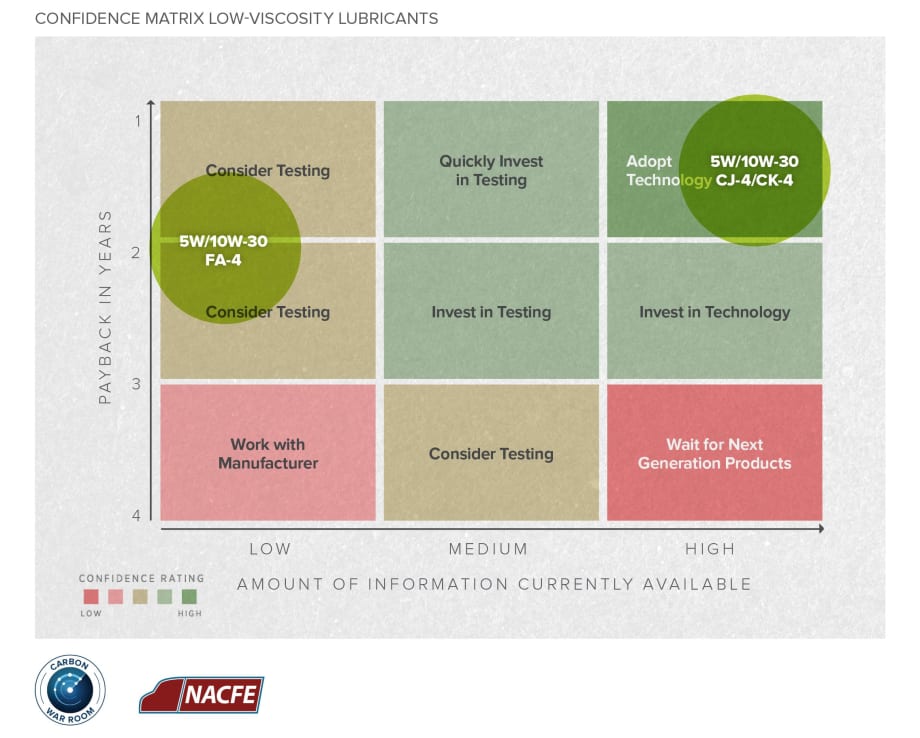
The latest Confidence Report from Trucking Efficiency, a collaborative effort of the North American Council for Freight Efficiency and Carbon War Room, finds that Class 8 over-the-road fleets can realistically expect fuel savings in the range of 0.5% to 1.5% by switching from 15W-40 to 5W/10W-30 engine oil. That could be the currently available CJ-4 class or the newer CK-4 class available after December 2016.
In addition, switching from 5W/10W-30 oil to the fuel-efficient FA-4 variant of the new PC-11 oils, also available after December 2016, is expected to add a further 0.4–0.7% of fuel savings.
The report aims to give the industry "a foundational understanding of low-viscosity oil and how it contributes to efficiency." It helps fleets rationalize their investment in low-viscosity engine oil by providing an unbiased overview of the oil’s benefits and challenges.
Since 2003, the report found, fleets have been ramping up their investment in lower viscosity lubricants. However, adoption rates, even among the most efficiency-conscious fleets, only recently crossed 40%, while the adoption rates for the industry as a whole remain at only about 20%.
The timing of the report was designed to give the industry information in advance of the availability of a new category of oils, collectively known as Proposed Category 11 (PC-11), in December 2016. For the first time, engine oil buyers will be faced with a choice of performance categories within a given viscosity — the CK-4 oils, which will be an update of the currently available CJ-4 performance category, and the brand new type of oils to be known as FA-4.
The report combines research, conversations at trucking industry events, and interviews with fleets, truck OEMs, engine oil manufacturers, and certifying bodies active in the North American market today.
'Thicker Oil Protects Engines Better?'
Misperceptions may have hindered the wide-scale adoption of lower-viscosity oils so far, notes the report. There is a generally held belief that heavier, or “thicker,” engine oil protects engines better.
But modern engines subject oil to a variety of temperature and lubricating conditions, and the ability of the engine oil to perform under these conditions depends on many more factors than simply the oil’s viscosity, notes the report.
Before any particular engine oil is approved, both the engine OEM and the oil suppliers will have tested it extensively. All approved engine oils meet the durability requirements of every major OEM, regardless of viscosity, and all major North American engine OEMs have approved lower-viscosity 5W/10W-30 engine oil for over-the-road applications.
“Lower viscosity engine oils deliver fuel savings, and concerns over lower engine protection are simply not valid anymore,” says Yunsu Park, NACFE Study Manager.
“What we learned is that there’s just much more to what makes an oil work and not work other than viscosity,” Park explained.
“The amount of work and testing that goes into oil is so extensive. We had one manufacturer tell us that after analysis the low viscosity oil actually showed less wear when you take the components apart and examine them very closely. Viscosity itself is just one of many characteristics of an oil.”
The report offers a “primer” in areas such as viscosity, base stocks and the additives used in oils to provide engine protection.
Challenges
While engine protection may no longer be a valid reason not to switch to lower-viscosity oils, cost and compatibility with the entire fleet are another story.
For fleets using non-synthetic 15W-40 oils, there is a cost in switching to low-viscosity engine oil. This is largely due to the fact that much of the 15W-40 oil found on the market today is mineral-based, while most XW-30 engine oils are synthetic or synthetic-blends.
A change only in viscosity does not result in a significant cost increase, but synthetic and synthetic-blend oils are positioned as premium products and command a premium price. At the retail level, a switch from a mineral-based oil to a synthetic blend typically increases cost by 30–40%, even within the same brand family.
Every fleet interviewed for this report cited compatibility with all of a fleet’s equipment as a basic requirement for adoption of a new engine oil. While lower-viscosity 5W/10W-30 oil versions of CJ-4/CK-4 oil have been approved for engines going back to at least the 2010 model year, the soon-to-be introduced FA-4 oil, which offers the greatest fuel efficiency gains, may have issues with compatibility.
However, that incompatibility may not be as across-the-board as previously thought, says Mike Roeth, executive director of NACFE.
“When I went into this I had the assumption that FA-4 would not be backward compatible,” he said. “In talking to people we learned it is not approved to be backward compatible, but as they start testing older engines with the newer oils, maybe it will. As fleets work over time with engine manufacturers and oil suppliers, I expect there to be a growing amount of test data available that there will be some backwards compatibility for this oil.”
Lower-Viscosity Oil Recommendations For Trucking Fleets
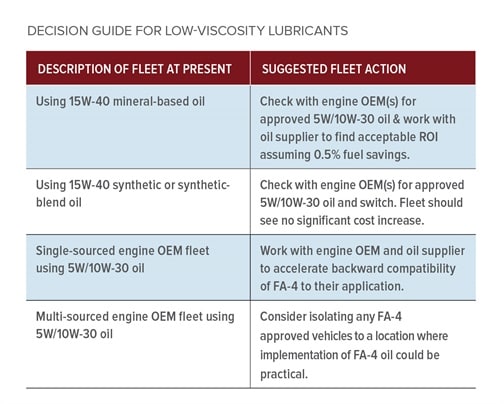
Given that fuel savings of this magnitude can be difficult for fleets to conclusively verify in their own testing, the Confidence Report suggests that fleets considering a switch to lower-viscosity engine oil use a conservative 0.5% in calculating the payback they will earn from switching.
If an acceptable return-on-investment is shown with this low level of fuel savings, fleets should be able to confidently make the switch.
While these efficiency gains are modest relative to some other technologies, the study’s authors note that this is one of the rare instances where an efficiency technology can be implemented across the entire fleet very quickly, does not require an upfront investment, and does not require any changes in operation or maintenance practices.
It recommends that fleets currently using 15W-40 engine oil consult with their engine supplier(s) to identify approved 5W/10W-30 oils for their vehicles. They should then work with their oil supplier to find an acceptable ROI of cost vs. fuel savings, with a conservative assumption for fuel-economy improvement.
For more information and to download the full report or an executive summary, go to https://nacfe.org/research/technology/powertrain/low-viscosity-lubricant/
More Fuel Smarts

How Volvo Updated Its D13 for EPA 2027 [Watch]
Volvo’s updated D13 promises lower emissions without sacrificing performance or fuel economy. Take a closer look at what changed inside the engine in this HDT Spotlight video.
Read More →
Diesel Price Spike Shortens Payback for Natural Gas Trucks, Report Says
Energy Vision estimates fleets could recover the higher purchase price of an RNG-fueled Class 8 tractor in 1.3 to 2.8 years under current fuel-price scenarios.
Read More →
Calstart Becomes Catalyst Mobility, Reflecting Broader Focus
Calstart is now Catalyst Mobility, reflecting the nonprofit’s growing national role in clean transportation, including zero-emission trucks, infrastructure and incentive programs.
Read More →

Record Diesel Prices Squeeze Trucking Fleets
Average U.S. diesel prices have climbed to nearly $6 a gallon, surpassing the 2022 record as tight refinery capacity and Middle East disruptions keep fuel costs elevated.
Read More →
How Fuel Delivery Shapes Engine Performance
Fuel delivery depends on more than what happens at the injector. For fleet, maintenance and technical professionals, looking at the full path from pump to injector can provide useful context for understanding engine performance.
Read More →
East Coast Port Launches $45M Electric Truck Push
The Port Authority of New York and New Jersey announced millions in incentives for zero-emission drayage trucks, yard tractors, and new charging hubs near the port.
Read More →
California Bill Could Shed Light on Electric Truck Prices
Why do battery-electric Class 8 trucks remain so expensive? A California bill headed to Gov. Gavin Newsom would give fleets and state agencies more visibility into what manufacturers charge.
Read More →
Detroit Opens Orders for EPA 2027 Engines
Detroit isn’t starting from scratch to meet EPA 2027 diesel emissions standards. Its Gen 6 DD13 and DD15 engines keep much of today’s platform while updating the fuel and aftertreatment systems.
Read More →
Zero-Emission Truck Corridor Planned for West Coast
California, Oregon, Washington, British Columbia and Baja California are coordinating plans for truck charging and hydrogen fueling from Canada to Mexico.
Read More →
A Closer Look at Kenworth’s Electric T880E Vocational Truck [Video]
Learn more about Kenworth's T880E battery-electric vocational truck at the Paccar Technical Center, including its range, applications, upfitting considerations, and PTO options, in this HDT Spotlight video.
Read More →