




Report: Driver Turnover Hit All-Time Low in Q1
According to a recent report from Stay Metrics, while driver turnover rates spiked early in the first quarter of 2020, they soon began trending down and dropped to all-time lows in March.

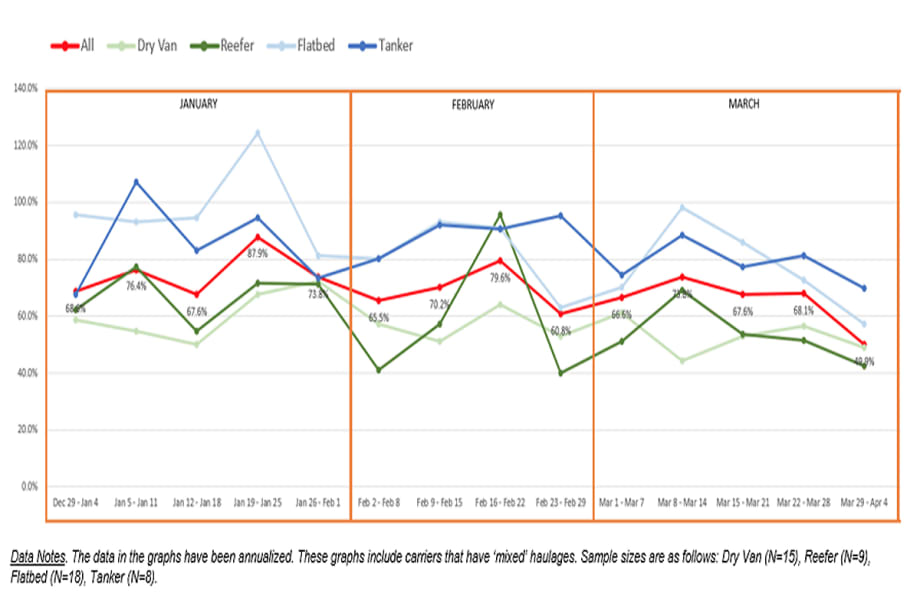
According to a new report from Stay Metrics, turnover spiked for all truckload sectors before the coronavirus pandemic but not necessarily due to positive economic activity, then dropped in March.
Source: Stay Metrics
According to a recent report from Stay Metrics, while driver turnover rates spiked early in the first quarter of 2020, they soon began trending down and dropped to all-time lows in March.
The new report tracks turnover rates on a weekly basis to show how drivers responded to changing market conditions that directly impacted their pay. It shows a major shift in the turnover paradigm for the first quarter, with turnover spiking for all truckload sectors before the coronavirus pandemic, but not necessarily due to a positive economic environment. Some freight sectors experienced disruptions before the COVID-19 pandemic that could explain the turnover spike.
“Fleet executives and managers cannot fall asleep at the wheel,” said Tim Hindes, Stay Metrics Co-Founder and CEO. “Now is the time to double down on retention efforts. Let drivers know they belong to a stable organization that is essential to the economy and also use this period to rebuild driver-focused cultures.”
Key findings in the report include:
Tanker
This sector had comparatively higher turnover than other sectors. Rates spiked in the second week of January to 107.1% before the trendlines split for oil and gas haulers and food-grade haulers.
In the third week of January, oil and gas haulers saw a sudden dip from 106.1% to 62.9%. The decline could be explained by the decrease in oil production in the U.S.
Drivers in this sector may have transitioned to food-grade tankers and other industry sectors. In February, the turnover rate for oil and gas haulers jumped from 78% to 119.1% and stayed elevated during the middle three weeks of March (118%, 106.6% and 112.8%) before returning to 68.6% the last week.
By contrast, the turnover rate of food-grade tank haulers increased slightly in early February to 93.6% and fell steadily through March to reach a low of 47.8% before a slight spike at the end of March to 68.6%.
Flatbed
Flatbed also had comparatively high turnover. This sector saw a substantial spike in the third week of January from 94.6% to 124.3%, followed by a noticeable dip in the fourth week of February from 91.0% to 62.9%. Rates increased in the second week of March from 70.2% to 98.3% and fell through the end of March to reach 57.2%.
Reefer
Refrigerated transport saw a major spike in mid-February. Shipments of food and produce items were stable throughout the health crisis and may explain why drivers in this sector tended to stay with their carriers. By the end of the quarter, turnover reached a low of 42.6%.
Dry van
This sector also had comparatively low turnover. A substantial spike occurred the third week of February (51.0% to 64.0%) but dropped to 53.0% the next week and held steady through the last week of March.
More Drivers

Truck Drivers Need More Than Another Alert
Fleets have more visibility into truck health, safety events, and driver activity than ever. The next challenge is turning all that information into useful guidance for the person who has to decide what to do next.
Read More →
FMCSA Removes 110 Truck Driver Training Schools from Certified ELDT List
Federal regulators also are targeting more than 160 additional training providers and launching a nationwide audit of third-party CDL skills testers as part of a broader crackdown on trucking fraud.
Read More →
Hours of Service Pilot Programs: FMCSA Readies for 2027 Rollout
Two pilot programs could eventually reshape hours-of-service rules, giving truck drivers options to pause their 14-hour clock or use longer split sleeper rest periods.
Read More →
Medical Cards, English Proficiency Reshape Roadcheck Violations
Medical-card violations jumped to the top of the driver out-of-service list during CVSA’s 2026 International Roadcheck, while English-language proficiency violations appeared among the leading violations for the first time.
Read More →
Driver Trust Can Make or Break the Success of Fleet Safety Technology
New Teletrac Navman research suggests that onboarding, transparency about driver data, and positive feedback can play a significant role in how commercial drivers respond to safety and coaching technology.
Read More →
EEOC Sues KLLM Over Alleged Sex Discrimination in Driver Training
KLLM is facing a federal sex-discrimination lawsuit over policies the EEOC alleges put female truck driver trainees at a disadvantage.
Read More →
FMCSA Moves to Codify English Language Requirements for Commercial Drivers
By changing regulations on English-language proficiency requirements for commercial drivers, rather than relying on a guidance memo, the FMCSA said future administrations won't be able to walk back the Trump administration's stricter enforcement with just a memo.
Read More →
Drivers Put Western Star Trucks to the Test at Star Nation Experience
Watch to get an inside look at the Western Star trucks, technology, and community behind the Star Nation Experience 2026!
Read More →
Trump Administration Looks to Put More Veterans Behind the Wheel
The Freedom Haulers program pulls together existing and expanded programs at several federal agencies to recruit veterans to drive commercial heavy-duty trucks and cut the red tape for them to get a CDL, training, and employment.
Read More →
Putting Mack’s Command Steer to the Test
A test drive of Mack’s Command Steer active steering system evaluates how it can make truck driving easier and less tiring.
Read More →