




Repairs to I-5 Bridge In Washington on Schedule
The permanent replacement for the collapsed Interstate 5 Skagit River Bridge span reached a major milestone this week as crews began setting eight enormous concrete girders that will support the new roadway.
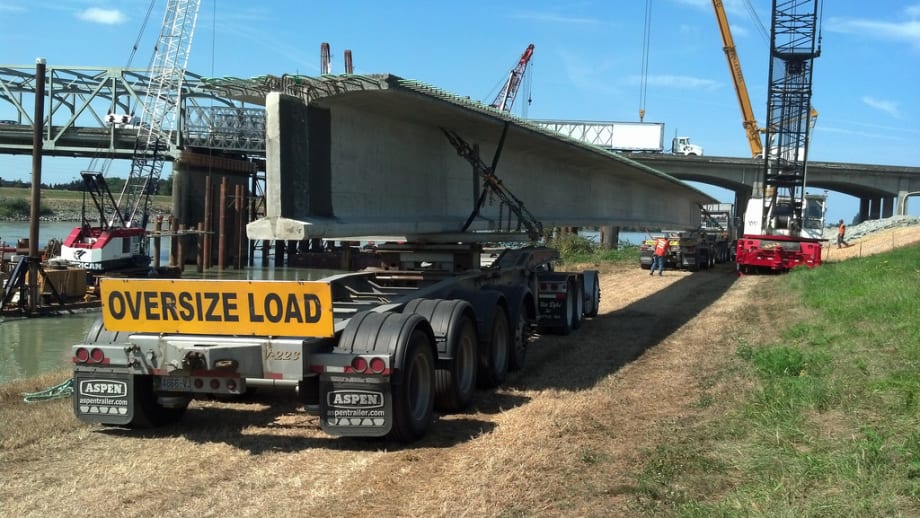
One of the eight massive girders for reparis to the I-5 bridge. Credit: Washington State DOT.
The permanent replacement for the collapsed Interstate 5 Skagit River Bridge span reached a major milestone this week as crews began setting eight enormous concrete girders that will support the new roadway.
Contractor crews working for the Washington State Department of Transportation expect to have all of the girders in place by the end of this week. They will then spend the following two to three weeks working on the final roadway, including the deck, barriers and other key components.
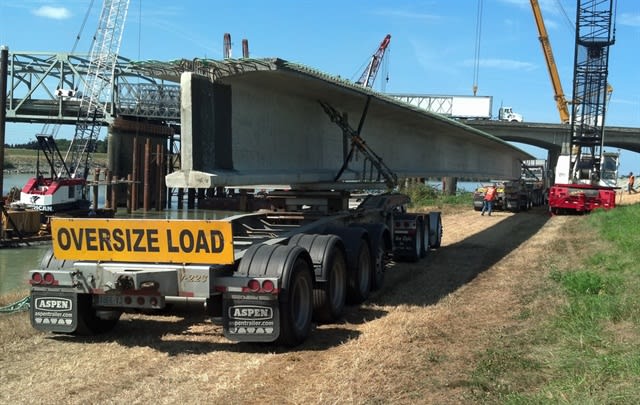
One of the eight massive girders for reparis to the I-5 bridge.
Washington State DOT.
“We’re still on schedule to replace the temporary span in early September, shortly after Labor Day weekend,” said Jay Drye, WSDOT assistant regional administrator. “A full closure of I-5 is needed to complete the job, and we’re working closely with the community and the contractor to finalize those details so folks have enough time to plan ahead.”
Once the girders are on site, two cranes, one on the northern dike of the Skagit River, the other on a barge in the river, will work together to lift each girder into place. Each girder is roughly as long as the width of a football field, 162 feet, and weighs a little more than a space shuttle when empty, 168,000 pounds.
Since construction started in early July, crews have driven piles in the river to create temporary work platforms, which will support the new bridge span during construction, while building a rail system to move the new bridge span into place. On the east side of the bridge, crews continue to drive piles that will eventually hold the temporary span after it is shifted out of the way to make room for the permanent replacement.
This project is necessary to replace the portion of the Skagit River Bridge that collapsed near Mount Vernon on May 23, after an oversized semi-truck struck critical steel supports. Three people were injured but no one was killed
The corridor carries 71,000 vehicles daily.
For more information on the project or to sign up for email updates, visit the project website.
You can also view pictures of the bridge repair effort and pictures of trucks hauling the girders in the Washington DOT's Flickr feed.
More Fleet Management

Color Match Smarter: Tools That Restore & Perform
For fleet managers and collision repair professionals keeping heavy-duty trucks on the road, getting the color right the first time isn't just about appearance — it's about efficiency, turnaround time, and bottom-line results. Discover how today's digital color tools are transforming the repair process from guesswork to precision.
Read More →
FMCSA Pauses Biennial-Update Enforcement Amid Motus Transition
Carriers whose updates were due on or after June 1 have more time, while FMCSA works to stabilize its new registration system and warns of phishing sites impersonating its new carrier registration system, Motus.
Read More →
2026 Blueprint for Countering Smarter Supply Chain Theft
Cargo theft is no longer just the cost of doing business. It's a multi-billion-dollar criminal enterprise exploiting vulnerabilities across your fleet, drivers, and supply chain.
Read More →


How Telematics Improves Visibility, Control, and Performance in Refrigerated Fleets
Explore how telematics help refrigerated fleets improve visibility, uptime, efficiency, compliance, and cargo protection across connected cold chain operations.
Read More →
What the U.S.-Canada Trade War Means for Trucking
Escalating U.S.-Canada tariffs could disrupt cross-border freight, reduce truck volumes, raise costs, and create new uncertainty for carriers on both sides of the border.
Read More →
What Are Trucking’s Top Concerns for 2026?
The American Transportation Research Institute wants to know what's worrying trucking fleet managers, drivers, and other stakeholders in its annual Industry Issues survey.
Read More →
American Trucking Associations Looks for a New Leader
ATA President and CEO Chris Spear abruptly left his job at the association on August 21, at a pivotal time for the trucking industry.
Read More →
Public Wi-Fi Cybersecurity Risks: How Truck Drivers and Fleets Can Protect Their Data
Public Wi-Fi can expose truck drivers and fleets to credential theft, malware, and other cyber threats. Here’s how to reduce the risk on the road.
Read More →
For Nicky Cupp, Fleet Innovation Starts With Frustration
HDT Truck Fleet Innovator Nicky Cupp turns everyday pain points at Fraley & Schilling into opportunities for better technology and smarter processes.
Read More →
Adam Buttgenbach’s Approach to Electric Trucks: Start With Where They Fit
HDT Truck Fleet Innovator Adam Buttgenbach helped PepsiCo build one of North America’s largest EV fleets by focusing on where electric trucks make operational sense.
Read More →