





Related: NACFE Updates Tire Pressure Systems Report, Looks to Further Updates
Regional Haulers Can Save Fuel with Application-Specific Specs
Fuel economy may not be top-of-mind for some regional fleets because of the higher priorities placed on servicing the application. However, technologies exist that can improve fuel efficiency in almost every instance.
June 16, 2020
Fuel efficiency may not be top-of-mind for all regional fleets, but technology exists that not only stays out of the way, but can help with dual-purposing of some equipment to include highway and urban operations.
Photo: Jim Park
4 min to read
Regional fleets could probably do a better job at fuel savings if they took advantage of available fuel-saving technologies and applied them to their fleets as specific applications demand. The North American Council for Freight Efficiency has released an in-depth report on last fall's Run on Less Regional freight efficiency demonstration. The report contained results of the demonstration along with several recommendations for improving fuel efficiency in regional environments.
Run on Less Regional took place October 7-25, 2019. Ten trucks logged more than 58,000 miles and 237 deliveries over the 18-day period. The cumulative mpg across the 10-truck fleet was 8.3, with a calculated freight efficiency of 103 ton-miles/gallon. The demonstration fleet achieved a 38% increase in fuel efficiency compared to NACFE's estimated average Class 8 regional haul fuel efficiency of 6 mpg.
If all regional haul fleets were to operate at this fuel-efficiency, the industry would save more than $9 billion in fuel over the course of a year and 30.6 megatons of CO2, the report noted.
Regional haul for Class 7 and 8 tractors is defined by NACFE as an operation where the truck stays within a 300-mile radius of a home base. This may include tractors that return to home base every day or ones on a route for multiple days but that stay within that 300-mile radius. By nature, that group include all types of operation from milk-runs to line-haul terminal to terminal relay-type operations.
In fact, NACFE identified seven different duty cycles under the regional umbrella: shuttles, dedicated, dedicated fast turn, hub-and-spoke, city, diminishing load, and milk runs. Certain characteristics of each sub-category either lend themselves to various fuel-saving technologies or render those technologies ineffective.
On the milk-run or the diminishing-load duty-cycles, for example, lift axles might prove to be more advantageous than trailer skirts, whereas the hub-and-spoke or dedicated fast-turn applications would likely see greater benefit from downsped drivelines or tractor and trailer aero treatment.
However, some fleets ask double-duty of their tractors, which can limit the applicability of certain technologies. Such trucks may be involved in city pickup and delivery by day and linehaul by night. In such a scenario, the aero add-ons may be easily damaged in an urban environment and tall gears might not be ideal for high-frequency, start-and-stop applications.
"Regional haul is not homogeneous," says Mike Roeth, NACFE’s executive director. "You have to get down to at least this level of detail before you can start [acquiring] technology that will be helpful in specific applications."
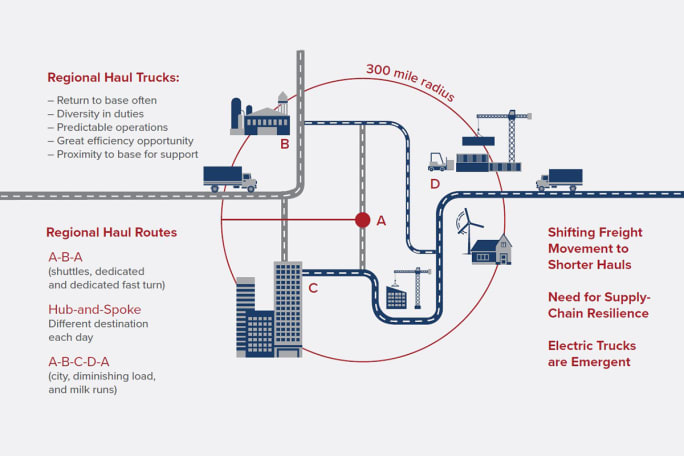
NACFE's definition of regional operations includes anything within a 300-mile radius of the terminal, including dedicated fast turn and hub-and-spoke operations with significant amounts of highway driving, all the way to multi-stop "milk runs."
Source: NACFE
The full Run on Less Regional report, goes into much greater detail, but Roeth did release these specific suggestions for regional fleets that want to improve fuel efficiency:
- Big data and connectivity can be used to further optimize tractor operations for each route. Many technologies exist to improve the efficiency for these regional routes. Understanding each in-depth will help in making choices to save fuel and money, and reduce emissions.
- Fleet managers must understand and act on the variety in duty cycles so they can specify vehicles properly and coach drivers in efficient driving techniques.
- Because of its return-to-base operation, regional haul is ideal for alternative-fuel vehicles, especially battery-electric trucks. Infrastructure to charge electric or alternative fuel trucks is a critical barrier to deployment. Having confidence in the location of the infrastructure to support these vehicles is important when deciding to move forward with electric trucks.
NACFE and others anticipate that regional operations will increase significantly in the coming years, and we are already seeing the average length of haul in the long-haul sector go down. As the regional sector grows, more emphasis is bound to be placed on fuel efficiency, but while Roeth admits that fuel efficiency might not be top-of-mind for some regional operators, there's no reason it can't become more of a focus.
"These fleets do appreciate fuel economy less. It's just lower on their priority list than in the long-haul sector," he says. "They tend to place a higher value on getting the driver home and making the deliveries. Fuel economy is a cost of doing business, but it's not top-of-mind for them. The tendency is to spec more of a ‘vanilla’ truck that will be tasked with a variety of assignments that one targeted for good fuel economy while on the highway."
That said, Roeth sees real potential for alternate-fueled and electric vehicles in the regional sector because in most of the applications, all the trucks return to base at the end of the shift. Depending on the length of haul and the specific application — as well as the availability of fueling/recharging infrastructure — compressed natural gas, hydrogen fuel cell, and battery-electric trucks could fit well into many regional operations.
“Regional operations are also fertile ground for alternate fueled vehicles because by their very nature they make it easier for fueling infrastructure for vehicles that use an energy source other than gasoline or diesel fuel to be installed,” Roeth says.
The 10 fleets participating in last fall's Run on Less Regional demonstration, using only commercially available technology, include: C&S Wholesale Grocers, Hirschbach, Hogan Transportation, J.B. Hunt, Meijer, PepsiCo, Ploger Transportation, Schneider, Southeastern Freight Lines, and UPS.
Complete results can be found at Run on Less. A copy of the complete report can be found here.
More Fuel Smarts

Wex Adds Cardless Fuel Payments for Over-the-Road Customers
A new fuel card feature for Wex customers offers convenience and security.
Read More →
New California Law Could Shed Light on Electric Truck Prices
Why do battery-electric Class 8 trucks remain so expensive? A California bill signed by Gov. Gavin Newsom would give fleets and state agencies more visibility into what manufacturers charge.
Read More →
How Volvo Updated Its D13 for EPA 2027 [Watch]
Volvo’s updated D13 promises lower emissions without sacrificing performance or fuel economy. Take a closer look at what changed inside the engine in this HDT Spotlight video.
Read More →

Diesel Price Spike Shortens Payback for Natural Gas Trucks, Report Says
Energy Vision estimates fleets could recover the higher purchase price of an RNG-fueled Class 8 tractor in 1.3 to 2.8 years under current fuel-price scenarios.
Read More →
Calstart Becomes Catalyst Mobility, Reflecting Broader Focus
Calstart is now Catalyst Mobility, reflecting the nonprofit’s growing national role in clean transportation, including zero-emission trucks, infrastructure and incentive programs.
Read More →
Record Diesel Prices Squeeze Trucking Fleets
Average U.S. diesel prices have climbed to nearly $6 a gallon, surpassing the 2022 record as tight refinery capacity and Middle East disruptions keep fuel costs elevated.
Read More →
Sponsored•September 9, 2026
How Fuel Delivery Shapes Engine Performance
Fuel delivery depends on more than what happens at the injector. For fleet, maintenance and technical professionals, looking at the full path from pump to injector can provide useful context for understanding engine performance.
Read More →
East Coast Port Launches $45M Electric Truck Push
The Port Authority of New York and New Jersey announced millions in incentives for zero-emission drayage trucks, yard tractors, and new charging hubs near the port.
Read More →
Detroit Opens Orders for EPA 2027 Engines
Detroit isn’t starting from scratch to meet EPA 2027 diesel emissions standards. Its Gen 6 DD13 and DD15 engines keep much of today’s platform while updating the fuel and aftertreatment systems.
Read More →
Zero-Emission Truck Corridor Planned for West Coast
California, Oregon, Washington, British Columbia and Baja California are coordinating plans for truck charging and hydrogen fueling from Canada to Mexico.
Read More →